In brief: This guide explains Dhanwantharam Thailam uses and benefits as the classical texts describe them, and how to use the oil step by step. Dhanwantharam Thailam is a classical Ayurvedic massage oil: Bala root, the ten Dashamoola roots, Ashwagandha, Shatavari and a long list of further herbs, grains and fruits cooked into sesame oil by the Taila Paka method. People also search for it as Dhanvantaram Thailam, Dhanwantara Taila or Dhanvantari oil; it is the same classical formula. Described in the Ashtanga Hridayam, it is mildly warming, classically placed with Vata, and traditionally used for Abhyanga of the whole body and of the muscles and joints.
Dhanwantharam Thailam: Uses, Benefits and How to Use It
Reviewed by Dr. Anu Joy, MD (Ayurveda), Ayurveda physician at Art of Vedas
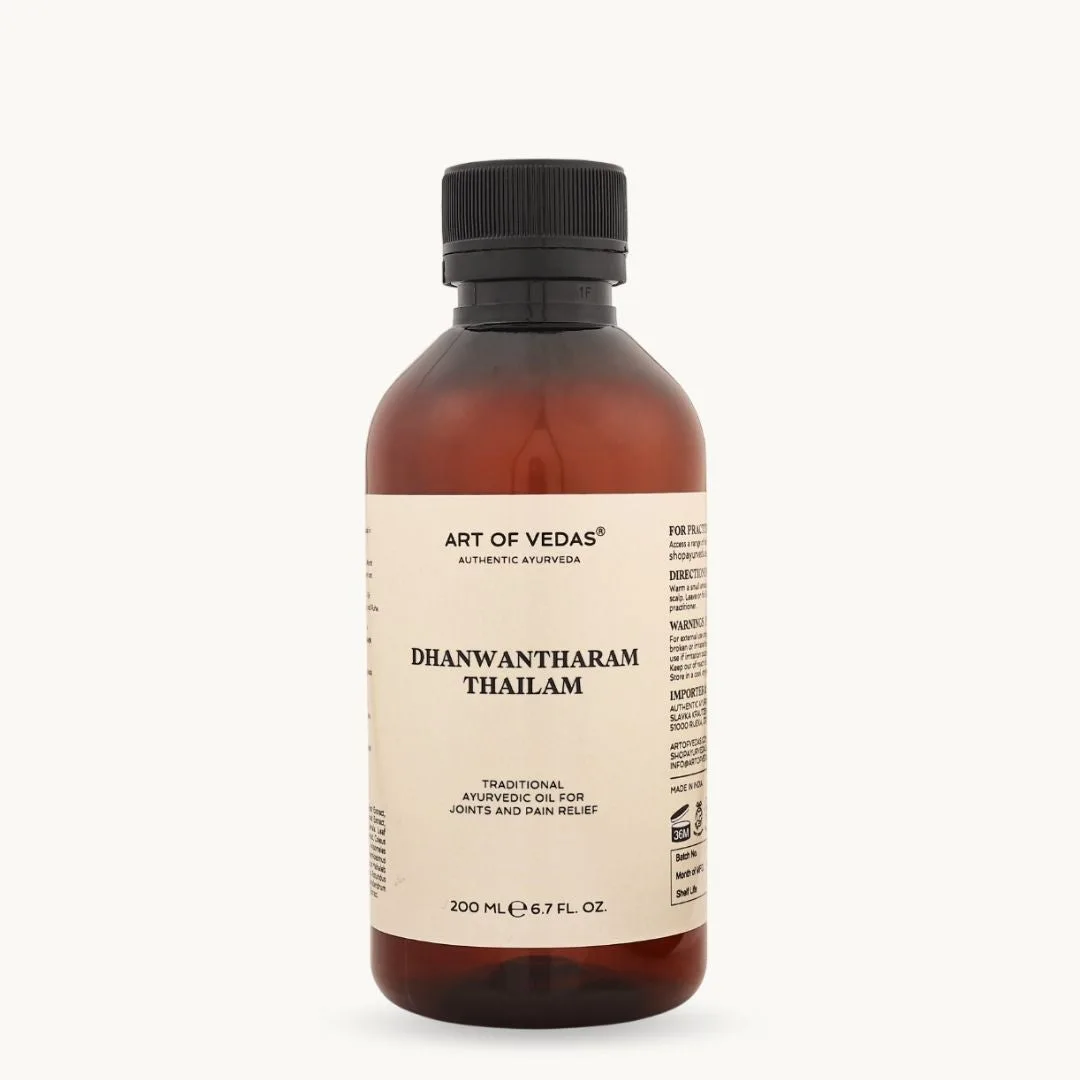
The declared ingredient list of the Art of Vedas oil, plant by plant with botanical names, is on its own page: Dhanwantharam Thailam ingredients: the declared list, plant by plant. The origin of the name and the classical text are explained in Dhanvantari Thailam: origin and classical text.
The classical framework: what "benefits" means in Ayurvedic terms
Classical Ayurveda describes an oil through Dosha, Dhatu and Srotas, the three organising ideas of its view of the body. When the texts speak of the benefits of an oil, they describe which Dosha it is placed with, which Dhatus (tissue layers) it is said to reach, and through which Srotas (channels) it is understood to work. This is a descriptive, traditional language, and it is the language in which the benefits of Dhanwantharam Thailam are set out below.
Dhanwantharam Thailam is classically placed with Vata. Vata Dosha is the principle of movement, dryness, lightness and cold, and in the classical texts it governs the muscles, the joints, the nerves and the fine channels of the body. A dry, cold, mobile quality is the classical picture of Vata out of balance, and the oily, warm, heavy and steadying qualities of a sesame oil cooked with nourishing roots are its classical counterpart. The uses described in the texts follow from this.
1. Brimhana: deep nourishment in the classical texts
The first quality the tradition gives to Dhanwantharam Thailam is Brimhana, a classical term for nourishing and building. Brimhana is more than moisturising the skin: in classical terms it refers to the nourishment of the Dhatus, the seven tissue layers described in the texts.
The herbs most associated with this quality are Bala (Sida cordifolia) and Ashwagandha (Withania somnifera), which the Charaka Samhita places among the Brimhana and Balya herbs. Bala is one of the central classical herbs for Vata; the texts associate it with Mamsa Dhatu, the muscle layer, and with Majja Dhatu, the deepest tissue layer.
People who use the oil regularly for Abhyanga usually describe the experience in simple words: the skin feels supple and cared for, the body feels warm and settled after the massage. The classical texts describe this settled, grounded feeling as the signature of Vata in balance.
2. Sandhi: the joints in the classical texts
The Ashtanga Hridayam places Dhanwantharam Thailam among the classical Vata oils and mentions the Sandhi, the joints, among the areas it is traditionally applied to. The related Sanskrit idea is Sandhi Poshana, the nourishment of the joints.
In the classical view, the joints are kept smooth by a form of Kapha called Sleshaka Kapha, the lubricating Kapha. Vata, with its dry and mobile quality, is said to dry this Sleshaka Kapha. An oily, warm Vata oil such as Dhanwantharam Thailam is the classical counterpart: warmed and massaged around the knees, hips, shoulders and the small joints of the hands and feet, it is part of a traditional care for the joints that older people in particular keep through the colder months.
3. Balya: strength and the muscles in classical terms
Next to Brimhana, the texts give Dhanwantharam Thailam a Balya quality, the classical term for strength-giving. Bala (Sida cordifolia) takes its name from this idea: the Sanskrit word Bala means strength. The Charaka Samhita, Sutrasthana 25, names Bala as the leading herb of the Balya group, and its place at the head of the Dhanwantharam formula means that this quality runs through the whole oil.
In daily life this is why people who are physically active, who work with their body or who simply feel the cold and dryness of the season choose Dhanwantharam Thailam for Abhyanga of the arms, legs, back and shoulders. After the massage and a warm shower, the muscles feel warm and the body rested.
4. Majja Dhatu: the deepest tissue layer in the classical texts
Classical anatomy names Majja Dhatu as the deepest of the soft tissue layers, the layer it connects with the nerves. The Ashtanga Hridayam describes Majja Dhatu as the layer most exposed to Vata and most dependent on nourishment through oil, which is why oil massage has such a prominent place in the classical Vata routine.
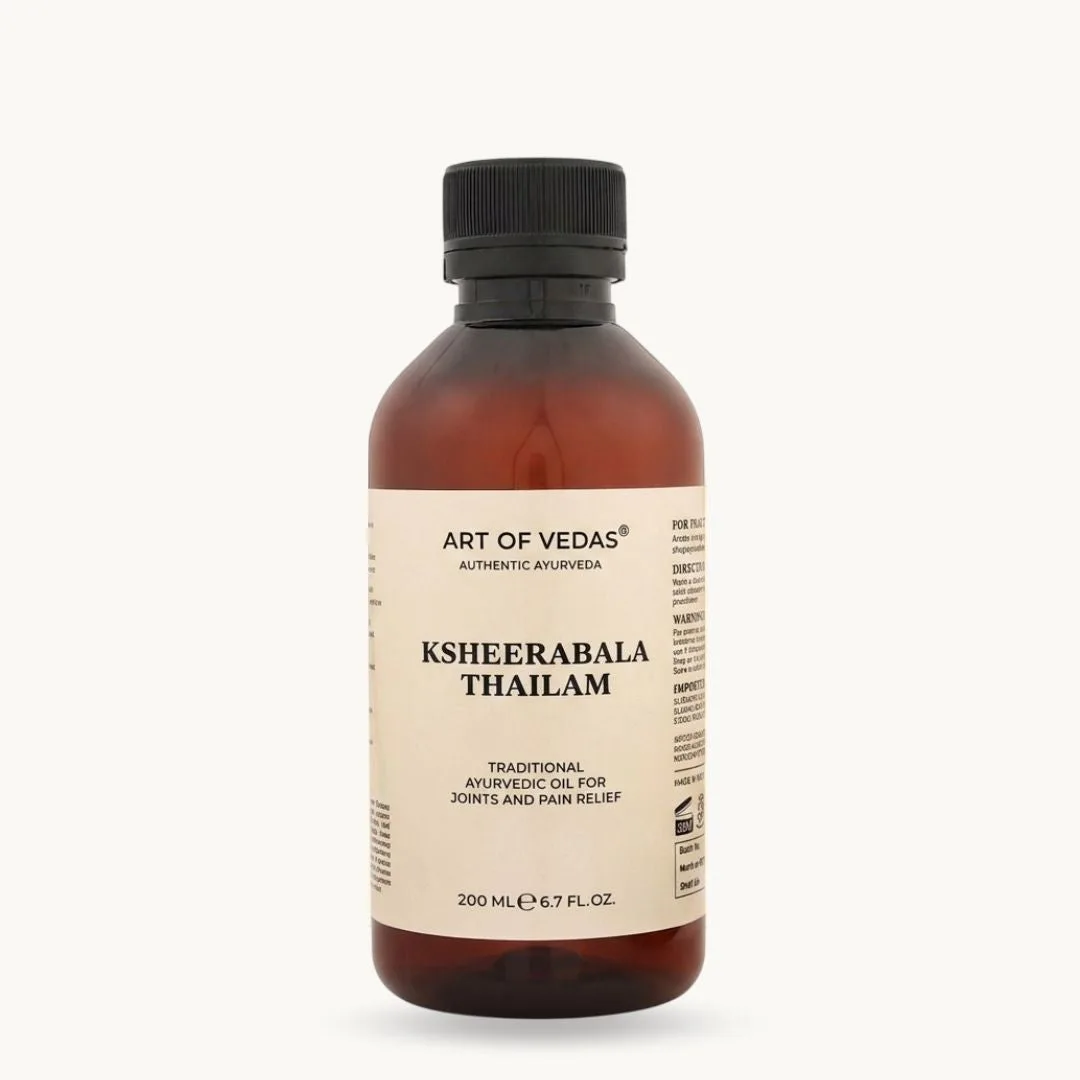
In classical terms, the warm, heavy and oily qualities of Dhanwantharam Thailam are the counterpart of the restless, light and mobile qualities of Vata. Many people therefore use the oil in the evening, as a calm Abhyanga before rest. For an oil that the tradition associates even more closely with the head and the nerves, see Ksheerabala Thailam.
5. Sutika Paricharya: the classical postnatal tradition
The Ashtanga Hridayam describes Sutika Paricharya, the care of the mother in the weeks after childbirth, as a time of rest, warmth and oil. The tradition sees birth as a time of strongly increased Vata, so the classical routine places warm oil, warm food and rest at its centre.
Dhanwantharam Thailam is the oil most often named for this traditional Abhyanga, which is classically given over several weeks. Whether and when it is suitable after a birth is a question for a qualified Ayurvedic practitioner, your midwife or your doctor; please ask them first. More on the tradition: Dhanwantharam oil in traditional postnatal care.
6. Rasayana: the classical idea of long-term care
The tradition also places Dhanwantharam Thailam in the wider context of Rasayana, the classical science of rejuvenation. Rasayana is not a cosmetic promise; in the classical texts it describes a way of living, with routines and preparations that keep the tissues nourished over many years.
The Charaka Samhita describes daily oil massage itself as part of this way of living. Kept up over months and years, Abhyanga is one of the simplest Rasayana practices of the daily routine (Dinacharya). When the oil is a classical preparation such as Dhanwantharam Thailam rather than plain sesame oil, the herbs cooked into it add their own classical qualities. The wider framework is explained in the Rasayana guide of Art of Vedas.
Dhanwantharam 101 and the repeated cooking (Avartana)
Classical oils can be cooked more than once. One round of cooking with a fresh decoction of the herbs is called an Avartana, and an oil that has been through this process again and again carries a number: Dhanwantharam 101 Avartana has been cooked one hundred and one times. The tradition regards such an oil as finer and more concentrated, which is why it is used in drops on one area rather than poured for a whole-body massage.
For a daily Abhyanga of the whole body, the standard Dhanwantharam Thailam is the form to use. The 101 oil is a separate preparation, best used with the advice of a qualified Ayurvedic practitioner; it is explained in the Dhanwantharam 101 Avartana guide. The full range of classical Vata oils is in the Art of Vedas Thailams collection.
Who traditionally chooses Dhanwantharam Thailam?
In the classical tradition, Dhanwantharam Thailam is chosen by:
- people with a Vata-predominant constitution who keep a regular Abhyanga and want a classical oil richer in character than plain sesame oil;
- people who feel the dryness and cold of autumn and winter in the skin, the muscles and the joints, and who want a warm oil massage for those months;
- older people who keep an oil routine for the joints and the muscles as part of their daily care;
- new mothers in the weeks after birth, following the classical Sutika tradition, ideally with the guidance of a qualified Ayurvedic practitioner or midwife;
- everyone who keeps Abhyanga as part of the daily routine (Dinacharya) and wants a classical oil with a Rasayana character.
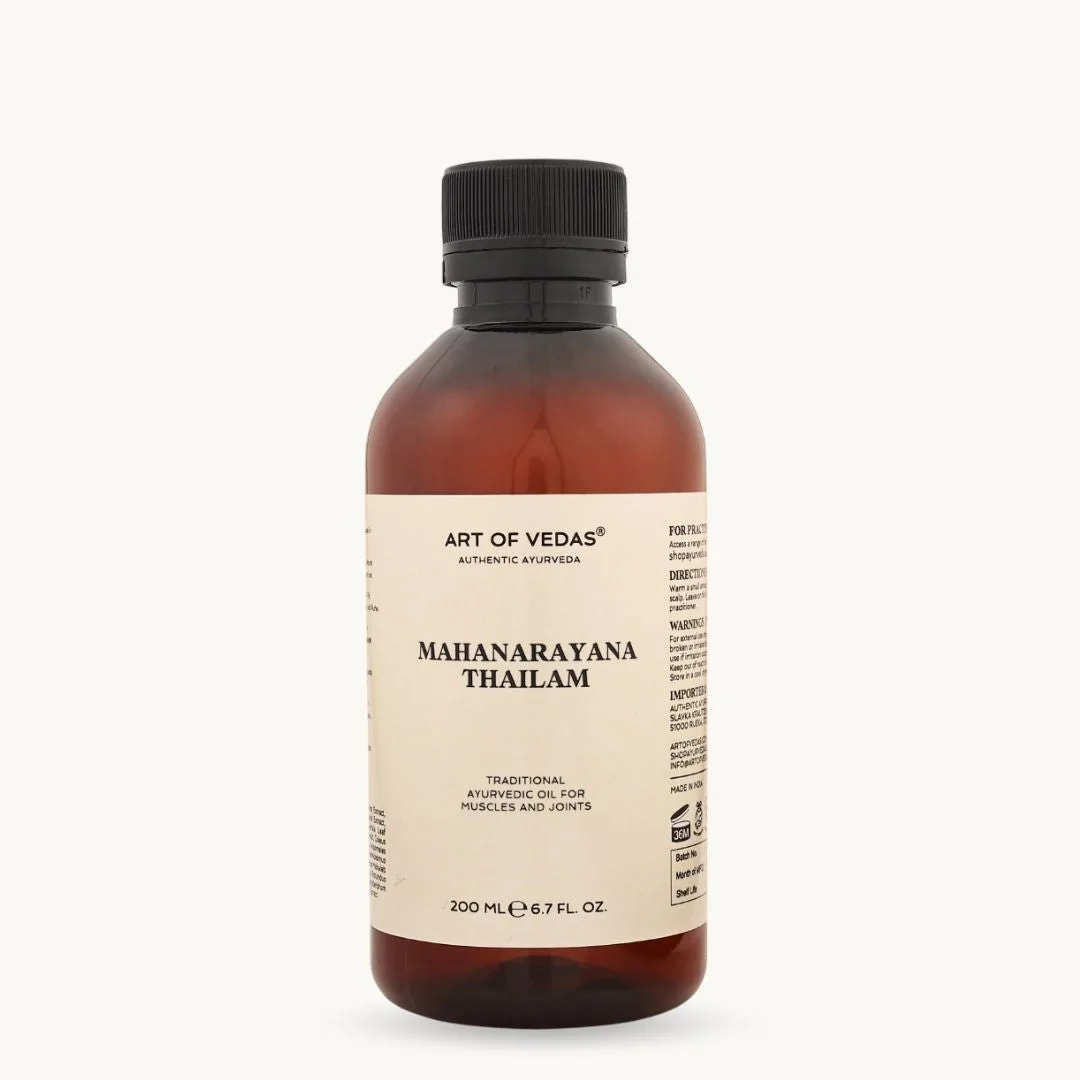
If you are unsure whether Dhanwantharam Thailam suits your constitution, the Art of Vedas Dosha assessment is a useful starting point, and a qualified Ayurvedic practitioner can advise you personally. For a comparison with other classical Vata oils such as Mahamasha Thailam or Mahanarayana Thailam, see the comparison of classical Ayurvedic massage oils.
Dhanwantharam Thailam for the skin
Dhanwantharam Thailam for the skin is, in the first place, a traditional body oil. Sesame oil cooked with Bala, the Dashamoola roots and nourishing herbs leaves a soft, supple feel on dry skin, and the classical texts name dry, rough, cold skin as typical of Vata. That is why the oil is a natural choice for dry, Vata type skin on the arms, legs and body, especially in the cold months. For daily face care, a lighter face oil is usually preferred.
Before the first full application, do a patch test: rub a few drops into the inner forearm and wait 24 hours. Do not apply the oil to broken or irritated skin, keep it away from the eyes, and do not use it if you react to sesame or to any declared ingredient. More on Vata and dry skin is in the guide dry skin in Ayurveda.
How to use Dhanwantharam Thailam: step by step
This is how to use Dhanwantharam Thailam for a classical full-body Abhyanga at home:
- Warm the oil in a water bath. Stand the closed bottle, or a small bowl with the amount you need, in warm water for a few minutes. Never use a microwave and never heat the bottle directly.
- Test the temperature on the inner wrist. A drop should feel pleasantly warm, never hot.
- Use enough oil. For a full body, roughly 20 to 50 ml is usual, depending on your size and on how dry the skin is. For one area, a teaspoon is enough.
- Massage from head to feet. Begin at the scalp and the neck, then the shoulders, arms, chest, abdomen, back, legs and feet. Use long strokes along the limbs and circular strokes around the joints; on the abdomen, move in gentle circles in the direction of the clock.
- Finish with the feet. Give the soles of the feet a little extra time.
- Leave the oil on for 20 to 45 minutes. Stay warm in the meantime, in a dressing gown or old clothes.
- Take a warm shower or bath. Warm, not hot water. A mild cleanser or a little chickpea flour removes the excess oil.
How often you use the oil is best set with a qualified Ayurvedic practitioner: the classical daily routine (Dinacharya) describes a daily Abhyanga, many people keep two or three sessions a week, and the season and your constitution matter. More on the practice itself is in the guide how to do Abhyanga at home.
Frequently asked questions about Dhanwantharam Thailam
What is Dhanwantharam Thailam? A classical Ayurvedic massage oil in which Bala root, the ten Dashamoola roots, Ashwagandha, Shatavari and a long list of further herbs, grains and fruits are cooked into sesame oil. It is described in the Ashtanga Hridayam. Art of Vedas sells it in 200 ml, 450 ml, 1 litre and 5 litre bottles.
Is Dhanwantharam Thailam the same as Dhanvantaram Thailam? Yes. Dhanwantharam Thailam, Dhanvantaram Thailam, Dhanwantara Taila, Dhanvantari Thailam and Dhanvantari oil are spellings of the same classical oil. The spelling changes with the language and the transliteration; the formula does not. Where the name comes from is explained in Dhanvantari Thailam: origin and classical text.
What are the Dhanwantharam Thailam uses and benefits in the classical texts? It is used for Abhyanga, the Ayurvedic oil massage, over the whole body or on the muscles and joints of one area. The texts describe it as Brimhana, Balya, Vata-balancing and with a Rasayana character, and they place it in the classical postnatal tradition (Sutika Paricharya). Art of Vedas sells Dhanwantharam Thailam as an oil for external use, not as a remedy for any condition.
How do I use Dhanwantharam Thailam? Warm the closed bottle in a water bath, test a drop on the inner wrist, then massage the oil in from head to feet, with long strokes along the limbs and circular strokes around the joints. Leave it on for 20 to 45 minutes and take a warm shower. For a full body, roughly 20 to 50 ml is usual; for one area, a teaspoon.
How often can you apply Dhanwantharam oil? Daily, as the classical daily routine (Dinacharya) describes, or two to three times a week. Because Dhanwantharam Thailam is only mildly warming, it suits a regular routine through most of the year; a lighter rhythm fits the hottest weeks. Ask a qualified Ayurvedic practitioner what suits your constitution and your season.
Is Dhanwantharam Thailam warming, and should you warm it before use? It is mildly warming: a sesame-based Vata oil, gentler in character than Mahanarayana Thailam. Warm Dhanwantharam Thailam before every application. Stand the closed bottle in a bowl of warm water for a few minutes until a drop feels pleasantly warm on the inner wrist. Do not use a microwave, and never heat the open bottle directly.
How long is Dhanwantharam Thailam traditionally used? The classical texts see oil massage as a regular practice rather than a short course. They describe a general principle: the outer layers, the skin and the muscles, respond first to a regular Abhyanga, while the deeper Dhatus are reached by steady use over weeks and months. A qualified Ayurvedic practitioner can tell you which rhythm suits you.
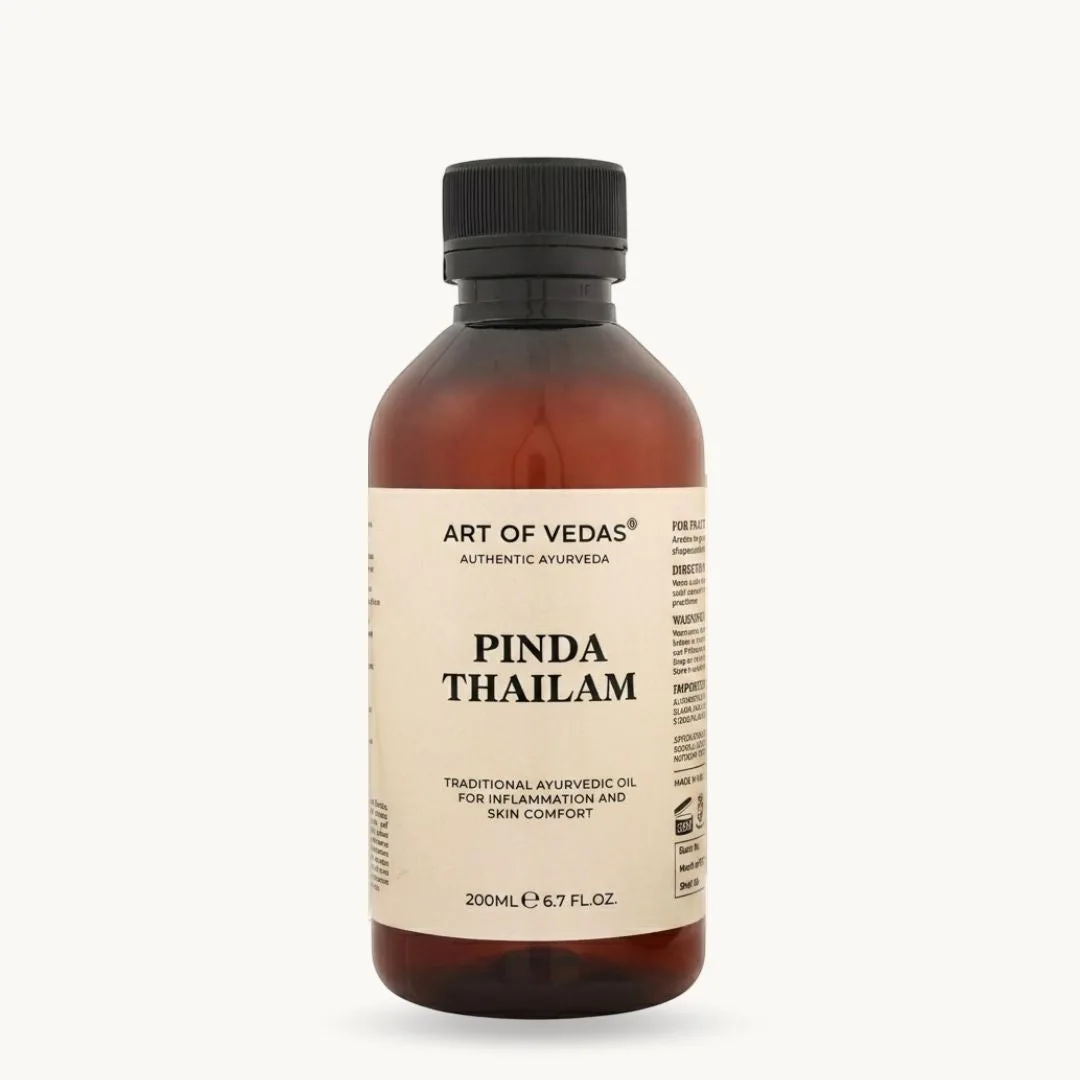
Is Dhanwantharam Thailam suitable for Pitta constitutions? It is classically placed with Vata and suits Vata and Vata-Kapha constitutions best. People with a Pitta constitution can generally use it in moderation, as it is only mildly warming, but it is not a cooling oil. In the hot season, many people of Pitta constitution prefer a cooling oil such as Pinda Thailam.
Dhanwantharam or Mahanarayana Thailam: which one? Both are classical sesame-based Vata oils for Abhyanga. Dhanwantharam Thailam is mildly warming and suits a gentle, regular routine over the whole body; Mahanarayana Thailam is warmer and richer and suits a focused massage of the muscles and joints. Many people keep both and choose by the season and by the area they wish to massage.
What is the difference between Dhanwantharam Thailam, Dhanwantharam 101, Kuzhambu and Ghritham? The same classical formula in different forms. Dhanwantharam Thailam is cooked into sesame oil and is the form for Abhyanga. Dhanwantharam 101 is the oil cooked 101 times (Avartana), used in drops on one area. Dhanwantharam Kuzhambu is a thicker, heavier preparation for smaller areas. Dhanwantharam Ghritham is the ghee form, used under practitioner guidance. The comparison of Kuzhambu and Thailam explains the difference in detail.
How does Dhanwantharam Thailam smell? Warm, slightly earthy and herbal, with the notes of cinnamon, cardamom, deodar and dill over the sesame base. The scent is very different from modern cosmetic oils because the plants are cooked into the oil. Some people find it strong at first; it becomes familiar with regular use.
Can Dhanwantharam Thailam be used in pregnancy or for children? Ask your doctor or a qualified Ayurvedic practitioner first. Dhanwantharam Thailam is for external use only; do a small skin test on the inner forearm before the first full application, keep it away from the eyes and broken skin, and do not use it if you react to sesame or to any declared ingredient.
For external use only. Dhanwantharam Thailam is a traditional Ayurvedic oil. It does not replace the advice of a doctor or of a qualified Ayurvedic practitioner.