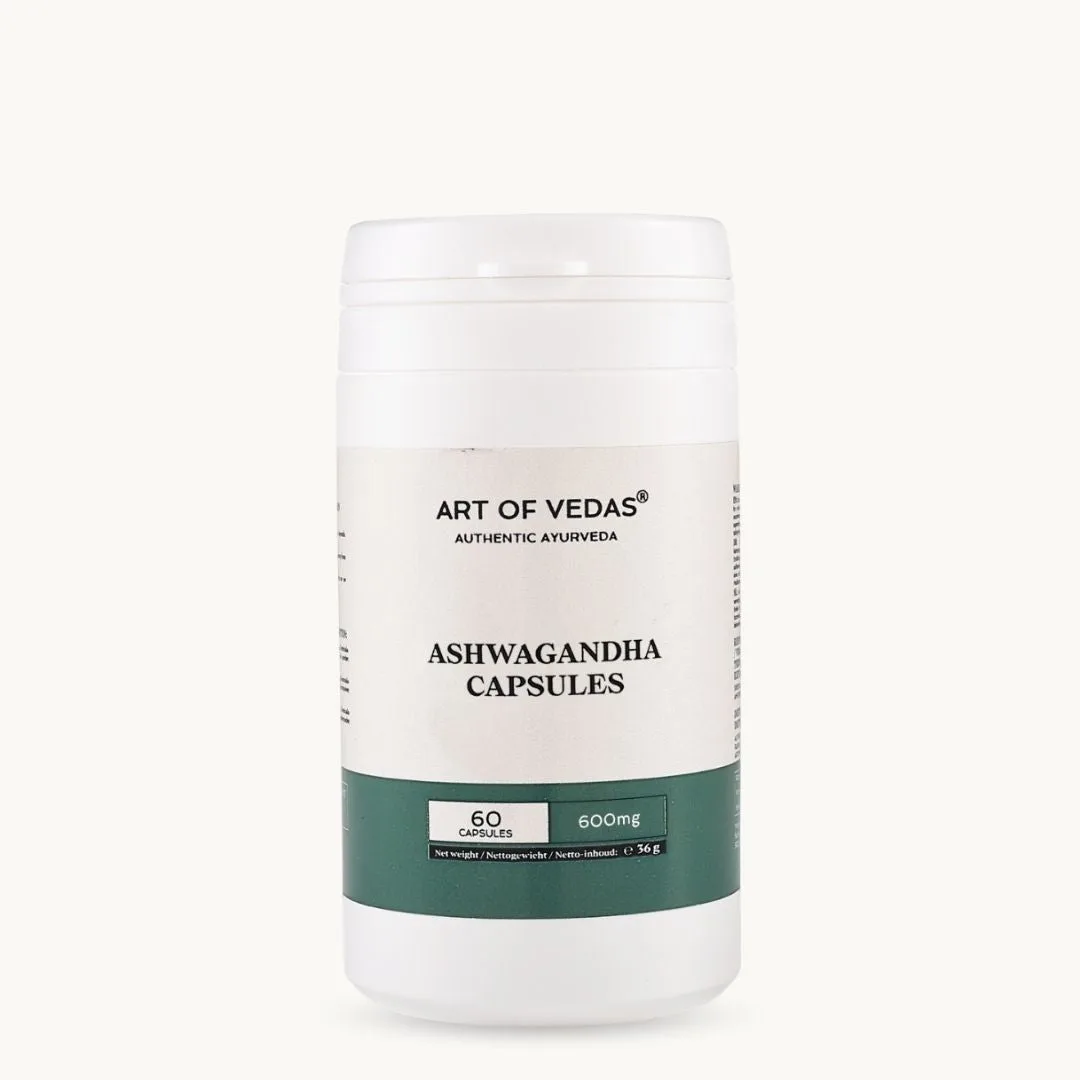
In brief: How to take Ashwagandha is decided first by the label: for Ashwagandha Capsules from Art of Vedas, 2 capsules daily with warm water; for Ashwagandha Powder, half to one teaspoon (2 to 3 g) with warm water, preferably in the evening. Ayurveda adds three points to this: a regular time of day, a suitable carrier (Anupana), classically warm water or warm water, and use as a Rasayana over a longer period rather than in large single amounts. Do not exceed the recommended daily amount, and please consult a qualified Ayurvedic practitioner before use.
Ashwagandha (Withania somnifera) is one of the best known plants of classical Ayurveda, and the question of how to take it comes up as often as the question of what it is. This guide answers the practical side: how much Ashwagandha per day, at what time, with what, for how long, and how capsules and powder fit into a daily routine. What the classical texts say about the qualities of the root is described in our guide Ashwagandha effects in Ayurveda; what the plant itself is, in What is Ashwagandha?
How much Ashwagandha per day?
For a food supplement, the daily amount is the one stated on the label. It has been set for the product in question and should not be exceeded. For the two Ashwagandha products of Art of Vedas, the labels state:
- Ashwagandha Capsules: 2 capsules daily with warm water, or as advised by a practitioner. Each capsule contains Withania somnifera root powder, 600 mg per capsule.
- Ashwagandha Powder: half to one teaspoon (2 to 3 g) daily with warm water, preferably in the evening.
More is not better in Ayurveda. The classical idea of a Rasayana is a modest amount taken regularly, not a large amount taken now and then. If you are unsure which amount within the stated range suits you, or if you would like to take Ashwagandha together with other herbs, a qualified practitioner can advise you on the basis of your Prakriti.
When to take Ashwagandha: morning or evening?
The label of Ashwagandha Powder recommends the evening, the time at which the warm preparation with milk has traditionally been taken. For the capsules, the label names no time of day; what matters most is regularity. Many people find it easiest to link the capsules to a fixed moment, for example breakfast or the evening meal, so that they become part of the Dinacharya, the Ayurvedic daily routine.
A practitioner may suggest a different time depending on your Prakriti and the season. Taking the capsules at the same time each day also makes it easy to see how long a pack lasts.
With what to take Ashwagandha: the Anupana
In Ayurveda the carrier with which a herb is taken is called Anupana. It is part of the preparation, not a detail. For Ashwagandha, the tradition names two carriers:
- warm water: the classical Anupana for Ashwagandha. Its sweet taste and unctuous quality match the sweet Vipaka and the Snigdha Guna of the root, which is why the two have been combined for so long, especially in Vata routines.
- Warm water: the simple alternative, stated on the label of the capsules. It suits people with a Kapha nature, people who do not take milk and anyone who takes the capsules during the day.
Some practitioners add a pinch of cardamom to the which makes the earthy taste of the powder milder.
Preparing Ashwagandha powder with warm water
- Warm a cup of milk or water until it is pleasantly hot, but not boiling.
- Stir in half to one teaspoon (2 to 3 g) of Ashwagandha Powder.
- Add a pinch of cardamom if you like.
- Drink it warm, preferably in the evening.
The classical texts also describe a richer preparation in which the root is simmered in milk and water, called Ksheera Paka. It is described in our guide Ashwagandha as a Rasayana.
How long to take Ashwagandha
As a Rasayana, Ashwagandha is traditionally taken daily over weeks and months, often in the cooler half of the year, in autumn and winter. Classical Ayurveda does not set a time after which a particular effect appears, and a food supplement cannot promise one. It is sensible to review the routine with a practitioner after some time, for example after one pack, and to adapt it to your Prakriti and to the season.
How long a pack lasts at the amount on the label:
- Ashwagandha Capsules, 60 capsules: 30 days at 2 capsules a day.
- Ashwagandha Capsules, 90 capsules: 45 days at 2 capsules a day.
- Ashwagandha Powder, 250 g: about 80 to 125 days at 2 to 3 g a day.
The question of how long Ashwagandha takes to work is answered from the classical point of view in our guide Ashwagandha effects in Ayurveda.
Capsules or powder for daily use?
Both forms contain the same root powder. The capsules are measured, have no taste and are easy to take with you; the powder is the classical Churnam, taken with and lets you adjust the amount within the stated range. Some people use the powder at home and the capsules when travelling. A detailed comparison, including tablets, is given in Ashwagandha powder or capsules; the difference between root powder and extract is explained in Ashwagandha extract or root powder.
Ashwagandha with other herbs
In Ayurvedic practice, Ashwagandha is often part of a wider routine. A herb often mentioned alongside it is Shatavari, which is described as cooling and is therefore often chosen where Pitta is strong. Whether and how to combine Ashwagandha with other herbs is a question for a qualified practitioner; for each product, its own daily amount on the label applies. Read more in our Shatavari guide.
Ashwagandha in the daily routine: practical notes
- Keep the pack where you will see it at the chosen time of day, for example next to the breakfast table, but out of the reach of children.
- If you forget a day, simply continue the next day with the usual amount; do not take a double amount.
- When travelling, the capsules are the more practical form.
- Store capsules and powder in a cool, dry place, away from light, and close the pack well after use.
Practitioner advice
Ashwagandha capsules and powder are food supplements. Please keep the following points in mind:
- Consult a qualified Ayurvedic practitioner or your doctor before use, especially during pregnancy or breastfeeding, if you take medication, or before giving Ashwagandha to children. Our Ashwagandha Capsules are not suitable for children or during pregnancy and breastfeeding.
- Do not exceed the recommended daily amount stated on the label.
- Food supplements are not a substitute for a varied and balanced diet and a healthy lifestyle.
Frequently asked questions about taking Ashwagandha
How much Ashwagandha should I take per day? Take the amount stated on the label: for Ashwagandha Capsules from Art of Vedas, 2 capsules daily with warm water; for Ashwagandha Powder, half to one teaspoon (2 to 3 g) with warm water. Do not exceed the recommended daily amount.
Should I take Ashwagandha in the morning or at night? The label of the powder recommends the evening. For the capsules, regularity matters more than the hour: choose a fixed time that suits your routine. A practitioner can adapt the timing to your Prakriti.
Should I take Ashwagandha with milk or with water? warm water is the classical Anupana for Ashwagandha; warm water is the simple alternative and the carrier stated for the capsules. People with a Kapha nature or who do not take milk usually choose warm water.
Can I take Ashwagandha every day for a long time? As a Rasayana, Ashwagandha is traditionally taken daily over weeks and months, in the amount on the label. Please discuss the duration with a qualified practitioner, who can review your routine after some time.
Can women take Ashwagandha? Ashwagandha is traditionally taken by women and men alike. During pregnancy and breastfeeding, please do not take it without the advice of a qualified practitioner or your doctor; our Ashwagandha Capsules are not suitable during pregnancy and breastfeeding.
What should I do if I forget a dose? Continue the next day with the usual amount. Do not take a double amount to make up for the missed day.
This guide describes how Ashwagandha is traditionally taken in Ayurveda and is for general information only. Ashwagandha capsules and powder are food supplements, not medicines. Food supplements are not a substitute for a varied diet. Please consult a qualified Ayurvedic practitioner or doctor before use.