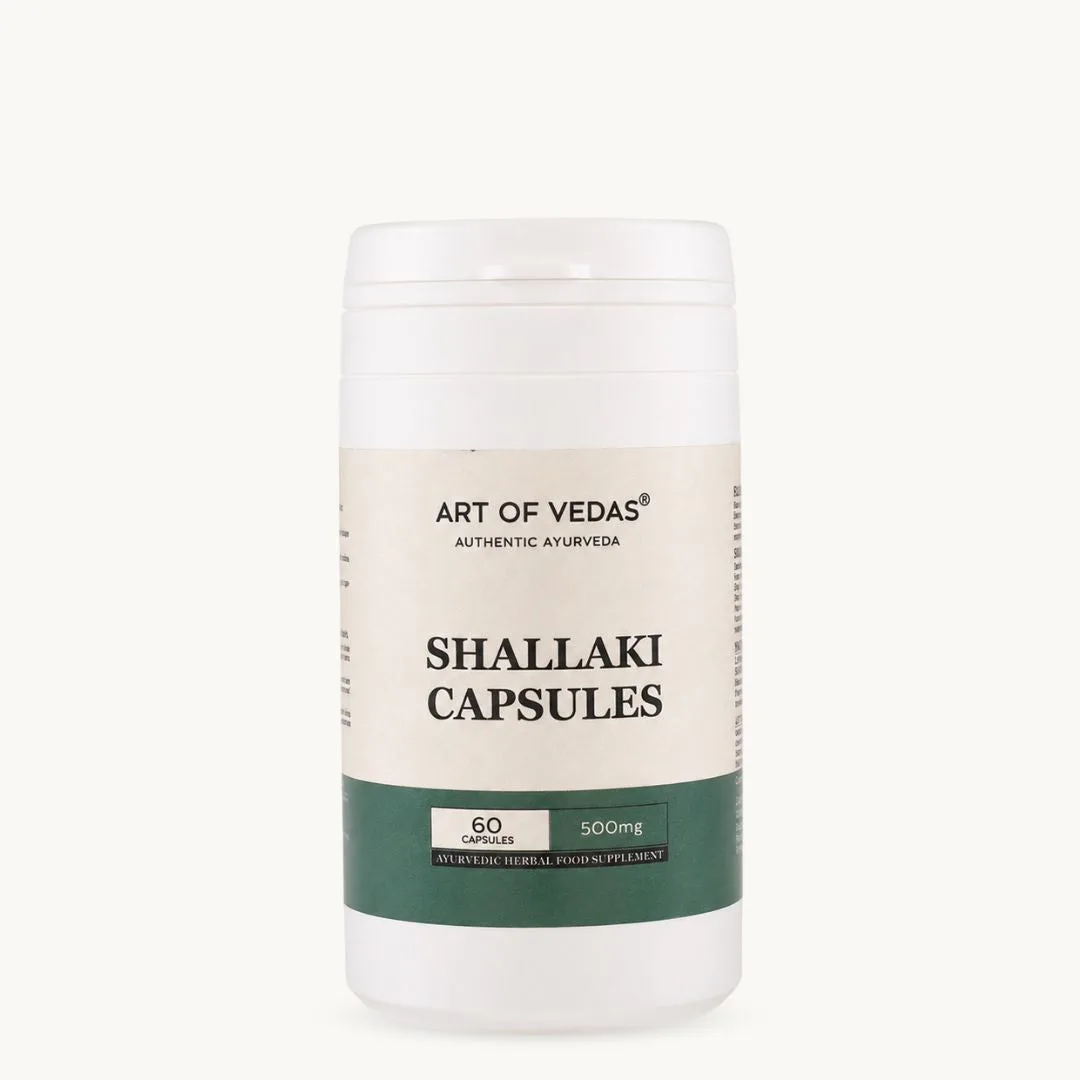
In brief: Shallaki is the Ayurvedic name of Indian frankincense, the gum resin of the tree Boswellia serrata, also known as Sallaki or Salai. The resin is collected from incisions in the bark, dried and, for capsules, ground to a powder. Classically it is bitter and astringent, cooling and drying, and associated with Kapha. Art of Vedas offers it as Boswellia capsules (Shallaki): 60 vegetarian capsules of 600 mg, taken as 2 capsules daily with warm water.
Shallaki, Indian frankincense and Boswellia serrata are three names for one material. Shallaki is the name used in the Ayurvedic texts, Indian frankincense is the usual English name, and Boswellia serrata is the botanical name that identifies the tree without doubt. This guide explains what Shallaki is, what it is called, how the resin is tapped, how it differs from the frankincense burnt as incense and from Guggulu, what its classical qualities are, and how Boswellia capsules are taken.
What is Shallaki? Boswellia serrata explained
Shallaki is the oleo-gum-resin of Boswellia serrata, a deciduous tree of dry, open woodland in the family Burseraceae. The term oleo-gum-resin describes what the tree exudes: a mixture of an aromatic oil, a gum that dissolves in water and a resin that does not. Exposed to the air, this exudate hardens into pale, fragrant drops known as tears.
Boswellia is the frankincense genus. The English name Indian frankincense therefore points to a real family connection, while the species name, serrata, marks the particular tree that Ayurveda uses. For a closer look at the genus, see our guide to Boswellia serrata and our guide to the Burseraceae resin family.
Names: Shallaki, Sallaki and Salai
Shallaki is also written Sallaki. In trade the resin is called Salai or Salai guggul, and the classical lexicons add further synonyms such as Kunduruki. The name Salai guggul is misleading, because the word guggul properly belongs to a different resin. In English the resin is sold as Indian frankincense, in German as Indischer Weihrauch. Our guide to the names Shallaki, Salai and Salai guggul sets them out in full.
How the resin is tapped
A resin is not harvested like a root or a leaf. An incision is made in the bark, and the tree exudes resin into the wound. Over the following weeks the exudate hardens in the air into tears, which are then collected. The tree is not felled; it continues to grow.
The method shapes the material. What is collected already contains the oil, gum and resin fractions together, and it only becomes a powder once it has been cleaned, dried and ground. Classical practice gives particular attention to cleaning the raw resin before use. The whole process is described in our guide to how a resin is tapped.
Indian frankincense, incense frankincense and Guggulu
Shallaki and the frankincense burnt as incense
The frankincense burnt in churches and as household incense, known as olibanum, comes chiefly from other Boswellia species. The two are relatives, not substitutes: a shared genus does not make them the same material. Resin sold for burning is intended as incense and is not prepared to be taken. The Shallaki in a food supplement is a separate material, named by its species.
Shallaki and Guggulu
Guggulu is the resin of Commiphora wightii. It belongs to the same plant family, Burseraceae, but to a different genus, and it is the base of a whole group of classical tablet formulas. Shallaki is more often met as a single herb. The shared word guggul in the trade name Salai guggul is why the two have been confused for so long. Our guide to Shallaki and Guggulu sets the two resins side by side.
Classical qualities and Dosha affinity
In the classical description, Shallaki has the following character:
- Rasa (taste): Tikta (bitter) and Kashaya (astringent)
- Character: cooling and drying
- Dosha: grouped with the resins traditionally used to steady Kapha
A bitter and astringent taste, together with a cool and dry character, stands opposite the heavy and moist nature of Kapha, which is why the texts group Shallaki with the resins for Kapha. These are traditional statements about the classical character of the resin, offered as context and not as a promise of any effect. Whether Shallaki suits a particular person depends on constitution and circumstances, and that is a question for a practitioner.
In the classical tradition Shallaki was used as a cleaned resin, as a powder (Churnam) and within compound tablets. Our comparison of powder, tablet and capsule explains how these forms differ.
Boswellia capsules: Shallaki as a food supplement
Today the most practical form for a daily routine is the capsule. Art of Vedas offers Boswellia capsules (Shallaki) with the following facts:
- 60 capsules of 600 mg
- Content: Boswellia serrata gum resin powder
- Capsule shell: vegetarian, made of HPMC
- Recommended amount: 2 capsules daily with warm water
Taking the capsules with warm water follows the classical preference for a warm Anupana, the liquid with which a herb is taken. Do not exceed the recommended daily amount. Food supplements do not replace a varied, balanced diet. Keep the pack closed, in a dry place and out of the reach of children.
A good label names the species and the material, so that Indian frankincense cannot be mistaken for another resin. Our guide to reading a Shallaki label shows what to look for. To view the product, go to Boswellia capsules (Shallaki).
Who should ask a practitioner first
Please consult a qualified Ayurvedic practitioner or your doctor before taking Shallaki capsules, in particular:
- during pregnancy or breastfeeding
- if you take any medication
- before giving them to children or adolescents
- if you are unsure whether the cooling and drying character of the resin suits your constitution.
A practitioner considers the person, the season and the daily routine together, as the classical texts intend.
Frequently asked questions about Shallaki and Indian frankincense
What is Shallaki? Shallaki is the Ayurvedic name of Indian frankincense, the oleo-gum-resin of the tree Boswellia serrata. It is also called Sallaki or Salai.
Is Shallaki the same as the frankincense used as incense? No. The incense frankincense, olibanum, comes chiefly from other Boswellia species. Both belong to the same genus, but they are different species and different materials.
Is Shallaki the same as Guggulu? No. Guggulu is the resin of Commiphora wightii, a different genus. The trade name Salai guggul borrowed the word guggul, and that is the source of the confusion.
How are Boswellia capsules taken? The recommended amount for the Shallaki capsules of Art of Vedas is 2 capsules daily with warm water. Do not exceed this amount.
What do the capsules contain? Boswellia serrata gum resin powder in a vegetarian HPMC capsule. One pack contains 60 capsules of 600 mg.
Who should ask for advice before taking Shallaki? Anyone who is pregnant or breastfeeding, takes medication or wishes to give the capsules to a child should first consult a qualified Ayurvedic practitioner or a doctor.
This article describes the classical Ayurvedic tradition for educational purposes. Shallaki capsules are a food supplement. They do not replace a varied, balanced diet. Do not exceed the recommended daily amount.