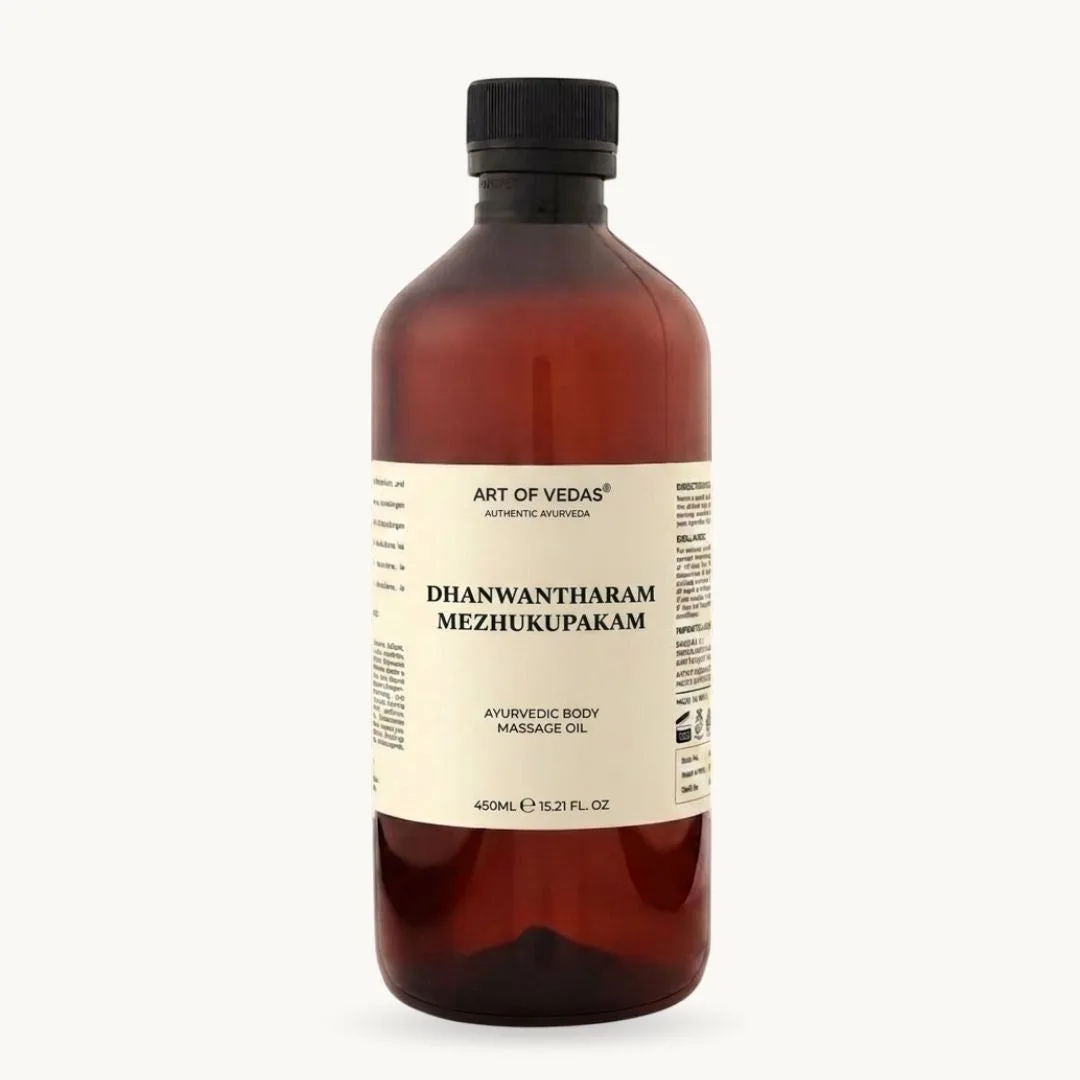
In brief: Dhanwantharam Mezhukupakam (also written Dhanwantaram Mezhukupakam or Dhanwantharam Mezhupakam) is the semi-solid form of the classical Dhanwantharam recipe: Bala, the ten Dashamoola roots, Ashwagandha, Shatavari and further plants cooked further than for the Thailam or the Kuzhambu until the preparation sets to a soft, wax-like consistency. Mezhuku means wax and Pakam the stage of cooking. Described in the Ashtanga Hridayam, the recipe is mildly warming and classically placed with Vata; the Mezhukupakam is used in small amounts on one area, softened between the hands. This guide covers what it is, how it compares with the Thailam and the Kuzhambu, how to apply it and who should ask first.
Dhanwantharam Mezhukupakam: the semi-solid form of the Dhanwantharam recipe and how to use it
Reviewed by Dr. Anu Joy, MD (Ayurveda), Ayurvedic doctor of Art of Vedas

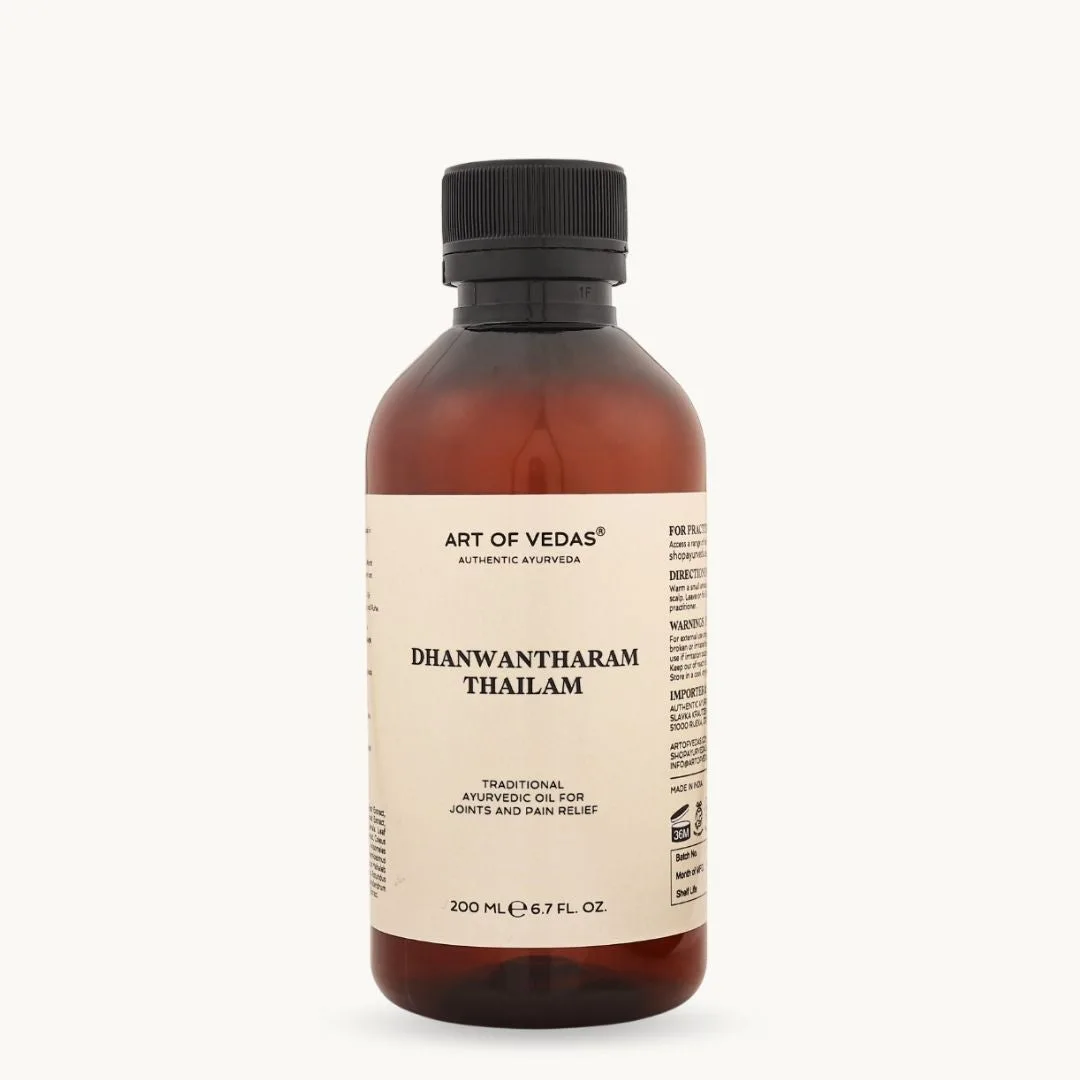
What a Mezhukupakam is, and what the name means
Mezhukupakam is a word for a consistency, not for a recipe. Mezhuku means wax, and Pakam, from the Sanskrit Paka, is the stage to which a preparation is cooked. A Mezhukupakam is therefore a classical oil preparation cooked to the wax stage: it holds its shape in the jar at room temperature, gives under a fingertip, and melts to an oil on the skin. The recipe behind it is Dhanwantharam, a widely used classical recipe named after Dhanvantari. Art of Vedas sells it as Dhanwantharam Thailam, the flowing oil, as Dhanwantharam Kuzhambu, the thick preparation, and as Dhanwantharam Mezhukupakam, the semi-solid one, in a 450 ml pack. Our complete guide to Kuzhambu explains the thick form in general.
Thailam, Kuzhambu and Mezhukupakam: three stages of one cooking
The classical texts describe the cooking of a medicated oil, Sneha Paka, in stages: how far the cooking is carried decides the consistency. Taken off the fire at the soft stage, the preparation is a flowing oil, a Thailam, the form for Abhyanga of the whole body. Prepared in a heavier base of sesame and castor oil and cooked further, it becomes a Kuzhambu, thick and slow-flowing, for one area. Cooked further still, to the wax stage, it is a Mezhukupakam, semi-solid in the jar, for the smallest application. The plants are the same throughout. In the hand, the Thailam spreads at once; the Kuzhambu pours slowly; the Mezhukupakam is taken from the jar by the fingertip and softened between the palms.
The recipe behind it, and its character
The classical Dhanwantharam recipe names, among others, Bala root, the ten Dashamoola roots, Ashwagandha, Shatavari and further roots, grains, fruits and aromatic plants, cooked into a sesame oil base. For the Mezhukupakam, the declared list on the product page and the label is the reference for what is in the pack. The method is described in our complete guide to Thailams. Dhanwantharam is classically placed with Vata; the texts describe it as nourishing (Brimhana) and strengthening (Balya) in general terms, and it is only mildly warming. Of the three forms, the Mezhukupakam is the heaviest: it does not spread, and it leaves a film that keeps the area warm and covered for longer than an oil would.
How Dhanwantharam Mezhukupakam is used in practice
Take a pea-sized to hazelnut-sized amount with a clean, dry fingertip, never a wet one, so that no water gets into the pack, and close the lid at once. Rub it between the palms for half a minute until it has melted to a warm oil; in a cold room, stand the closed pack in warm water first. No microwave, and never the open pack on direct heat. Work it into one area, the lower back, a shoulder, a knee, an ankle or the soles of the feet, with slow, sustained strokes until only a thin film remains. Keep the area warm and covered, with a cloth, a sleeve or socks, for 20 to 30 minutes or overnight, then wash with warm water. Use the Thailam for a full Abhyanga, in the sequence our Abhyanga guide sets out. Daily or on alternate days in autumn and winter, in the evening, less often in the hottest weeks. Keep the pack closed and cool, and use it within the period after opening printed on the label.
Who should ask first, and which of the three to choose
Dhanwantharam Mezhukupakam is for external use only. Do a small skin test on the inner forearm before the first full application, keep it away from the eyes, the face and broken skin, and do not use it if you react to sesame, castor oil or any declared ingredient. In pregnancy, while breastfeeding and for children, ask your doctor or a qualified Ayurvedic practitioner first. For the daily routine over the whole body, the Thailam; for a teaspoon on one area, the Kuzhambu; for the smallest amount and the longest-lasting film, the Mezhukupakam. A qualified Ayurvedic practitioner can tell you which suits you.
Frequently asked questions about Dhanwantharam Mezhukupakam
What is Dhanwantharam Mezhukupakam? The semi-solid form of the classical Dhanwantharam recipe: Bala, the ten Dashamoola roots, Ashwagandha, Shatavari and further plants cooked to the wax stage, so that the preparation holds its shape in the jar and melts to an oil on the skin. The recipe is described in the Ashtanga Hridayam. Art of Vedas sells it for external use in a 450 ml pack.
What does Mezhukupakam mean? Mezhuku means wax and Pakam the stage of cooking, so a Mezhukupakam is a classical oil preparation cooked to the wax stage. It is a word for a consistency rather than for a recipe: Dhanwantharam Mezhukupakam is the Dhanwantharam recipe at that stage. Mezhupakam is another spelling.
What is the difference between Dhanwantharam Thailam, Kuzhambu and Mezhukupakam? Three consistencies of one recipe. The Thailam is the flowing oil, cooked into sesame oil, for Abhyanga of the whole body. The Kuzhambu is cooked in sesame and castor oil to a thick consistency, for a teaspoon on one area. The Mezhukupakam is cooked further still, to a semi-solid, for the smallest application. Art of Vedas offers all three.
What is Dhanwantharam Mezhukupakam used for? For a focused application on one area, the lower back, a shoulder, a knee, an ankle or the feet. Dhanwantharam is mildly warming and classically placed with Vata. Art of Vedas sells it for external use; ask a qualified Ayurvedic practitioner what suits you.
How do you use Dhanwantharam Mezhukupakam? Take a pea-sized to hazelnut-sized amount from the jar with a clean, dry fingertip, rub it between the palms until it melts to a warm oil, and work it into one area with slow, sustained strokes. Keep the area warm and covered for 20 to 30 minutes or overnight, then wash with warm water.
Does Dhanwantharam Mezhukupakam need to be warmed? Only in the hands. Rubbing the amount between the palms for half a minute softens it to an oil, which is the traditional way to prepare it for the skin. In a cold room, stand the closed pack in warm water for a few minutes first. Never heat the open pack directly and never use a microwave.
Why has my Dhanwantharam Mezhukupakam gone hard, or soft? Because it is cooked to the wax stage, it is firmer in a cold room and softer in a warm one; both are normal and neither means it has spoiled. A few minutes in warm water, or a moment between the palms, restores it. Keep the pack closed and cool and keep water out of it.
Can Dhanwantharam Mezhukupakam be used in pregnancy or for children? Ask your doctor or a qualified Ayurvedic practitioner first. Dhanwantharam Mezhukupakam is for external use only: do a small skin test on the inner forearm before the first full application, keep it away from the eyes, the face and broken skin, and do not use it if you react to sesame, castor oil or any declared ingredient.