In brief: Shatavari is the sweet, cooling root that classical Ayurveda places among its principal Rasayana herbs, taken as a Churnam or in capsules where heat and dryness need to be met with nourishment rather than stimulation.
A hundred roots, and only the root is used
Pull up a mature Shatavari plant and the reason for its name is visible at once. Above ground it is a modest climber with fine, needle-like foliage. Below ground it carries a dense cluster of tuberous roots radiating from a single crown. The Sanskrit name is usually read as the one who possesses a hundred roots, and it is those roots alone that classical pharmacy uses, peeled, dried and reduced to a pale, fine powder.
The taste is the next thing anyone notices. Shatavari is frankly sweet, with a thin bitter edge behind the sweetness. In Ayurveda this is not a detail of flavour but the first reliable piece of information about a substance: rasa, the taste on the tongue, is treated as a signal of how a material will behave once it is inside the body.
How classical Ayurveda classifies it
Every herb in the Ayurvedic materia medica is described through a small set of fixed coordinates. For Shatavari (Asparagus racemosus) they read as follows:
- Rasa (taste): madhura, sweet, with a secondary tikta, bitter
- Virya (potency): shita, cooling
- Vipaka (post-digestive effect): madhura, sweet
- Guna (qualities): guru, heavy, and snigdha, unctuous
- Effect on the Dosha (the three functional principles): settles Pitta, the heating principle, and Vata, the principle of movement and dryness; taken heavily it can add to Kapha, the principle of structure and moisture
This combination is less common than it sounds. Many of the herbs in everyday Ayurvedic use are warming, light and drying, built for damp and stagnant conditions. Shatavari sits on the other side of that balance, which is why classical practice reaches for it when a person is running hot, thin and depleted rather than heavy and congested.
What Rasayana actually means
Shatavari is described in the classical compendia as a Rasayana, a word that is often translated loosely as tonic and thereby misunderstood. Rasayana names the class of substances used to sustain and rebuild rasa, the first and most fluid of the bodily tissues, and through it Ojas, the refined essence that classical texts associate with stability and resilience. A Rasayana is not a stimulant. It does not push the body to do more. It is closer in intention to good food taken deliberately over a long period.
Within that class, tradition associates Shatavari most strongly with women, in the way that Ashwagandha is associated with the opposite constitution: warming where Shatavari cools, drying where Shatavari moistens. The two are traditionally paired for that reason. The same logic governs Bala, another sweet and strengthening root, and Brahmi, the Rasayana of the same family directed at the mind rather than the tissues.
Who it suits, and when
Prakriti, the individual constitution a person is born with, is the first filter. Shatavari is classically chosen for those of Pitta Prakriti and for anyone whose Vata has become dry and unsettled. Late summer, when accumulated heat is at its peak, is the season in which Ritucharya, the seasonal regimen, most often calls for cooling and moistening substances.
The reverse is equally worth knowing. Because it is guru and snigdha, Shatavari is not the obvious choice when Agni, the digestive fire, is low, when meals sit heavily, or in a constitution already inclined to Kapha. Classical practice in that situation attends to Agni first and introduces the sweet, heavy herbs afterwards. When a well chosen herb disappoints, the order of operations is often the reason rather than the herb itself.
Churnam or capsules
Shatavari reaches Europe in two honest forms. Shatavari Powder is the traditional Churnam: the dried root, milled, nothing else. It is stirred into warm water, a warm plant based drink or a warm porridge, in the daily amount given on the pack, taken in one or two portions. Its sweetness makes it straightforward to take by mouth, and taking it that way also means the taste itself registers, which classical theory considers part of how the substance works.
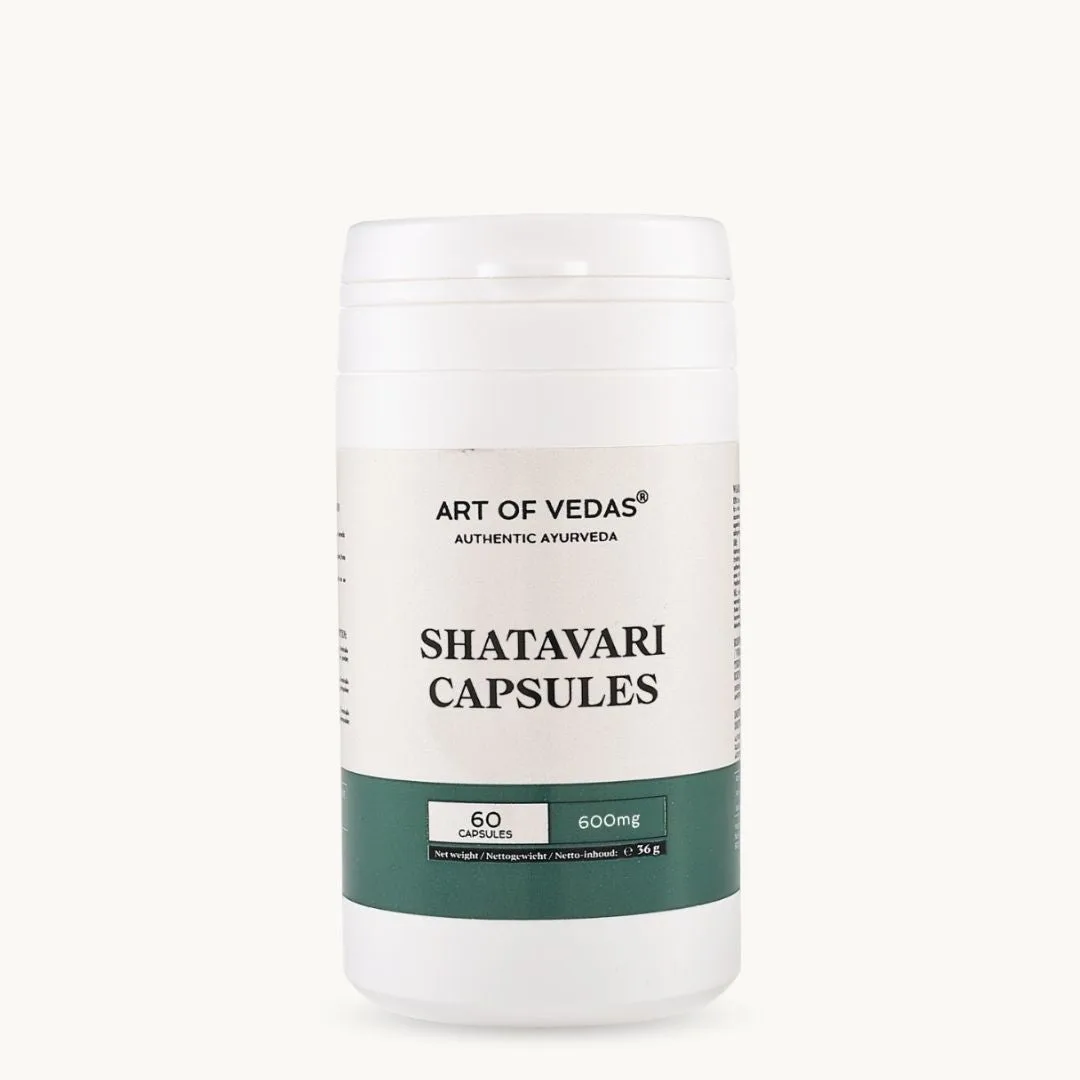
The alternative, Shatavari Capsules, gives a fixed quantity per capsule and travels well, which is often the difference between a herb taken for months and a herb taken for a few days.
Sensible pairings
- With Ashwagandha, where dryness and unsettled Vata dominate and a warming counterweight is wanted
- With Amla Powder, also classed as a cooling Rasayana, for a pairing that stays firmly on the Pitta side
- After a period of Triphala, when Agni and elimination want attention before a heavy sweet root is introduced
Judging quality and storing it well
Good Shatavari powder is pale, ivory to light beige, never grey or brown, fine and free flowing, with a clean sweet smell close to milled grain. Clumping, darkening or a flat, dusty smell all point to moisture, which is the main enemy of a starchy root powder. Keep it airtight, away from light and away from kitchen steam, and use an opened pack within a few months. Capsules are less exposed but follow the same rule: cool, dark, sealed.
One practical note on identity: regional names are shared by more than one plant, and only the botanical name on the label settles the question. It should read Asparagus racemosus, and the part listed should be the root.
Sensible caution
Shatavari is a food supplement and is not a substitute for medical advice or for any treatment prescribed to you. If you are pregnant or breastfeeding, take prescribed medication, or are under the care of a doctor, speak to that doctor before adding it. Anyone with a known sensitivity to asparagus should avoid it. In Ayurvedic practice a herb is chosen for a person rather than for a symptom, and a qualified practitioner will place it in the context of your Prakriti, your Agni and your Dinacharya, the daily routine that carries everything else.
Questions we are asked
How long is a course, and how is it judged?
Classical practice treats six to twelve weeks as the smallest sensible unit of use, and what is looked for at the end of it is steadiness rather than a sudden change. If nothing at all has shifted by then, the more useful question is usually whether the herb suited the constitution in the first place.
Is Shatavari only for women?
No. Tradition associates it strongly with women because of its cooling and moistening qualities, but it is given to anyone whose picture is hot, dry and depleted, and men of Pitta Prakriti take it routinely. Constitution decides, not category.
Is it related to the asparagus sold in shops?
Distantly. Both belong to the genus Asparagus, but the kitchen vegetable is a different species and the part eaten is the young shoot rather than the root. That shared genus is the reason anyone with a known sensitivity to asparagus should leave Shatavari alone.
What should I take it with?
Warm water is the simplest and most common vehicle. A warm plant based drink works well and suits the sweetness of the root, as does stirring the powder into a warm porridge at breakfast. Cold liquids are generally avoided in Ayurvedic practice because they dull Agni at the moment you want it working.
Can it be taken all year round?
It is more usual to take a Rasayana in defined courses: several weeks on, a pause, then a reassessment. Long unbroken use of a heavy, sweet substance is watched carefully in classical practice, particularly in anyone whose digestion has slowed. Many practitioners align courses with the seasons, taking Shatavari through the hotter months and something warmer through the cold.
Does it need to be taken at a particular time of day?
Morning on an empty stomach and evening before the last meal are both traditional. Evening tends to be favoured where the aim is settling and grounding, morning where it is strength through the day. Pick one and keep to it, since regularity is doing more of the work here than timing.