In brief: Bala, botanically Sida cordifolia, is the root that Ayurveda named after strength itself, and in European practice it is met almost entirely through the classical herbal oils built on it.
A plant named after what the tradition expected of it
A few of the plants catalogued in the classical Ayurvedic compendia carry a name that doubles as a description. Bala is one. The word means strength, and Charaka Samhita places the plant among the balya dravyas, the substances gathered together for exactly that quality. Botanically it is Sida cordifolia, a modest, low-growing member of the mallow family with small pale yellow flowers and heart-shaped leaves. The part the tradition values is neither the leaf nor the flower but the root, which is dug, dried and coarsely powdered before anything else is done with it.
Classical dravyaguna, the Ayurvedic study of substance and quality, describes Bala as madhura (sweet) in Rasa (taste) and in Vipaka (the effect after digestion), shita (cooling) in Virya (potency), and snigdha (unctuous) with guru (heavy) among its qualities. That combination explains its reputation. Sweet, heavy, oily substances are what Ayurveda reaches for when Vata (the Dosha, or functional principle, governing movement and dryness) has become excessive. What makes Bala unusual is that it settles Vata without provoking Pitta, which is why it appears in formulas where a warming herb alone would be too much.
The four Balas
Classical texts rarely speak of Bala on its own. They speak of the bala chatushtaya, the set of four: Bala (Sida cordifolia), Atibala (Abutilon indicum), Nagabala and Mahabala (Sida rhombifolia). The four share a sweet, cooling, nourishing character and are used in overlapping ways. Nagabala is the one where traditions differ, identified with more than one botanical source depending on the lineage of practice, a reminder that Sanskrit plant names describe a role as much as a species. So a preparation naming Bala, Atibala and Nagabala together is not padding its label. It is following a convention in which the four roots are understood to reinforce one another.
Why Bala almost always reaches you as an oil
Bala root can be taken as a Churnam (a classical herbal powder) and appears in several decoctions, yet most people meet it in a bottle of Thailam (a classical herbal oil preparation), for a reason beyond convenience.
The classical method, taila paka, is slow. A decoction of the root is simmered with a base oil until all the water has gone, leaving the fat-soluble fraction of the plant in the oil, and the cycle is often repeated. Where a label mentions avarthy, that is the count of repetitions, so an oil described as 101 avarthy has been through the cycle many times. Since classical Ayurveda works on Vata with sneha, meaning oleation, the oil is not merely a carrier for Bala. It is half of the reasoning.
The classical Bala oils and what separates them
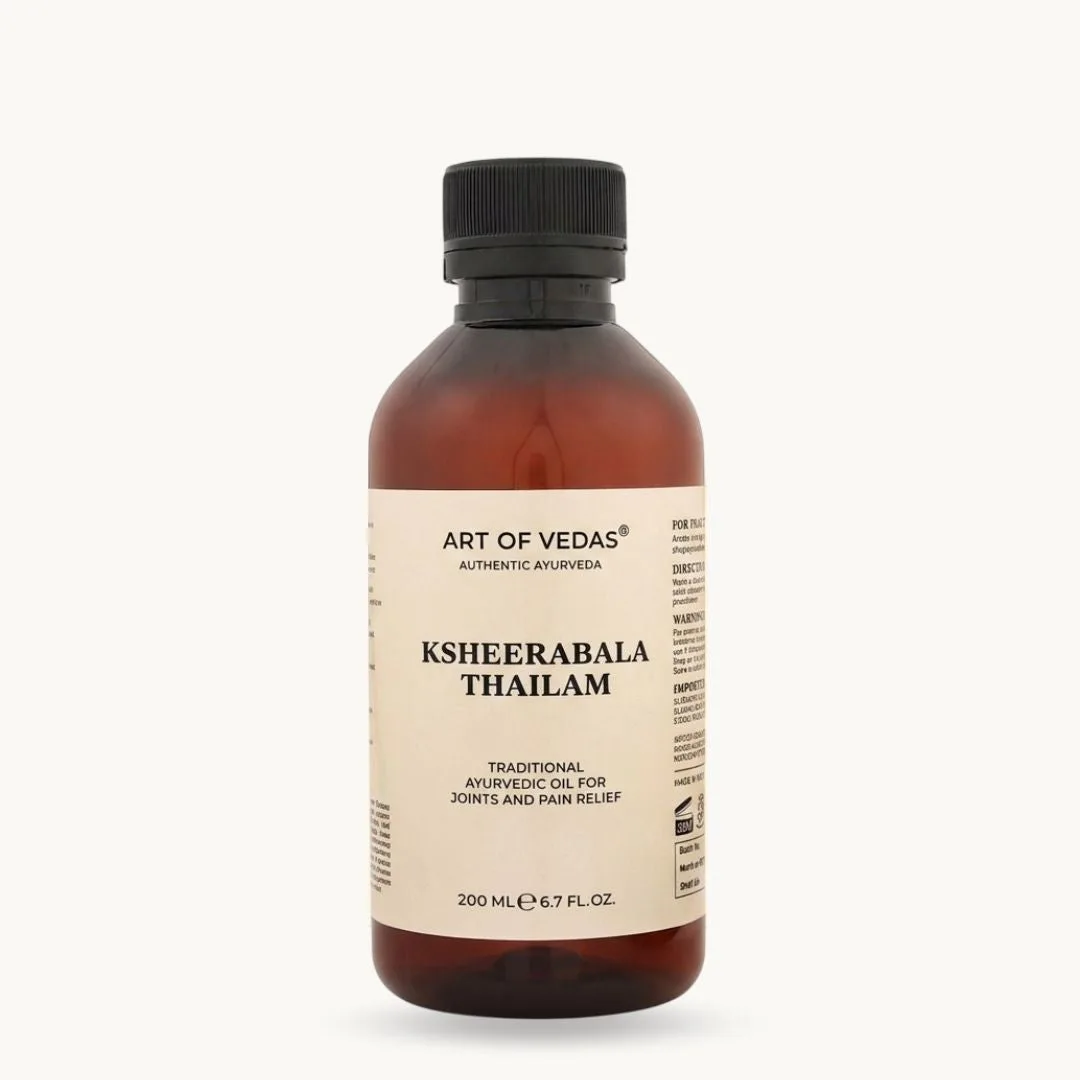
Ksheerabala Thailam
Ksheerabala Thailam is the one chosen where a heavier oil would feel like too much. Classical practice associates it with majja Dhatu, the innermost of the bodily tissues, and directs it towards Shiro Abhyanga (oiling of the head). The tradition also names it in Karnapoorana (the ear practice) and in Nasya (the nasal practice), both of which belong with a qualified practitioner rather than at home. Carrying the cooling quality of Bala rather than counteracting it, it suits people who find warming oils uncomfortable.
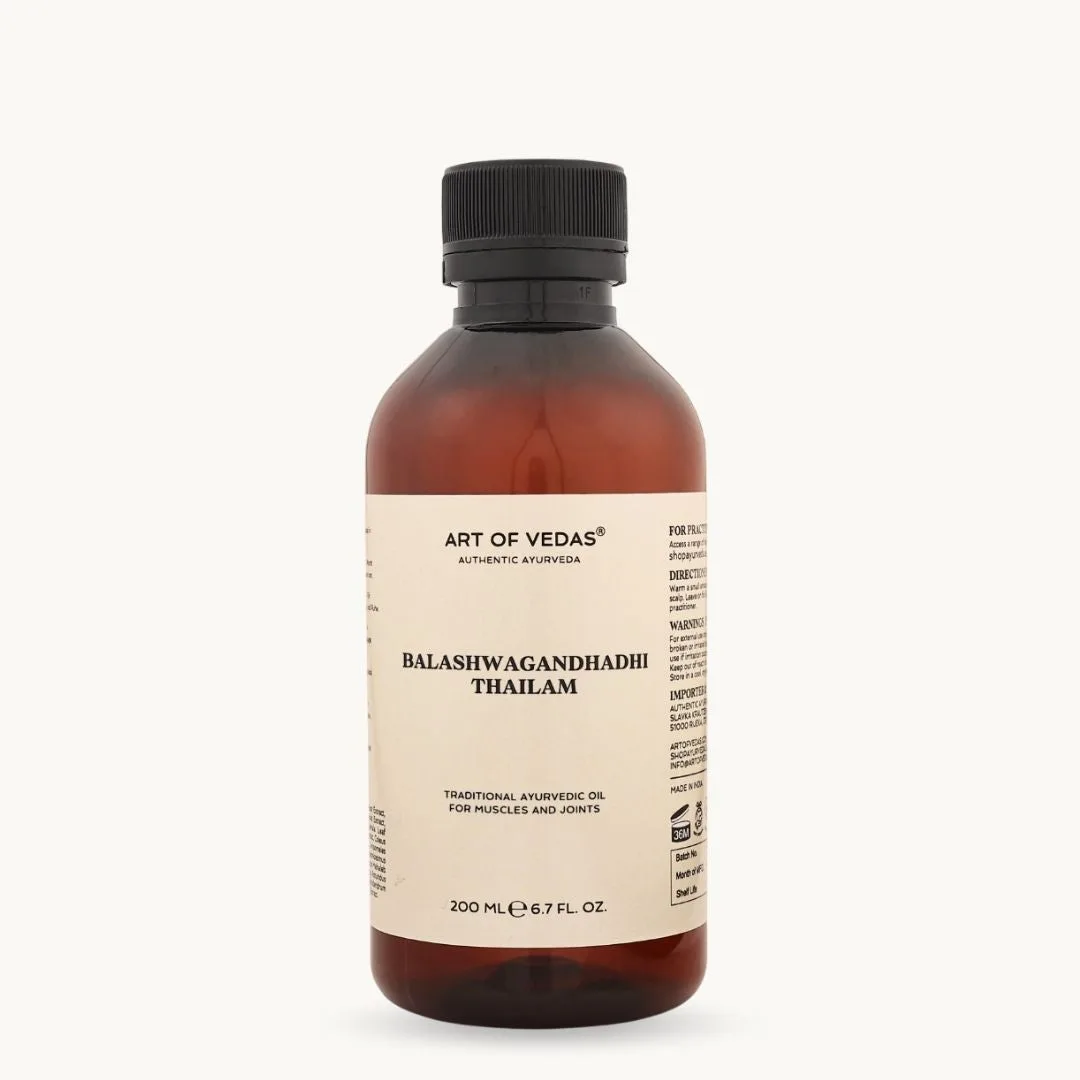
Balaswagandhadi Thailam
Balaswagandhadi Thailam pairs Bala with Ashwagandha, as its name states. The result is warmer and more grounding than Ksheerabala, and the conventional choice for full-body Abhyanga (oil self-massage) over the limbs, shoulders and back. Classically it is spoken of in connection with mamsa Dhatu, the muscle tissue, and the tradition directs it towards the cold months and towards a body tired by sustained physical effort.
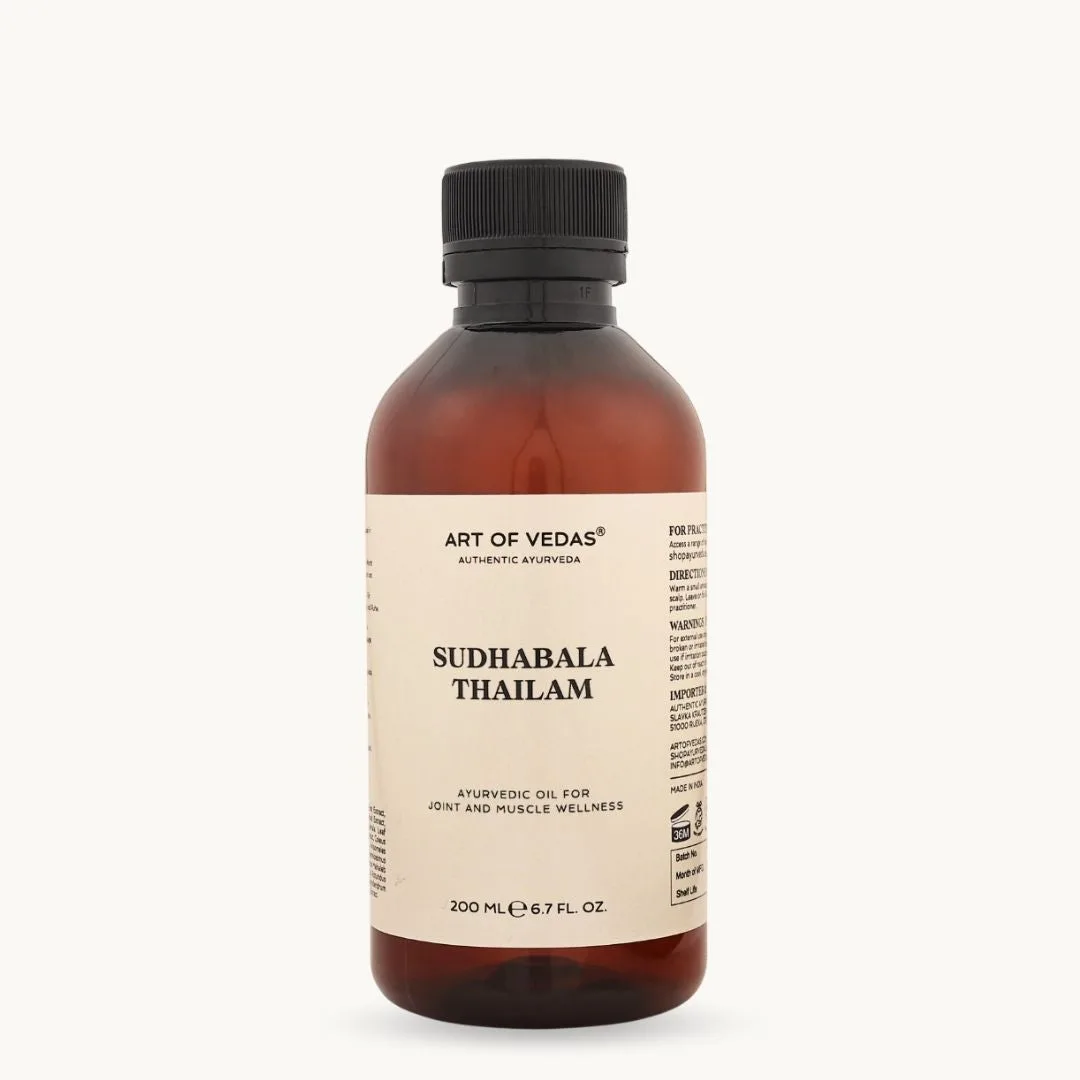
Sudhabala Thailam
Sudhabala Thailam is the plainest expression of the group, keeping Bala itself at the centre of the preparation. That simplicity is the point: it is a sensible first classical oil, and a reasonable choice for thin or sensitive skin. As with any classical preparation, read the ingredient list on the bottle rather than assuming from the name.
Balaswagandhadi Kuzhambu
A Kuzhambu is not a variant of a Thailam but a different preparation: thicker, semi-solid at room temperature and more concentrated. Balaswagandhadi Kuzhambu is softened between the palms and applied in small quantity to one area rather than across the whole body. It is the form to reach for where weight on one region matters more than a light film everywhere.
Using Bala oils at home
Warm the closed bottle by standing it in hot water for a few minutes. Never heat a classical oil on a hob or in a microwave, which spoils the texture the repeated processing created. Twenty to thirty millilitres is usually enough for a full-body Abhyanga. Work from the extremities inward, using long strokes along the limbs and circular strokes at the joints, and give the soles of the feet and the crown of the head extra time.
Leave the oil on the skin for fifteen to twenty minutes before a warm shower, and use as little soap as possible afterwards, since the residue left behind is what classical practice is interested in. In the traditional routine the oiling comes before exertion rather than after, a pattern covered in our guide to yoga and Ayurveda.
Choosing between them
- Head and scalp, or any application where lightness matters: Ksheerabala Thailam.
- Whole-body Abhyanga in the cold, dry part of the year: Balaswagandhadi Thailam.
- First classical oil, sensitive skin, or a preference for simplicity: Sudhabala Thailam.
- Concentrated work on one area, or a professional therapy room: Balaswagandhadi Kuzhambu.
Bala belongs to a wider family of Vata practice. Where Bala is its sweet, nourishing side, the ten roots of Dashmoola are the drier, more mobilising counterpart, and the two are often used in sequence across a season rather than in competition. Those working with the head and the senses tend to keep a Bala oil alongside Brahmi, which occupies quite different territory in the classical scheme.
Sensible use
- Patch test on the inner forearm and allow twenty-four hours before first full use.
- Keep classical oils away from the eyes and away from broken or irritated skin.
- Nasya and Karnapoorana are best learned from a qualified practitioner rather than from a video.
- During pregnancy, while breastfeeding or while under medical care, speak to your doctor before beginning any oil practice.
- Store away from light and heat, and close the cap firmly.
Questions we are asked
What is Bala used for in Ayurveda?
Classically Bala is a balya and brimhana herb, belonging to the groups described as strength-promoting and nourishing. The tradition directs it towards the body where Vata has become excessive, most often through external oil application rather than internal use.
Is Bala the same as Ashwagandha?
No. They are different plants, and classical pharmacology places them on opposite sides of one quality: Bala is described as cooling, Ashwagandha as warming. That is the logic of Balaswagandhadi, where the pairing gives an oil that is grounding without being as cooling as Bala on its own.
What does avarthy mean on the label of an oil?
Avarthy is the number of times the decoction and oil cycle has been repeated during preparation. A higher count means a more concentrated oil with a finer texture, and a considerably longer preparation time. It is a description of method, not a marketing figure.
Can Bala oil be used on the hair?
Yes. Ksheerabala Thailam in particular is used for Shiro Abhyanga, in which the oil is worked into the scalp with the fingertips and left for twenty minutes or overnight. Use a small quantity, since more oil than the scalp can take only makes washing out harder.
How often can a Bala oil be applied?
Daily application is the classical pattern, described in Dinacharya, the Ayurvedic daily routine, as a morning practice before bathing. The classical seasonal advice is to oil more freely through the cold, dry months and to ease off in warm, humid weather. Regularity matters more than quantity.