The information in this article is provided for educational purposes and reflects traditional Ayurvedic knowledge. It is not intended as medical advice and should not replace consultation with a qualified healthcare professional.
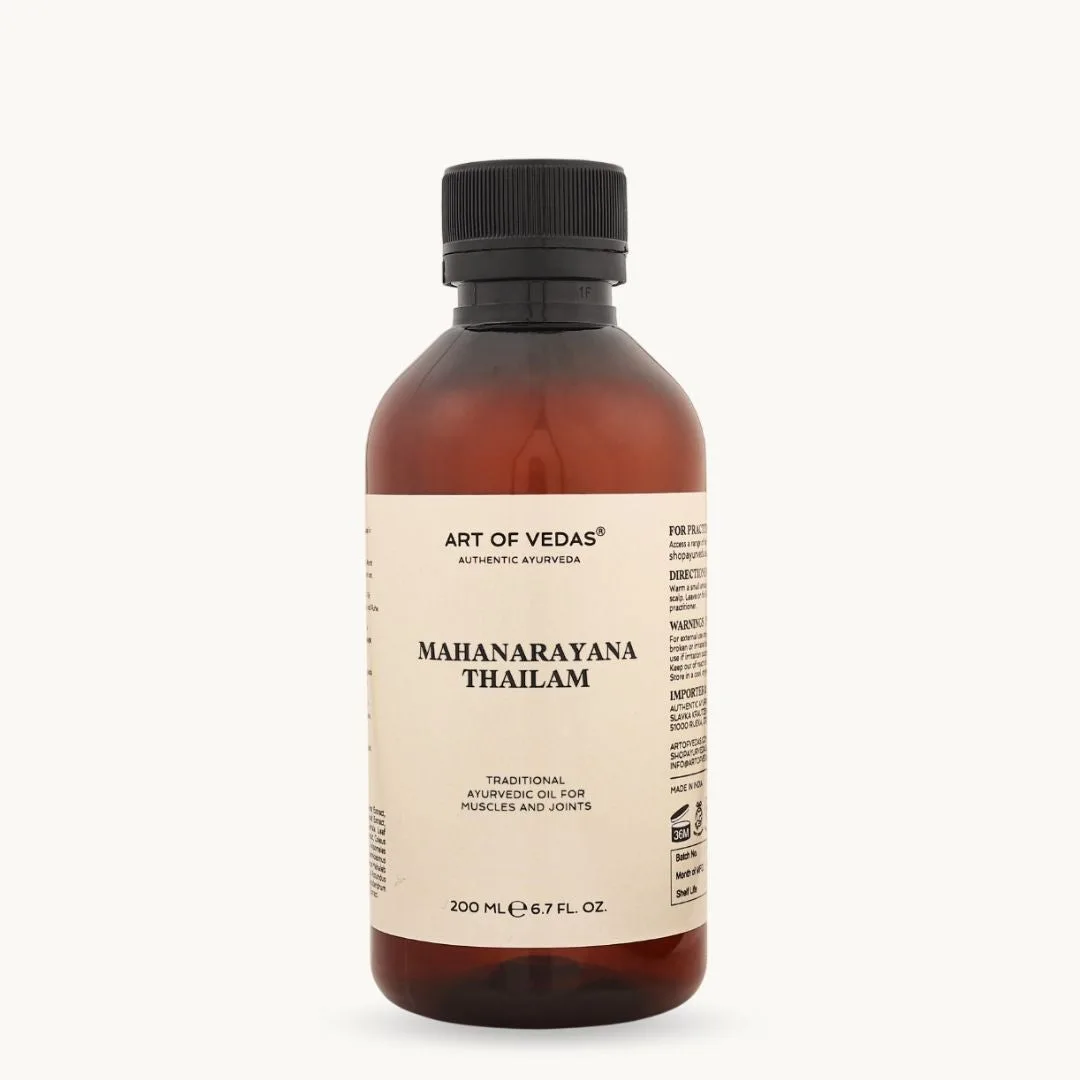
In brief: Mahanarayana Thailam is one of the most complex classical Ayurvedic formulas - containing over forty herbs processed in sesame oil with a milk-water decoction base - and is described in the Sahasrayogam as the primary oil for Vata conditions involving the joints, muscles, and deep connective tissues. This guide covers the formula's composition, the classical texts that define its use, and the correct application methods.
Mahanarayana Thailam: The Classical Ayurvedic Oil for Joints, Muscles and Deep Vata
Most Ayurvedic oils contain between ten and twenty herbs. Mahanarayana Thailam contains over forty. This is not complexity for its own sake - the Sahasrayogam's description of the formula reflects a deliberate classical strategy: to address Vata simultaneously across all its manifestations in the musculoskeletal, connective, and nervous tissues, using herbs whose different properties combine to create a broader and deeper action than any simpler formula could achieve.
The name itself signals the formula's scope. "Maha" means great or superior; "Narayana" refers to a classical designation associated with Vishnu - the preserver in Vedic cosmology - reflecting the traditional understanding of this formula as one that preserves the body's structural integrity and mobility. The Sahasrayogam and Ashtanga Hridayam both reference the formula in the context of Vata conditions involving the joints, muscles, and the structural tissues of the body.
The Formula: Why Over Forty Herbs
The classical preparation of Mahanarayana Thailam follows the Ksheerapaka method - a specific process in which the herbs are first decocted with water and milk, reducing to a quarter of the original volume, and this decoction then processed with sesame oil through a prolonged heating process that transfers the herbs' therapeutic properties into the oil. The milk component is significant in classical terms: milk's nourishing, cooling, and tissue-building properties are understood as adding a specific depth of nourishment to the formula that pure water decoction does not provide, and as creating an affinity for the deeper tissues (Asthi and Majja dhatu) that pure oil preparations reach less effectively.
The primary herbs in the formula address the main dimensions of Vata-related musculoskeletal conditions. Bala (Sida cordifolia) provides the foundational Vata-balancing and Balya action. Ashwagandha contributes its Rasayana and tissue-building properties. Dashamoola (the classical ten-root formula) addresses Vata across all five subtypes and all its organ sites. Shatavari brings its deeply nourishing action on the connective and reproductive tissues. Devadaru (Cedrus deodara) contributes specific properties for musculoskeletal pain and Vata-related stiffness. Eranda (castor root) is the classical Vatahara (Vata-reducing) herb par excellence - warm, penetrating, and deeply lubricating for the joints and connective tissue channels.
The formula also includes herbs addressing the secondary dimensions of complex Vata conditions: Bilva, Agnimantha, and Shyonaka from the Dashamoola group; herbs with Medhya properties; herbs supporting the quality of Rasa and Rakta dhatu (the fluid and blood tissues that nourish the structural tissues); and herbs with specific Vedanasthapana properties in the classical pharmacopoeia. The interaction of these forty-plus herbs, processed together through the classical method, creates a combined action that the Sahasrayogam's descriptions suggest is qualitatively different from the sum of its individual components.
Classical Indications: What the Sahasrayogam Describes
The Sahasrayogam devotes substantial space to Mahanarayana Thailam, listing its classical indications in terms of the Vata-related conditions for which it is the preferred preparation. These include Sandhigata Vata (Vata localised in the joints, producing the stiffness and reduced mobility that classical texts associate with this pattern), Mamsa Gata Vata (Vata in the muscular tissues, producing spasm and tension), and Asthi Gata Vata (Vata in the bone tissue, producing the dry, brittle, or achy quality associated with deep Vata penetration into the structural tissues).
The Ashtanga Hridayam's descriptions add the broader Vata conditions: generalised depletion of the musculoskeletal tissues, weakness of the limbs, conditions arising from excessive physical effort or injury, and the specific classical pattern of Vata moving through the channels and creating variable, migratory discomfort in the musculoskeletal system.
The classical texts describe both external application and, in more serious conditions, internal use of Mahanarayana Thailam in small quantities as part of a classical Snehapana (internal oleation) protocol conducted under professional supervision. The external application through Abhyanga, Pizhichil (the classical continuous oil drizzle treatment), and local application to specific joints is the more widely relevant application for home use.
How to Apply Mahanarayana Thailam
For full-body Abhyanga targeting Vata conditions in the musculoskeletal system, the classical guidance involves warming the oil and applying it with moderately firm pressure - more than the gentle touch used for sensitive skin, enough to allow the oil to penetrate toward the deeper tissues. The Sahasrayogam's guidance emphasises sustained application time: the oil should be allowed to remain on the body for thirty to forty-five minutes before bathing when possible, as Mahanarayana's complex formula benefits from longer absorption time than simpler oils.
For specific joint or muscle areas, concentrated local application is described in classical texts as more targeted and effective than relying solely on full-body Abhyanga to reach the affected area. Warming the oil, applying it specifically to the area, covering with a warm cloth, and allowing the oil to absorb for twenty to thirty minutes is the classical local application method.
In classical Panchakarma settings, Mahanarayana Thailam is used as a primary oil for Pizhichil - the continuous warm oil drizzle treatment conducted by trained therapists. For Abhyanga at home, the self-application method following classical guidance produces meaningful benefits without requiring a clinical setting. See our guide to Abhyanga at home.
Find Mahanarayana Thailam and related classical oils in our Thailams collection. See also our guide to Ayurvedic joint and muscle care.
Frequently Asked Questions
What is Mahanarayana Thailam used for?
It is the primary classical oil for Vata conditions in the joints, muscles, and deep connective tissues - described in the Sahasrayogam for Vata localised in joints (stiffness), muscles (spasm), and bone tissue (dry, achy quality). The forty-plus herb formula addresses these simultaneously across multiple tissue layers. It is also used in classical Panchakarma therapies including Pizhichil and Abhyanga.
How is Mahanarayana Thailam different from Dhanwantharam Thailam?
Dhanwantharam is the primary Vata oil for general daily Abhyanga, postnatal care, and broad Vata management. Mahanarayana's forty-plus herb formula and Ksheerapaka (milk decoction) preparation give it deeper, more targeted action in the musculoskeletal and connective tissues specifically. Classical practice often uses Dhanwantharam for daily Abhyanga and Mahanarayana for more specific applications, or alternates seasonally.
What are the key herbs in Mahanarayana Thailam?
Primary herbs: Bala for Vata-balancing and strengthening; Ashwagandha for Rasayana; Dashamoola for broad Vata pacification across all five subtypes; Shatavari for connective tissue nourishment; Devadaru for musculoskeletal support; and Eranda (castor root) for deep joint and channel lubrication. Prepared through the classical Ksheerapaka method - herbs decocted in milk and water, then incorporated into sesame oil.
How long should Mahanarayana Thailam be left on the body?
Thirty to forty-five minutes before bathing for a full Abhyanga - longer than simpler oils, as the complex formula benefits from additional absorption time to reach deeper tissues. For local joint or muscle application, twenty to thirty minutes with a warm cloth covering is the classical approach.
Explore Mahanarayana Thailam at Art of Vedas
Find Mahanarayana Thailam in our Thailams collection. Related reading: Ayurvedic joint and muscle care, Abhyanga at home, Vata imbalance guide, and Dhanwantharam Thailam guide.
For external use only. Not a substitute for professional medical advice.