United Kingdom: shipping £10.00, complimentary from £100.00

Thailam

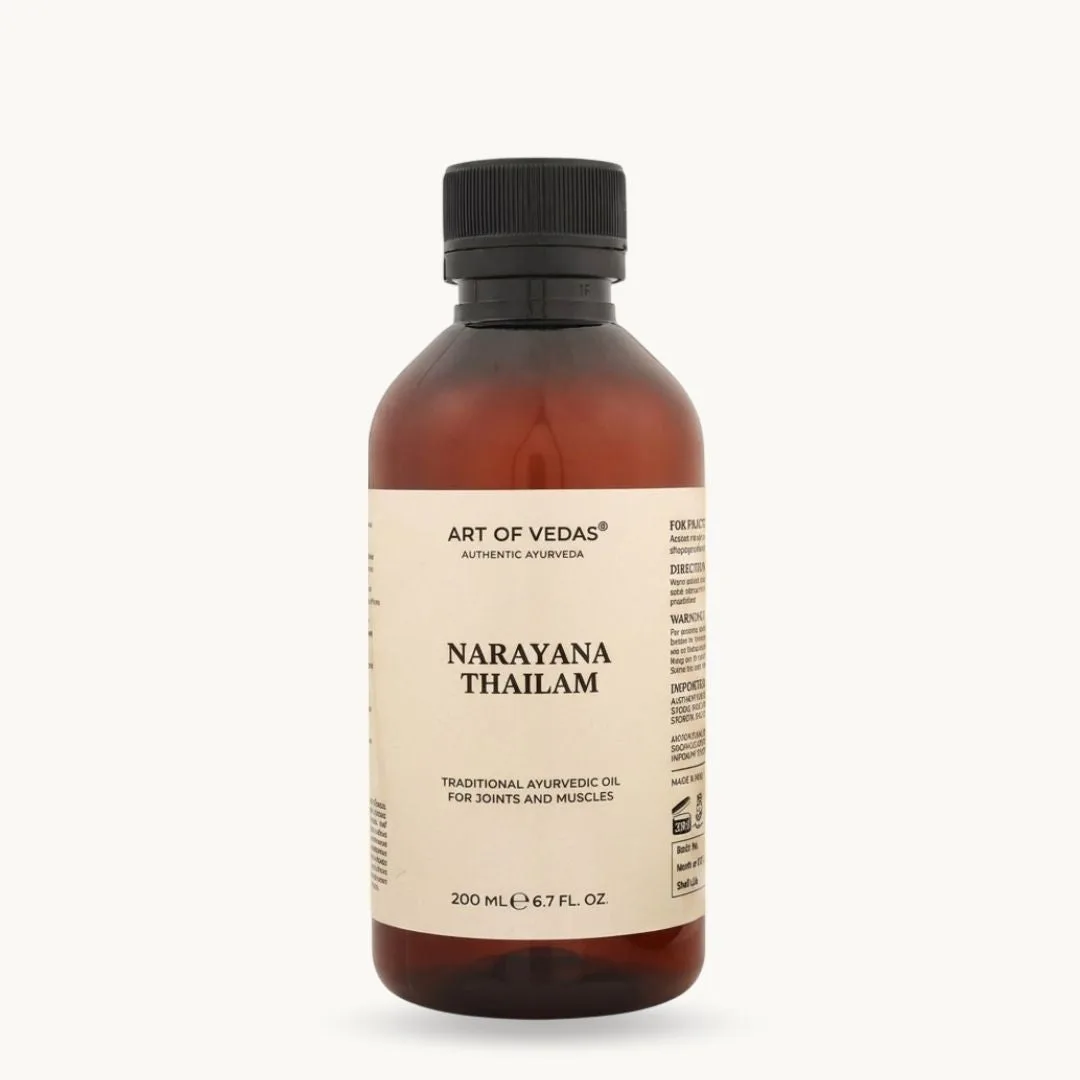
Narayana Thailam

Classical Ayurvedic Body Oil

Vata Balancing
★★★★★ 5.0 · Based on 1 review
£18.00

Narayana Thailam is a classical Vata-pacifying medicated oil, warming in character, composed to work across both the surface muscles and the body's deeper framework.


Net content200ML
Shipping is shown after you choose your delivery country at checkout
Ingredients

Asparagus Racemosus (Shatavari) Root Powder, Sesamum Indicum (Sesame) Seed Oil, Aegle Marmelos (Bael) Fruit Extract, Premna Corymbosa (Premna) Root Extract, Oroxylum Indicum (Indian Trumpet) Root Extract, Stereospermum Colais (Stereospermum) Root Extract, Erythrina Variegata (Indian Coral) Bark Extract, Paederia Foetida (Skunkvine) Whole Plant Extract, Withania Somnifera (Ashwagandha) Root Extract, Solanum Indicum (Indian Nightshade) Root Extract, Solanum Xanthocarpum (Yellow-Fruit Nightshade) Whole Plant Extract, Sida Cordifolia (Bala) Root Extract, Abutilon Indicum (Indian Mallow) Root Extract, Tribulus Terrestris (Gokshura) Fruit Extract, Boerhaavia Diffusa (Punarnava) Root Extract, Anethum Sowa (Indian Dill) Seed Powder, Cedrus Deodara (Deodar Cedar) Wood Powder, Parmelia Perlata (Stone Flower) Thallus Powder, Elettaria Cardamomum (Cardamom) Seed Powder, Pseudarthria Viscida (Pseudarthria) Root Powder, Desmodium Gangeticum (Salparni) Root Powder, Vigna Pilosa (Wild Mung) Seed Powder, Vigna Radiata (Mung Bean) Seed Powder, Alpinia Galanga (Galangal) Rhizome Powder, Withania Somnifera (Ashwagandha) Root Powder, Sodium Chloride, Boerhaavia Diffusa (Punarnava) Root Powder, Limonene, Linalool, Carvone

Narayana Thailam Ayurvedic ritual detail by Art of Vedas

Why Use Narayana Thailam?

Long revered within the Ayurvedic tradition, it is most often chosen to support comfortable, easeful movement and to nourish the structural seat of Vata.

Traditionally suited for:

  • Daily Abhyanga practice
  • Vata-predominant constitution
  • Cooler seasons, when warmth is most welcome
  • Supporting comfortable, easeful movement

How to use

For Abhyanga (full body massage)

  1. Warm the oil by standing the bottle in warm water for a few minutes.
  2. Apply generously to the whole body.
  3. Use long strokes along the limbs and circular motions around the joints.
  4. Massage the abdomen gently in a clockwise direction.
  5. Include the scalp, ears and soles of the feet.
  6. Allow 15 to 20 minutes for the oil to absorb.
  7. Follow with a warm shower or bath.

For targeted use

Apply a small amount to the chosen area and massage gently until absorbed.

Recommended frequency

Daily use is the traditional practice. For maintenance, use two to three times a week.

Important

  • For external use only.
  • Warm gently, do not microwave.
  • Take care in the shower, as oil can make surfaces slippery.

Classical reference

The oil is also referenced in Sahasrayogam, a classical text containing thousands of Ayurvedic formulations, and is included in the Ayurvedic Formulary of India (AFI), the official government compendium of standardized Ayurvedic preparations.

Notably, Narayana Thailam is considered the parent formulation from which the more elaborate Mahanarayana Thailam later evolved through the addition of more herbs.

Sanskrit Name and Etymology

Sanskrit: नारायण तैलम् (Nārāyaṇa Tailam)

The name combines:

  • Nārāyaṇa: A name of Lord Vishnu, the preserver deity in Hindu tradition, signifying the oil's preserving and protective qualities
  • Taila/Thailam: Medicated oil

The divine name reflects the high regard in which this formulation has been held, suggesting therapeutic power of the highest order.

Narayana Thailam is classified as:

  • Vatahara Thailam - Vata-pacifying oil
  • Balya - Strength-promoting
  • Brimhana - Nourishing, building
  • Bahya Prayoga - External application
  • Abhyantara Prayoga - Internal use (under practitioner guidance only)
Ayurvedic Pharmacology (Dravyaguna)


Rasa (Taste):
Predominantly Tikta (bitter), Kashaya (astringent), Madhura (sweet)


Guna (Qualities):
Snigdha (unctuous), Guru (heavy), Ushna (warming)


Virya (Potency):
Ushna (warm), balanced by cooling herbs like Shatavari and Shaileyaka


Vipaka (Post-digestive effect):
Madhura (sweet)

Dosha Action:

  • Vata Shamaka (strongly pacifies Vata) - Primary action
  • Kapha Shamaka (mildly pacifies Kapha) - Secondary action
  • Generally neutral to mildly aggravating for Pitta when used externally in moderation
Karma (Actions)
  • Vatahara - Pacifies Vata dosha
  • Vedanasthapana - Promotes comfort and ease
  • Balya - Promotes strength
  • Brimhana - Nourishes and builds tissues
  • Srotoshodhana - Supports channel clarity
Dhatu (Tissue) Affinity

Narayana Thailam has particular affinity for:

  • Mamsa Dhatu - Muscle tissue
  • Asthi Dhatu - Bone tissue
  • Majja Dhatu - Nerve tissue and marrow
Panchakarma Applications

In traditional Ayurvedic Panchakarma therapy, Narayana Thailam is used for:

  • Abhyanga - Therapeutic oil massage
  • Matra Vasti - Oil enema therapy (50ml daily, 7-14 days)
  • Nasya - Nasal administration (8 drops per nostril)
  • Shirovasti - Head oil retention therapy
  • Shirodhara - Continuous oil stream on forehead
  • Kati Vasti - Lower back oil pool therapy

Note: These Panchakarma applications should only be performed by or under the supervision of qualified Ayurvedic practitioners.

Learn more about Narayana Thailam

What is Narayana Thailam?

Narayana Thailam is a classical Ayurvedic body oil prepared from a blend of herbs in a sesame oil base, documented in the Bhaishajya Ratnavali. Art of Vedas offers Narayana Thailam as a warming oil for Abhyanga of the muscles and joints.

What is Narayana Thailam used for?

Narayana Thailam is traditionally used for massage of the muscles and joints. It is valued in Ayurveda for balancing Vata and for a strengthening, warming ritual that supports the body's ease of movement.

How do I use Narayana Thailam?

Warm the Narayana Thailam and massage it into the muscles and joints with long strokes along the limbs and circular motions around the joints. Allow it to absorb before a warm bath. For external use.

Which Dosha is Narayana Thailam best for?

Narayana Thailam is traditionally considered best for Vata, the Dosha associated with the muscles, the nervous system and movement. Its warm sesame base suits the Vata season.

Can I use Narayana Thailam every day?

Yes. A daily Abhyanga with Narayana Thailam is part of Dinacharya, the classical daily routine, and is especially welcome during the cooler Vata months.

Is Narayana Thailam good for the muscles?

Narayana Thailam is traditionally valued in Ayurveda for nourishing and strengthening the muscles. A regular warm massage is a classical way to keep the body feeling strong and supple. For external use.

Can Narayana Thailam be used for a full-body massage?

Yes. Narayana Thailam is a warming full-body Abhyanga oil. Apply it from the scalp downward with long strokes, giving attention to the muscles and joints, then allow it to absorb before bathing.

How is Narayana Thailam different from Mahanarayana Thailam?

Both are classical Vata oils for Abhyanga. Narayana Thailam is a traditional oil for the muscles and joints, while Mahanarayana Thailam is the larger, richer formulation often chosen for more focused joint and muscle massage.

What are the ingredients in Narayana Thailam, and how should it be stored?

Narayana Thailam is prepared in a sesame oil base with a classical blend of supporting herbs, without synthetic fragrance or colour. Store in a cool, dry place away from sunlight, and warm gently before use if it thickens.

From our customers

Customer reviews

★★★★★5.0Based on 1 review
★★★★★Verified buyer

Pain staying away :)

I've started to use this product with my clients. the feedback has been wonderful there has been improvement in the areas of pain, one patient had a very sore lower back which was proving difficult has applied this oil daily and notices the benefits and its really helping, its a wonderful addition to my practise thank you

aingealIreland