In brief: Ashwagandha powder tastes bitter and sweet, with a strong, earthy smell; Ayurveda records its Rasa as Tikta (bitter) and Madhura (sweet). Ashwagandha is the root of Withania somnifera, a Rasayana of the classical tradition, classically associated with Vata. The Charaka Samhita describes the dried root (Mula) ground to a Churna and taken in a warm drink with honey, traditionally in the evening. Today it is sold as a root powder and as capsules. This guide compares the two forms, the classical carriers and the practical points of taste and routine. Follow the label and ask a qualified Ayurvedic practitioner what suits you.
Ashwagandha Powder vs Capsule: Which Form Works Better and Why

This article is part of our Ashwagandha: The Classical Ayurvedic Rasayana for Strength and Vitality guide series.
The information in this article is provided for educational purposes and reflects traditional Ayurvedic knowledge. It is not intended as medical advice and should not replace consultation with a qualified healthcare professional.
Classical Ayurveda used ashwagandha (Withania somnifera) as a Churna - ashwagandha en poudre mixed with warm water before sleep - for thousands of years. Modern products offer ashwagandha gelule, standardised KSM-66 or Sensoril extracts, liquid tinctures and even gummies. The question of which form is better is genuinely worth addressing, because the answer is not simply "capsules are more convenient and therefore fine." The preparation form in Ayurveda was not incidental. It was part of the therapy.
Searches for ashwagandha en poudre, poudre ashwagandha, ashwagandha gelule and gélule ashwagandha in France alone reflect tens of thousands of monthly queries from people trying to make this exact choice. This guide clarifies what the classical texts say about preparation form, what modern research shows about the different preparations, and how to choose intelligently given your actual circumstances.
What the Classical Texts Say About Ashwagandha Preparation Form
The Charaka Samhita describes the primary ashwagandha preparation as follows: the dried root (Mula) is powdered and taken with Ksheera (warm water), Sarpi (clarified butter) and Madhu (honey) in appropriate proportions. This combination is not arbitrary. Each carrier substance (Anupana) serves a specific function in the classical model. warm water is considered the ideal vehicle for fat-soluble and oil-soluble compounds, driving nourishment into the deep tissues. Clarified butter enhances this fat-soluble transport and adds its own Vata-calming and tissue-building properties. Honey is considered in classical Ayurveda to act as a Yogavahi - a carrier that enhances the penetration of whatever it accompanies into the channels of the body.
The Ashtanga Hridayam, Chikitsa Sthana, describes ashwagandha Churna preparations as among the most important for building strength, supporting reproductive vitality and calming Vata in the nervous system. The ashwagandha poudre bienfaits in the classical account are intimately connected to this preparation method: not just what the herb contains, but how it interacts with the digestive process when taken in the classical way.
A capsule bypasses this Anupana interaction. The capsule shell dissolves in the stomach, releasing the powder without the sensory engagement of taste, without the warm liquid carrier, and without the conscious ritual that classical Ayurveda considered part of the therapeutic act. This does not make capsules ineffective. But it does make them a simplified version of the classical preparation.
Ashwagandha en Poudre: Advantages and Practical Considerations
Poudre ashwagandha - whole root powder - is the form that most closely reflects classical use. Its advantages are several. First, it allows flexible dosing: you can precisely adjust the quantity based on your response, which is important when calibrating to your individual constitution and tolerance. The classical texts specify different doses for different constitutions and health states, and this flexibility is only possible with powder.
Second, ashwagandha poudre bienfaits are potentially enhanced by the Anupana interaction. Taken in warm water with a small amount of honey or ghee, the fat-soluble compounds in ashwagandha root - including the withanolides that are the subject of most modern research - are presented to the digestive system in an environment that classical physicians understood would maximise their uptake and delivery to the tissues. Modern pharmacokinetics supports this intuition: fat-soluble compounds generally have better absorption with food containing fat.
Third, the taste and sensory experience of ashwagandha powder are themselves informative. The classical Rasa (taste) of ashwagandha - bitter (Tikta) and sweet (Madhura), with an earthy, distinctive smell - is considered part of its therapeutic signal in Ayurveda. Taste triggers digestive preparation in the classical model. A capsule bypasses this entirely.
The practical disadvantages are also real: the taste of raw ashwagandha powder is strong and takes some getting used to. Preparation requires a few minutes each time. For travel or inconsistent routines, powder is less convenient than a capsule you can take anywhere. Ashwagandha poudre bienfaits notwithstanding, the most important quality criterion for any supplement is that you actually take it consistently - and powder requires more commitment than capsules for most people.
Ashwagandha Gelule: The Modern Compromise
Ashwagandha gelule - capsules - offer one primary advantage that often outweighs all others: consistency. A capsule is tasteless, requires no preparation, and can be taken in thirty seconds with a glass of water anywhere. For people with busy schedules, travel demands or simply an aversion to the taste of ashwagandha powder, capsules are what enables daily use - and daily consistency over weeks and months is the operative variable for Rasayana herbs.
The quality question for gélule ashwagandha is the capsule's contents. There are three meaningful categories: whole root powder in a capsule (essentially the same material as loose powder, just encapsulated), standardised root extract (a concentrated fraction with defined withanolide content), and full-spectrum extract (a more complete extract retaining a broader range of compounds). From a classical perspective, whole root powder in a capsule is the most faithful to traditional use, while standardised extracts are more aligned with the pharmaceutical model - useful for specific research contexts but a departure from classical whole-plant philosophy.
Discover Art of Vedas Ashwagandha
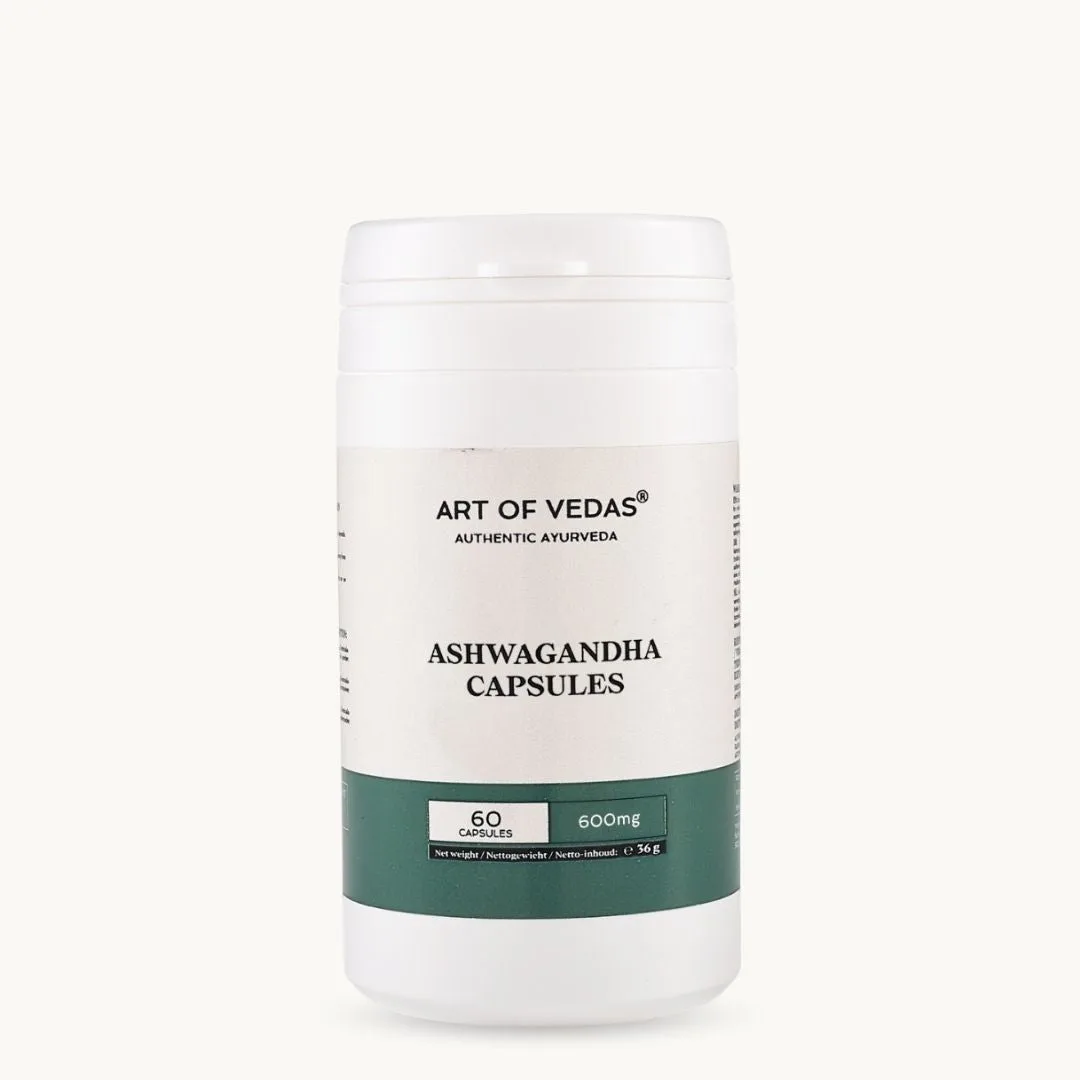
Art of Vedas offers Ashwagandha Capsules containing whole root powder in the classical Churna tradition - not a standardised extract stripped of its full plant complexity. For those who prefer to use the powder directly in warm water as the classical texts describe, the same whole root material is available in powder form. The complete ashwagandha bienfaits guide covers the full classical and contemporary context of this herb. For broader understanding of how ashwagandha fits within the Rasayana tradition alongside Triphala, Guduchi and Brahmi, the compléments santé Ayurvedic guide provides the full classical framework. The Art of Vedas supplements collection brings together the core classical herbs in genuine traditional form.
Frequently asked questions about Ashwagandha
What does Ashwagandha powder taste like? Ashwagandha powder tastes bitter and sweet, which Ayurveda records as the Rasa Tikta and Madhura, and it has a strong, earthy smell. The taste is distinctive and takes some getting used to. In the classical view the taste belongs to the character of the herb, which is one reason the tradition took Ashwagandha as a powder.
Ashwagandha powder or capsule: which is better? Neither form is better in every case. Ashwagandha powder is closest to classical use and can be taken in a warm carrier in the traditional way. Capsules hold the same root powder in a fixed amount, with no taste and nothing to prepare. The form you will take steadily, as the label directs, is the practical choice.
Are Ashwagandha capsules the same as the powder? Art of Vedas Ashwagandha Capsules declare Withania somnifera root powder in a vegetarian capsule, so they contain whole root powder, the same kind of material as the loose Ashwagandha Powder, only encapsulated. They are not a standardised extract. The difference between the two forms lies in the taste, the carrier and the routine, not in the plant.
What is Ashwagandha in Ayurveda? Ashwagandha is the root of Withania somnifera, used in Ayurveda as a Churna, a fine herbal powder. It is counted among the Rasayana herbs of the classical tradition, its Rasa is bitter and sweet, and it is classically associated with Vata. The Charaka Samhita and the Ashtanga Hridayam both describe Ashwagandha Churna preparations.
How is Ashwagandha powder traditionally taken? The Charaka Samhita describes Ashwagandha root powder taken in a warm drink with Madhu (honey) in suitable proportions. The drink should be warm rather than hot, comfortable to drink straight away. Today it is most simply stirred into warm water, with the honey added once the water has cooled a little.
When is Ashwagandha traditionally taken? The Charaka Samhita names the evening, before sleep, as the classical time for Ashwagandha Churna in a warm carrier. Some modern products suggest the morning instead. The right time depends on the individual constitution and daily routine, so follow the label and ask a qualified Ayurvedic practitioner what suits you.
What is the difference between Ashwagandha root powder and an extract? Ashwagandha root powder is the whole dried root, ground, as classical Ayurveda used it. A standardised extract is a concentrated fraction of the root with a defined content of selected compounds. From the classical point of view, whole root powder, loose or in a capsule, is the form closest to traditional use; an extract follows a modern model.
Can Ashwagandha be taken in pregnancy, by children or with medication? Ask your doctor or a qualified Ayurvedic practitioner first. Ashwagandha powder and capsules are sold in Europe as food supplements, so follow the serving stated on the label and do not exceed it. A practitioner can also advise which form and which carrier suit your constitution.
Is ashwagandha en poudre more effective than ashwagandha gelule?
The classical Ayurvedic answer is that ashwagandha en poudre taken with appropriate Anupana (honey, ghee) represents the most complete expression of the herb's therapeutic potential, because the preparation method is itself part of the therapy. Modern research has found clinically meaningful effects from both whole root powder and standardised extracts in capsule form, so the question of whether one is definitively more effective is not fully resolved. The practical answer for most people is: the form you will take consistently every day for weeks and months is the more effective form for you. If poudre ashwagandha prepared with warm water at night suits your routine and you find the taste acceptable, it is the classical choice. If capsules are what enable daily consistency, they are the pragmatic choice.
What is the correct Anupana (carrier) for ashwagandha poudre?
The Charaka Samhita specifies warm water (Ksheera) as the primary Anupana for ashwagandha Churna, with the addition of clarified butter (Ghrita) and honey (Madhu) for enhanced effect. warm water is considered ideal because it is both nourishing and an excellent carrier for fat-soluble compounds, supporting the delivery of ashwagandha's active constituents to the deep tissues. For those who do not use dairy, warm plant-based milks - particularly almond or oat milk - are a practical alternative, though classical texts do not specifically address these. The temperature should be warm rather than hot: the classical texts recommend consuming preparations at a temperature comfortable to drink immediately. Taken before sleep is the classical timing, aligning with the body's natural tissue-building processes during night rest.
What dose of ashwagandha gelule or poudre ashwagandha should I take?
Classical Ayurvedic texts typically reference ashwagandha root powder in doses of three to six grams daily (approximately one to two teaspoons of powder or two to four capsules of 750mg each). Starting at the lower end - around three grams - and assessing after two to three weeks before increasing is the classical gradual approach. For standardised extracts (KSM-66, Sensoril), the research-supported dose is typically 300 to 600mg daily of the extract. Because extracts are concentrated relative to whole powder, these doses are not directly comparable. The most important rule is consistency: three grams of whole root powder taken every day for three months is more useful than six grams taken inconsistently for three weeks.
When is the best time to take ashwagandha en poudre or ashwagandha gelule?
The Charaka Samhita specifies evening use - before sleep - as the classical timing for ashwagandha Churna taken in warm water. This aligns with the herb's Vata-calming, sleep-supporting and tissue-building properties: the body's Rasayana processes (tissue repair and nourishment) are most active during sleep, and providing ashwagandha in the evening ensures its supportive compounds are available during this rebuilding phase. Some modern products and practitioners recommend morning use, particularly for energy and physical performance applications. Both approaches have merit depending on the individual's constitution and goals. For sleep quality improvement and nervous system calming - the most common applications in European contexts - evening use before sleep in warm water remains the classical recommendation.