Tulsi in Ayurveda: Classical Properties of Holy Basil
Few plants hold as central a place in Indian culture, daily life, and classical medicine as Tulsi (Ocimum tenuiflorum) - known in English as Holy Basil. Revered in the Indian household as a sacred plant, Tulsi has been growing in courtyards and temples across the subcontinent for thousands of years. In the classical Ayurvedic tradition, this cultural centrality has a direct parallel: Tulsi is among the most consistently described and widely applied herbs in the entire pharmacopoeia.
Unlike some herbs whose classical applications are narrow and specific, Tulsi's classical profile is remarkably broad - described across the Charaka Samhita, Ashtanga Hridayam, Bhavaprakasha Nighantu, and numerous regional classical texts with a range of applications spanning the respiratory system, the digestive system, the nervous system, and the skin.
Tulsi in the Classical Texts
The Bhavaprakasha Nighantu - one of the most comprehensive classical Ayurvedic materia medica texts - provides an extensive description of Tulsi, noting two primary varieties in classical use: Shyama Tulsi (dark-leafed, also called Krishna Tulsi) and Rama Tulsi (lighter green, sometimes called Shri Tulsi or Vana Tulsi). Both are described as therapeutically valuable; Shyama Tulsi is generally considered the more medicinally potent in the classical tradition, while Rama Tulsi is more commonly cultivated and used as a daily food and beverage herb.
In Ayurvedic pharmacology, Tulsi is characterised as:
-
Rasa (taste): Katu (pungent), Tikta (bitter)
-
Virya (potency): Ushna (warming)
-
Vipaka (post-digestive effect): Katu (pungent)
-
Guna (qualities): Laghu (light), Ruksha (dry), Tikshna (sharp/penetrating)
-
Dosha effect: Vata-Kapha-shamana - primarily addressing Kapha and cold Vata; can increase Pitta in excess
The Ashtanga Hridayam describes Tulsi as Kasahara, Shwasahara, and Krimighna - placing it squarely within the classical category of herbs for the respiratory system and Pranavaha Srotas (the respiratory channels).
Tulsi and the Pranavaha Srotas
In classical Ayurvedic anatomy, the Pranavaha Srotas - the channels governing the movement of Prana (vital breath) throughout the body - are rooted in the heart and the gastrointestinal tract, and their functioning depends directly on the clarity and balance of Vata and Kapha in the chest and respiratory passages. Kapha congestion in these channels is the classical understanding of the most common respiratory disturbances - heaviness, congestion, difficulty with smooth breathing, and accumulation of mucus.
Tulsi's warming, penetrating, Kapha-clearing, and Krimighna properties make it a primary classical herb for supporting the clarity and health of these channels. In classical practice, Tulsi is used both in acute situations (fresh leaf juice, decoctions) and as a daily tonic for maintaining the health of the respiratory channels through the seasons - particularly in autumn and winter when Kapha and Vata accumulation is classically most pronounced.
Tulsi as a Dinacharya Herb
One of Tulsi's distinctive classical roles that separates it from most other herbs is its integration into the daily routine (Dinacharya) as a food-herb. The classical tradition of beginning the day with a few fresh Tulsi leaves - chewed directly or made into a morning tea - reflects Tulsi's classification as both a herb and a daily tonic appropriate for regular, ongoing use.
This Dinacharya use is underpinned by Tulsi's classical profile as a Rasayana - one of the herbs that, with regular use, supports the progressive strengthening of the immune function (Vyadhikshamatva), the vitality of the tissues, and the clarity of the Pranavaha Srotas. The Bhavaprakasha Nighantu specifically describes daily Tulsi use as supporting Agni, clearing Ama, and strengthening the system against seasonal disturbances.
For the complete context of Ayurvedic daily routine, see our guide to Dinacharya.
Classical Uses of Tulsi in Ayurvedic Practice
Respiratory Support
Tulsi is the primary single herb for Pranavaha Srotas in the classical tradition. Its Kasahara, Shwasahara, and Kaphahara properties make it relevant for the full range of classical respiratory conditions - from simple seasonal congestion to chronic Kapha accumulation in the chest. In classical acute protocols, fresh Tulsi leaf juice with honey and ginger is one of the most widely described home remedies in the Ayurvedic tradition.
Digestive Support and Agni
Tulsi's pungent taste and warming potency give it Deepana and Pachana properties consistent with other warming Katu herbs. The Charaka Samhita describes Tulsi as beneficial in conditions of sluggish Agni with Kapha accumulation in the digestive channels - a common context in temperate climates and in the spring and winter seasons.
Adaptogenic and Nervine Support
The classical texts describe Tulsi as Medhya - beneficial for the mind and cognitive function - and as a nervine herb supporting the stability of the nervous system. This classical observation corresponds to the modern characterisation of Tulsi as an adaptogenic herb. In the classical framework, Tulsi's support for the nervous system is understood through its Vata-regulating and Prana-supporting action - helping to maintain the steady, grounded quality of Prana Vata that underlies mental clarity and resilience under stress.
Skin and External Use
The classical texts also describe external applications of Tulsi for skin conditions - particularly those with a Pitta-Kapha character involving congestion, reactivity, or microbial factors in the skin. Tulsi leaf paste and decoctions are classical topical preparations in this context.
Tulsi Tea: The Most Classical Daily Form
Among the modern expressions of classical Tulsi use, Tulsi tea - made from dried or fresh leaves infused in hot water - is the most direct continuation of the traditional daily practice. In Ayurvedic terms, a warm water infusion draws out the aromatic volatile oils (responsible for Tulsi's distinctive fragrance and much of its Krimighna and Pranavaha Srotas action) along with its bitter and pungent principles.
The classical Anupana (vehicle) consideration for Tulsi tea in different contexts:
-
Plain warm water: The foundational daily preparation - appropriate for all constitutions as a morning tonic
-
With honey: Enhances the Kaphahara and Krimighna action - particularly relevant for respiratory conditions
-
With dry ginger: Enhances the warming and Deepana action - particularly relevant for sluggish Agni and cold-Vata conditions
-
With cardamom: A classical combination that adds Pitta-moderating quality, making the preparation more balanced for regular use in warm seasons
Tulsi and Seasonal Practice
In classical Ayurvedic seasonal practice (Ritucharya), Tulsi has specific relevance in the seasons of greatest Kapha and Vata accumulation:
-
Autumn (Sharada): Vata season - Tulsi supports the transition, helps maintain Agni as temperatures drop, and supports Pranavaha Srotas clarity as the season of Vata accumulation begins
-
Winter (Hemanta and Shishira): Kapha building season - daily Tulsi use supports Agni, counters Kapha accumulation, and supports the respiratory channels through the coldest months
-
Spring (Vasanta): Peak Kapha season - the highest-priority period for Tulsi use, as Kapha that has accumulated over winter begins to liquefy and impact the respiratory and digestive channels
Frequently Asked Questions
What is Tulsi used for in Ayurveda?
Tulsi is used in Ayurveda primarily for its Kaphahara (Kapha-clearing), Kasahara, and Shwasahara properties, with particular classical affinity for the Pranavaha Srotas (respiratory channels). It is also used as a daily Dinacharya herb for Agni support, Ama clearing, and general Vyadhikshamatva (systemic resilience). Classical texts also describe it as Medhya - beneficial for the mind and cognitive function.
Is Tulsi suitable for all doshas?
Tulsi is primarily Vata-Kapha-shamana. Its warming, pungent qualities make it most beneficial for Kapha and cold-Vata constitutions and conditions. For Pitta-predominant constitutions, daily use of large quantities is cautioned due to its Ushna (warming) virya - moderation, combination with cooling herbs like cardamom, or limitation to seasonal use is appropriate for Pitta types in the classical framework.
Can Tulsi be taken daily?
Yes - daily Tulsi use is one of the most classical and continuous traditions in Ayurvedic daily practice. The Bhavaprakasha Nighantu and numerous classical regional texts describe regular Tulsi use as a general Rasayana and Dinacharya herb. As with all warming herbs, the quantity and accompanying preparation should be adapted to constitution and season. A simple morning Tulsi tea or a few fresh leaves is the most classical daily approach.
What is the difference between Krishna Tulsi and Rama Tulsi?
Classical Ayurvedic texts distinguish between Shyama (Krishna/dark-leafed) Tulsi and Rama (Shri/green-leafed) Tulsi. Shyama Tulsi is generally regarded as the more medicinally potent variety in the classical tradition, with higher concentration of the aromatic volatile oils responsible for its Krimighna and Pranavaha Srotas action. Rama Tulsi is more widely cultivated and more commonly used for daily tonic and culinary purposes. Both are therapeutically valuable.
How does Tulsi differ from other Ayurvedic respiratory herbs?
Tulsi's distinctive position among Ayurvedic respiratory herbs is its combination of potency with food-herb status - making it appropriate for daily preventive use in a way that more potent single-indication herbs are not. It complements Trikatu (which targets Ama and Agni more directly) and Pippali (which is more specific for chronic respiratory channel conditions) as the daily Dinacharya herb that maintains baseline Pranavaha Srotas clarity across all seasons.
Explore Tulsi at Art of Vedas
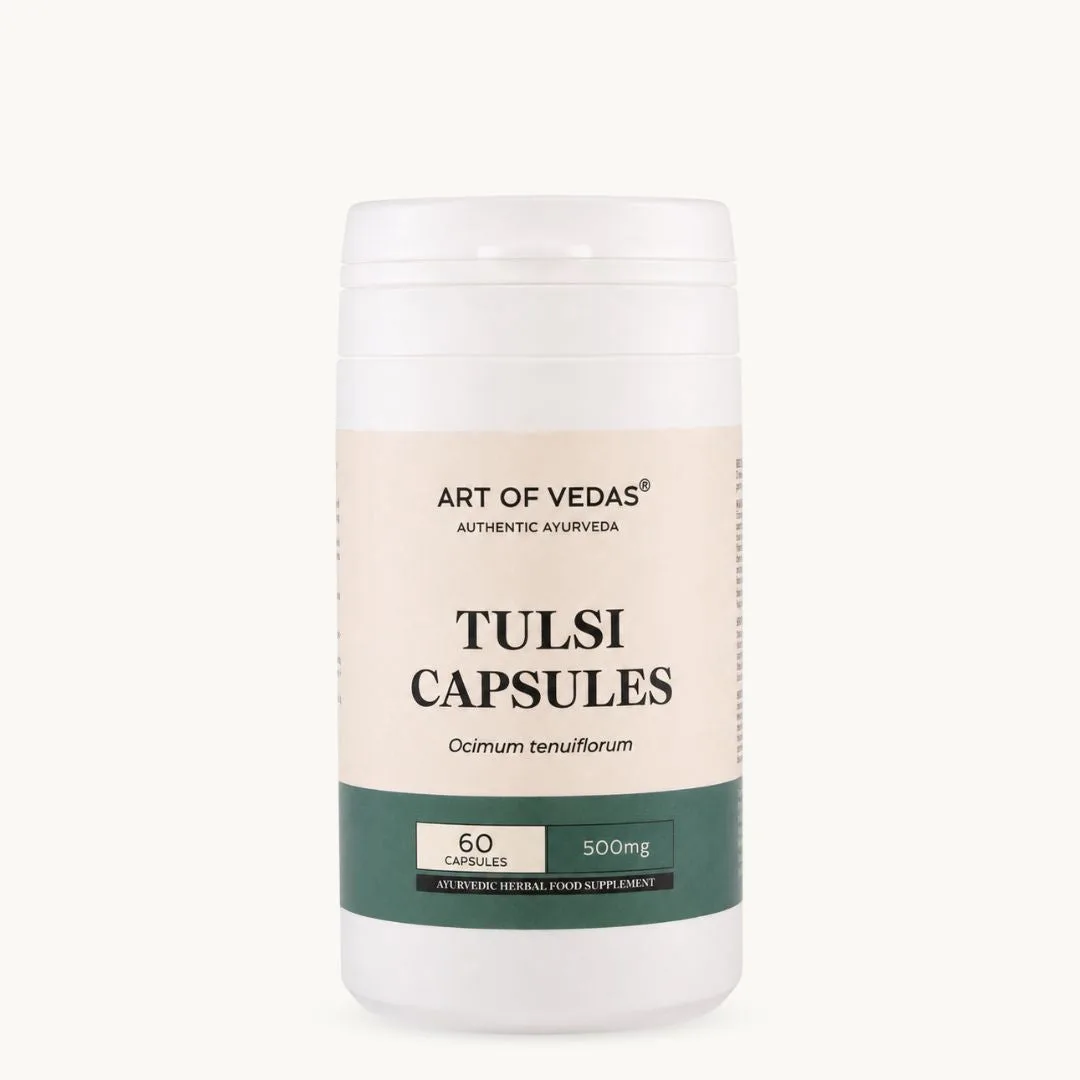
See our Tulsi Capsules at Art of Vedas. For related classical herb guides, see our Trikatu guide, our Guduchi guide, and our guide to the Ayurvedic daily routine. Browse the full classical supplement range at Art of Vedas Supplements.
This article is for informational and educational purposes only. Tulsi is a traditional Ayurvedic herb used as a food supplement. It is not a medicine and is not intended to diagnose, treat, cure, or prevent any medical condition. This product is a food supplement and not intended to replace a varied diet. Consult a qualified Ayurvedic practitioner or healthcare professional for personalised guidance.