Moringa in Ayurveda: Classical Properties of Shigru
In recent years, Moringa (Moringa oleifera) has attracted global attention as a nutrient-dense plant with a broad range of potential health benefits. What is less widely known is that Moringa has been a thoroughly documented herb in the classical Ayurvedic tradition for at least two thousand years - known as Shigru (also Sahajana or Drumstick tree) - with a well-defined pharmacological profile and specific traditional applications described in detail in the classical texts.
The modern enthusiasm for Moringa, while sometimes disconnected from its classical context, finds its roots in a tradition of careful observation that spans the Charaka Samhita, Sushruta Samhita, and Ashtanga Hridayam.
Shigru in the Classical Ayurvedic Texts
The Charaka Samhita lists Shigru among the Shophahara (anti-oedema) group of herbs - those specifically effective in conditions involving swelling and accumulation of fluid or metabolic residue in the tissues. The Ashtanga Hridayam of Vagbhata describes Shigru as a primary herb for conditions involving Kapha and Vata excess in the musculoskeletal tissues - the classical description aligning with modern interest in Moringa for joint and musculoskeletal support.
In Ayurvedic pharmacology, Shigru is characterised as:
-
Rasa (taste): Katu (pungent), Tikta (bitter)
-
Virya (potency): Ushna (warming)
-
Vipaka (post-digestive effect): Katu (pungent)
-
Guna (qualities): Laghu (light), Ruksha (dry), Tikshna (sharp/penetrating)
-
Dosha effect: Vata-Kapha-shamana primarily; can increase Pitta in excess due to its Ushna virya
Shigru's penetrating, sharp, warming qualities are what underlie its classical Shophahara (anti-oedema) and Deepana-Pachana actions - directly addressing the Kapha and Ama-related accumulations that underlie swelling and congestion in the classical framework.
Traditional Uses of Shigru in Ayurvedic Practice
Musculoskeletal and Joint Support
Shigru appears most prominently in classical texts in the context of conditions involving the musculoskeletal system - where Kapha and Vata imbalances in the Asthi (bone), Mamsa (muscle), and Meda (fat) Dhatus manifest as heaviness, congestion, and reduced mobility. The Sushruta Samhita lists Shigru among the herbs used for Vata-Kapha conditions of the joints and muscles.
Both the leaf and seed pod of Shigru are used in this context - the leaf as a food and supplement, and the seed and root bark as preparations. The warming, penetrating quality of Shigru is particularly relevant for conditions where cold and congestion are the underlying character - aligning with the classical Vata-Kapha profile.
Digestive and Agni Support
Like other pungent, warming Ayurvedic herbs, Shigru has Deepana and Pachana properties - supporting the digestive fire and clearing Ama from the gastrointestinal channels. The Charaka Samhita places Shigru in the Shophahara group specifically in the context of digestive channel congestion and accumulation (Amadosha).
Nutritional Density in the Classical Context
While the classical Ayurvedic texts do not use the language of modern nutritional science, the Bhavaprakasha Nighantu describes Shigru as Balya and Brimhana - qualities that align with modern recognition of Moringa's exceptional nutrient density. The leaf in particular is described as rich in nourishing qualities, making it a classical food-herb at the intersection of culinary and therapeutic use.
Eye Health Support
Several classical texts, including the Charaka Samhita, mention Shigru in the context of supporting the health of the eyes (Chakshushya) - attributed to its Tikta (bitter) taste and its classical action on Pitta and Rakta Dhatu, which in classical Ayurvedic understanding govern the health and clarity of the eyes through Alochaka Pitta.
Shigru and Moringa: The Classical Plant and Modern Use
The classical Ayurvedic tradition used primarily the leaf, seed pod (drumstick), root, bark, and seed oil of Shigru - with the drumstick pod being a significant part of traditional South Indian cuisine as well as classical medical practice. Modern Moringa supplements primarily use the dried leaf powder, which corresponds most closely to the classical Shigru Patra (leaf) preparations.
The classical leaf preparation is the most appropriate form for supplementation in the Ayurvedic context - it provides the broadest combination of Shigru's classical properties, it is Brimhana and Balya alongside its Deepana and Shophahara actions, and it is the least harsh preparation in terms of Pitta-aggravating potential.
Shigru in the Context of Vata-Kapha Conditions
The most classical context for Shigru in Ayurvedic practice is the management of Vata-Kapha conditions - particularly those involving the musculoskeletal system, the joints, and the digestive channels. In the classical understanding:
- Kapha provides the lubricating, nourishing, stabilising quality in the joints and tissues
- When Kapha becomes congested or combined with Ama, it becomes heavy and obstructive rather than nourishing
- Vata in excess in the joints creates instability, dryness, and erratic movement
- The combination of Kapha-Ama congestion with Vata dysregulation is the classical profile addressed by warming, penetrating, Shophahara herbs like Shigru
Practical Use: Shigru as a Daily Supplement
Moringa leaf powder as a daily supplement is the most practical modern expression of classical Shigru Patra use. Classical recommendations vary, but general guidance for supplement use:
- With warm water - the traditional vehicle for Balya and Brimhana herbs
- In the morning, as part of the Dinacharya routine - supporting the day's digestive and metabolic activity
- Combined with Trikatu or black pepper for enhanced absorption in the classical Yogavahi principle
Frequently Asked Questions
What is Moringa (Shigru) used for in Ayurveda?
Shigru is used in Ayurveda primarily as a Shophahara (addressing swelling and congestion), Deepana, and Pachana herb with particular affinity for Vata-Kapha conditions of the musculoskeletal system and digestive channels. It is also described as Balya and Chakshushya in classical texts.
Is Moringa suitable for all doshas?
Shigru is primarily Vata-Kapha-shamana. Its warming, pungent, drying qualities make it most appropriate for Vata and Kapha constitutions and conditions. For Pitta-predominant constitutions, its Ushna (warming) virya warrants moderation - smaller quantities and combination with cooling preparations are appropriate when using Shigru with elevated Pitta.
What part of the Moringa tree is used in Ayurveda?
Classical Ayurveda uses multiple parts of the Shigru tree - leaf, seed pod (drumstick), bark, root, and seed oil - each with specific traditional applications. Modern Moringa supplements primarily use the dried leaf, which corresponds to the classical Shigru Patra and is the most practical and broadly applicable form for daily supplementation.
Can Moringa be taken daily?
Classical texts describe Shigru leaf as a food-herb - used both in cooking and as a supplement - indicating its suitability for regular use. As a warming, pungent herb, daily use in large quantities by Pitta constitutions or in hot seasons warrants care. The appropriate dose and context are best established with an Ayurvedic practitioner.
Explore Moringa at Art of Vedas
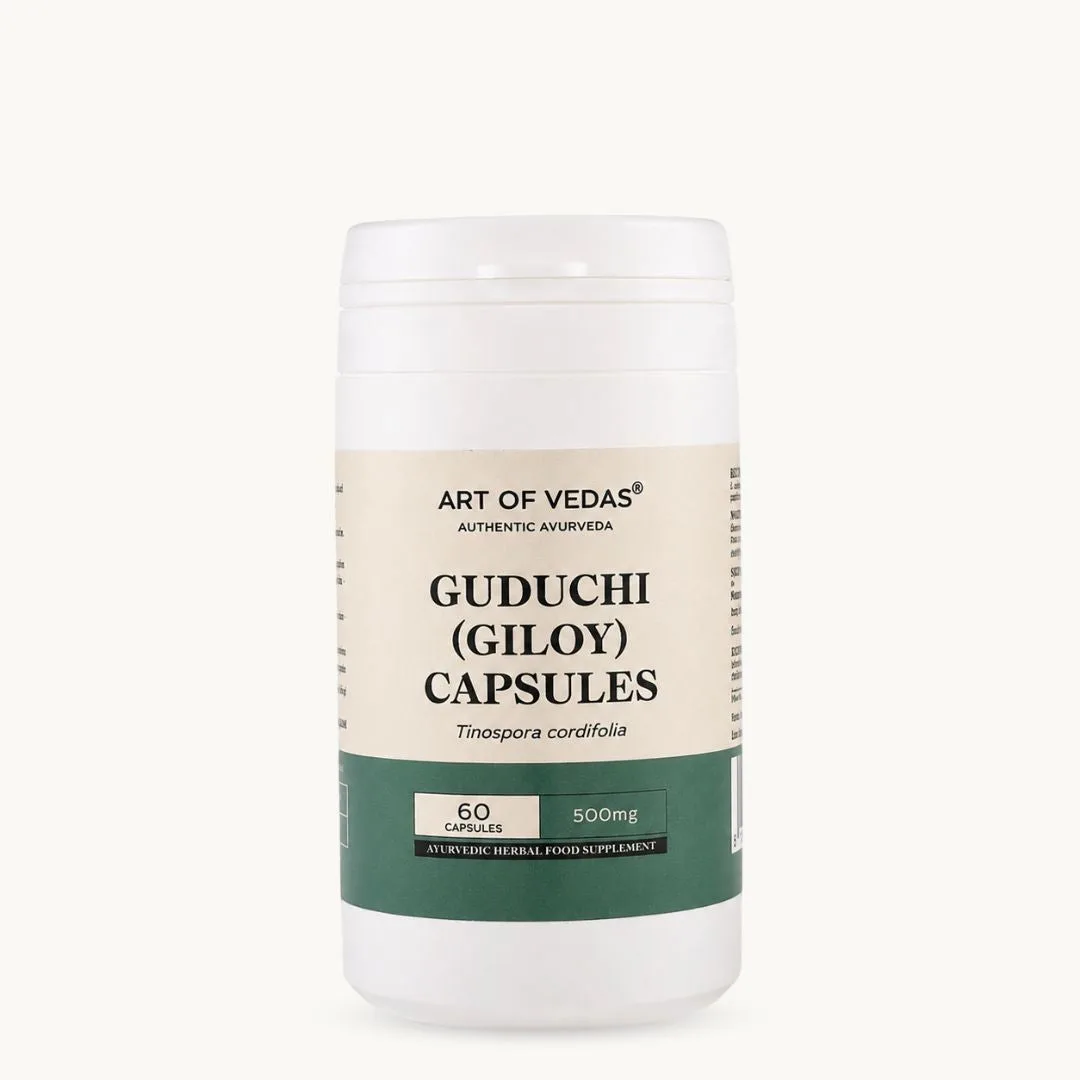
See our Moringa Capsules at Art of Vedas. For related classical herb guides, see our Trikatu guide and our Guduchi guide. Browse the full classical supplement range at Art of Vedas Supplements.
This article is for informational and educational purposes only. Moringa is a traditional Ayurvedic herb used as a food supplement. It is not a medicine and is not intended to diagnose, treat, cure, or prevent any medical condition. This product is a food supplement and not intended to replace a varied diet. Consult a qualified Ayurvedic practitioner or healthcare professional for personalised guidance.