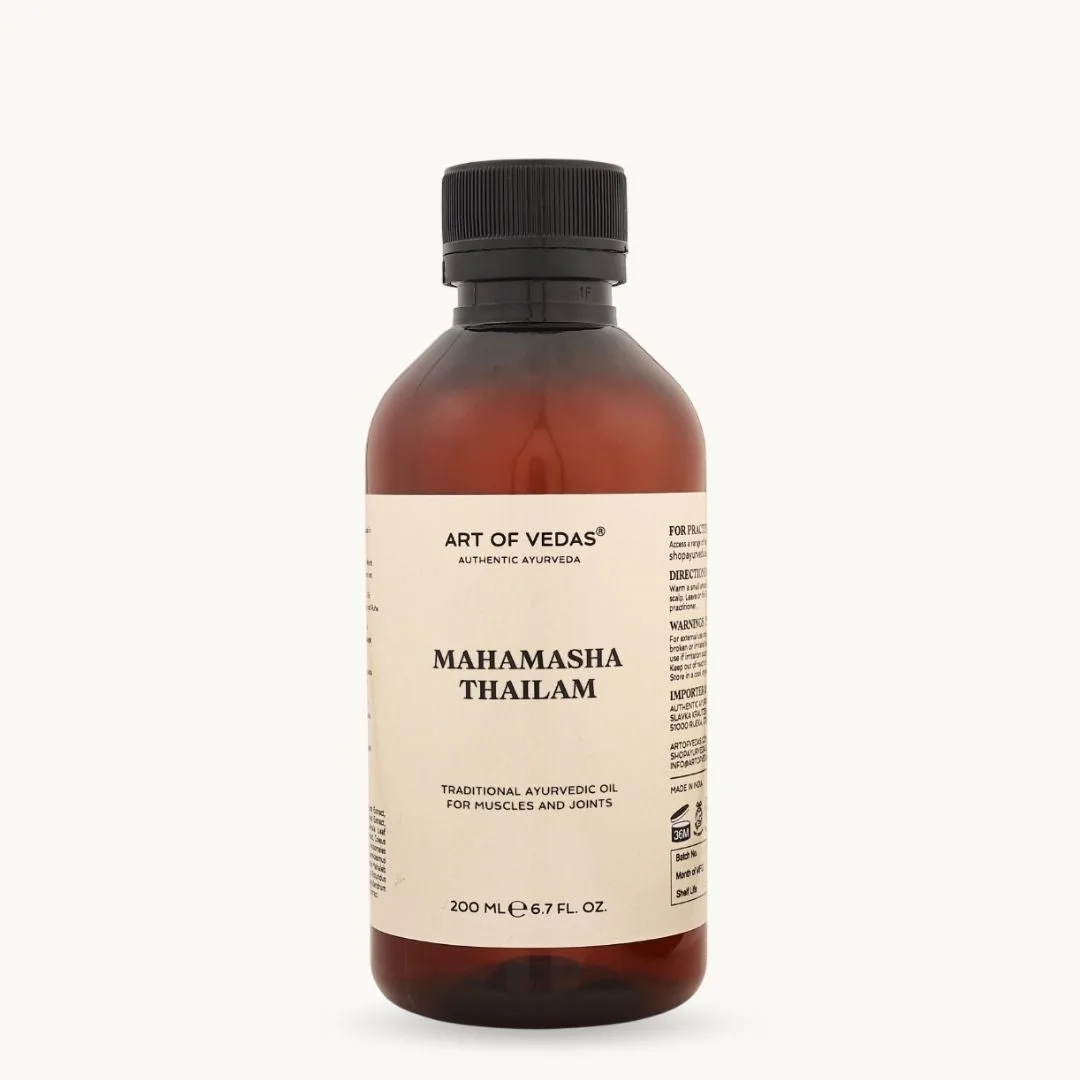
Mahamasha Thailam is one of classical Ayurveda's most specialized medicated oils, renowned for its traditional use in supporting nerve health, muscle nourishment, and Vata balance. For centuries, Ayurvedic practitioners have relied on this powerful oil to address concerns related to numbness, tingling, muscle weakness, and neurological discomfort.
What makes Mahamasha Thailam unique among Ayurvedic oils is its primary ingredient: black gram (Masha/Vigna mungo), a deeply nourishing legume that, when processed through traditional Taila Paka methods, creates an oil specifically formulated for nerve and muscle support.
At Art of Vedas, we source authentic Mahamasha Thailam prepared following classical Ayurvedic methods by traditional manufacturers who maintain the integrity of this ancient formulation. Whether you're new to Ayurvedic oils or seeking specialized support for Vata-related concerns, this comprehensive guide covers everything you need to know about Mahamasha Thailam.
Table of Contents
- What is Mahamasha Thailam?
- Ingredients and Composition
- Traditional Benefits According to Ayurveda
- How Mahamasha Thailam Works
- Uses and Applications
- How to Use Mahamasha Thailam Properly
- Dosage Guidelines
- Mahamasha Thailam vs Other Ayurvedic Oils
- Side Effects and Precautions
- Where to Buy Authentic Mahamasha Thailam
- Frequently Asked Questions
What is Mahamasha Thailam?
Mahamasha Thailam (also spelled Mahamasha Tailam or Maha Masha Thailam) is a traditional Ayurvedic medicated oil that originates from the classical texts of classical Ayurveda. The name derives from Sanskrit: "Maha" meaning great or superior, and "Masha" referring to black gram (Vigna mungo), the primary herb used in this preparation.
Alternative Spellings and Names
You may encounter this oil under several variations:
- Mahamasha Thailam (most common in South India/classical)
- Mahamasha Tailam (North Indian/Sanskrit spelling)
- Maha Masha Thailam (two-word variant)
- Mahaamaasha Thailam (some traditional manufacturers)
- Mahamasha Oil (anglicized form)
All refer to the same classical preparation.
Classical Text Reference
Mahamasha Thailam is documented in the Sahasrayogam, one of classical Ayurveda's authoritative classical texts (specifically referenced in Chapter 3, Verse 14). This text details the precise ingredients, preparation method, and traditional indications for the oil's use.
Traditional Preparation Method
Authentic Mahamasha Thailam is prepared using the classical Taila Paka (oil cooking) method, where herbs are processed with the base oil through a specific heating and cooling cycle that allows the properties of the herbs to infuse into the oil while maintaining their therapeutic potency.
The Art of Vedas Mahamasha Thailam follows this traditional preparation method, ensuring you receive an oil that maintains the integrity and effectiveness described in classical Ayurvedic texts.
Ingredients and Composition
Understanding what goes into Mahamasha Thailam helps explain its unique properties and traditional uses.
Primary Ingredients
1. Masha (Black Gram - Vigna mungo) The star ingredient, black gram is known in Ayurveda for its:
- Deeply nourishing (Brimhana) properties
- Strength-building (Balya) qualities
- Nerve-nourishing (Majja Dhatu) effects
- Vata-pacifying nature
2. Tila Taila (Sesame Oil) The base oil, sesame is chosen because it:
- Penetrates deeply into tissues
- Has a neutral heating quality suitable for Vata
- Carries properties of herbs effectively
- Is mentioned in classical texts as ideal for medicated oils
3. Dashamoola (Ten Roots) A classical Ayurvedic formula of ten roots that collectively balance Vata dosha:
Five large roots (Brihat Panchamoola):
- Bilva (Aegle marmelos)
- Agnimantha (Premna integrifolia)
- Shyonaka (Oroxylum indicum)
- Patala (Stereospermum suaveolens)
- Kashmarya (Gmelina arborea)
Five small roots (Laghu Panchamoola):
- Shalaparni (Desmodium gangeticum)
- Prishniparni (Uraria picta)
- Brihati (Solanum indicum)
- Kantakari (Solanum xanthocarpum)
- Gokshura (Tribulus terrestris)
4. Additional Herbs
Depending on the manufacturer and specific formulation variant, Mahamasha Thailam may also contain:
- Ksheera (Milk) - used in the cooking process to enhance nourishing properties
- Manjistha (Rubia cordifolia) - supports healthy circulation
- Eranda (Castor/Ricinus communis) - enhances Vata-pacifying effects
- Atmagupta (Mucuna pruriens) - traditionally used for nerve support
Important Note on Non-Vegetarian Ingredients
Traditional classical formulations of Mahamasha Thailam may contain Chaga Mamsa (goat meat) as specified in some ancient texts. This is relevant for vegetarians and vegans to know.
However, many modern manufacturers, including some whose products are available through Art of Vedas, prepare "Niramish" (vegetarian) versions that replace animal ingredients with vegetable alternatives while maintaining therapeutic effectiveness.
When purchasing Mahamasha Thailam, always check the product label or contact the manufacturer to confirm whether the specific formulation is vegetarian.
Traditional Benefits According to Ayurveda
According to classical Ayurvedic texts and traditional usage in classical Ayurveda clinics, Mahamasha Thailam is valued for its specialized benefits related to nervous system support and Vata dosha balance.
Important Disclaimer: The following are traditional uses as described in classical Ayurvedic literature and historical practice. These are not medical claims. This oil is intended for external wellness use as part of Ayurvedic self-care rituals and should not be used to treat, cure, or prevent any disease.
Neurological Support (Traditional Indications)
Mahamasha Thailam has been traditionally used in Ayurveda for:
Nerve-Related Concerns:
- Numbness and tingling sensations (traditionally applied externally to affected areas)
- Loss of sensation or reduced sensitivity
- Nerve-related discomfort and irritation
- Supporting healthy nerve function and transmission
Movement and Coordination:
- Tremors and involuntary movements (classical use in Vata disorders)
- Supporting smooth, coordinated movement
- Traditional application for conditions described in classical texts as "Kampa" (tremor-related)
Paralysis and Weakness:
- Facial palsy (traditional external application)
- Post-paralytic care (as part of comprehensive Panchakarma protocols)
- Supporting recovery of healthy movement patterns
Musculoskeletal Support (Traditional Indications)
Muscle Health:
- Muscle weakness and debilitation (traditional strengthening application)
- Supporting healthy muscle tone
- Nourishment for undernourished muscle tissue
- Muscle fatigue and exhaustion
Joint and Mobility:
- Joint stiffness and limited range of motion
- Frozen shoulder (classical indication in classical texts)
- Supporting healthy joint flexibility
- Traditional use for stiffness described as "Stambha" in Ayurveda
Bone Health:
- Supporting strong, healthy bones (through Majja Dhatu nourishment)
- Traditional use in conditions affecting bone tissue
Vata Dosha Balancing
In Ayurvedic philosophy, most of the conditions Mahamasha Thailam addresses are manifestations of Vata dosha imbalance. The oil's warming, nourishing, grounding qualities help:
- Pacify excess Vata (Vata Shamana)
- Nourish deficient tissues (Brimhana)
- Restore proper Vata flow in the body
- Ground scattered, mobile Vata energy
Traditional Use in Specific Conditions
Classical texts and traditional Ayurvedic practice mention Mahamasha Thailam for:
- Gridhrasi (sciatica-like symptoms)
- Pakshaghata (hemiplegia)
- Ardita (facial paralysis)
- Kampavata (tremor disorders)
- Sandhivata (joint disorders)
- Majjagata Vata (Vata affecting bone marrow/nerves)
Again, these are traditional Ayurvedic condition names, not modern medical diagnoses.
How Mahamasha Thailam Works
From an Ayurvedic perspective, Mahamasha Thailam works through several mechanisms:
1. Vata Pacification (Vata Shamana)
The oil's warm, heavy, oily qualities directly oppose Vata's cold, light, dry nature. When applied externally and massaged into the skin:
- The warmth counters Vata's cold quality
- The oil's heaviness grounds Vata's mobile, scattered energy
- The oleation (oiliness) moisturizes and soothes Vata's dryness
2. Tissue Nourishment (Brimhana)
Black gram (Masha) is considered one of Ayurveda's most nourishing substances, particularly for:
- Majja Dhatu (nerve tissue/bone marrow)
- Mamsa Dhatu (muscle tissue)
- Asthi Dhatu (bone tissue)
When processed into oil and applied externally, these nourishing properties penetrate the skin and support deeper tissue health.
3. Channel Opening (Srotoshodhana)
The combination of warming herbs and proper massage technique helps:
- Open blocked channels (Srotas) where Vata has become stuck
- Improve circulation of nutrients to tissues
- Support removal of cellular waste products
4. Strength Building (Balya)
Regular use of Mahamasha Thailam, particularly in Abhyanga (self-massage) practice, traditionally:
- Builds physical strength
- Improves tissue resilience
- Enhances endurance
- Supports healthy recovery after physical exertion
Uses and Applications
Mahamasha Thailam can be used in several ways depending on your needs and the guidance of an Ayurvedic practitioner.
External Application (Primary Use)
Full Body Massage (Sarvanga Abhyanga):
- Daily self-massage as part of Dinacharya (Ayurvedic daily routine)
- Particularly beneficial for those with Vata constitution or imbalance
- Best performed in the morning before bathing
Local Application (Sthanika Abhyanga):
- Applied to specific areas of concern
- Focused massage on joints, muscles, or areas with numbness/tingling
- Can be used on the spine for nerve support
Specific Body Areas:
- Spine and back (nerve pathway support)
- Joints (knees, elbows, shoulders)
- Feet and hands (for tingling/numbness)
- Face (for facial nerve support, always use gently)
Panchakarma Applications
In professional Ayurvedic clinical settings, Mahamasha Thailam may be used as part of Panchakarma procedures:
Snehana (Oleation Therapy):
- External oil application before main Panchakarma treatments
- Prepares the body for deeper detoxification
Basti (Medicated Enema):
- As a component of Anuvasana Basti (oil enema)
- Particularly for neurological Vata concerns
- Only under qualified practitioner supervision
Kati Basti (Localized Oil Pooling):
- Oil pooled on the lower back for spine/nerve support
- Typically performed by trained Ayurvedic therapists
Internal Use (Only With Practitioner Guidance)
Some classical texts mention internal use of Mahamasha Thailam:
- 5-10 drops with warm water
- Taken on empty stomach
Important: Internal use should ONLY be done under the guidance of a qualified Ayurvedic practitioner who can assess your constitution, any contraindications, and proper dosing for your individual needs.
How to Use Mahamasha Thailam Properly
To get the maximum benefit from Mahamasha Thailam, proper application technique matters.
Step-by-Step Application Guide
Step 1: Prepare the Oil
Warm the oil to a comfortable temperature (approximately 36-40°C / 97-104°F):
- Place the bottle in a bowl of hot water for 5-10 minutes
- Test temperature on your wrist before full application
- Never microwave - this can damage the properties
Step 2: Prepare Your Environment
- Choose a warm room free from drafts
- Lay down an old towel (oil may stain)
- Ensure you have 30-45 minutes undisturbed time
- Keep a warm bath or shower ready for afterward
Step 3: Application Technique
For full body massage:
- Pour approximately 30-60ml of warm oil into your palm
- Start at the top of your head (if including scalp)
- Work systematically downward
- Use long strokes on limbs (direction toward the heart)
- Use circular motions on joints
- Apply gentle pressure - not too light, not too heavy
For local application:
- Use 10-15ml for targeted areas
- Apply to the specific joint, muscle, or body part
- Massage in circular motions for joints
- Use long strokes along muscles and limbs
- Spend 5-10 minutes on the targeted area
Step 4: Absorption Time
- Allow the oil to penetrate for 20-30 minutes
- Cover yourself with an old robe or wrap to stay warm
- Some traditions suggest resting or doing gentle stretching during this time
- Avoid cold air or drafts
Step 5: Bathing
- Take a warm (not hot) bath or shower
- Use a mild, natural soap if needed
- Some oil will remain on the skin - this is beneficial
- Pat dry gently
Best Time for Application
According to Ayurvedic Dinacharya (Daily Routine):
- Morning: Before bathing (6-8 AM) is ideal for most people
- Evening: Before dinner for deeper relaxation (if morning isn't possible)
- Avoid: Directly after eating, during fever, or when feeling unwell
Frequency of Use
- Daily: For active Vata imbalance or specific concerns
- 3-4 times per week: For maintenance and prevention
- During seasonal transitions: Especially autumn/early winter (Vata season)
- Minimum course: 4-6 weeks for traditional Ayurvedic benefits
Special Application Techniques
For Numbness/Tingling:
- Apply warm oil to affected area
- Massage gently but firmly in the direction toward the heart
- May be done 2-3 times daily for acute concerns
For Joint Stiffness:
- Focus on the joint with circular massage
- Include the muscles above and below the joint
- Gentle movement after oil application can enhance benefits
For Sleep Support:
- Apply to feet and scalp before bed
- Use gentle, soothing strokes
- Focus on relaxation rather than vigorous massage
Dosage Guidelines
External Use Dosage
Full Body Massage:
- Amount: 30-60ml (approximately 2-4 tablespoons)
- Frequency: Daily or 3-4 times weekly
- Duration: Continue for at least 4-6 weeks for traditional benefits
Local Application:
- Amount: 10-15ml (approximately 1 tablespoon)
- Frequency: 1-3 times daily for targeted concerns
- Duration: As needed, or as advised by practitioner
Internal Use Dosage (Under Practitioner Guidance Only)
If recommended by a qualified Ayurvedic practitioner:
- Amount: 5-10 drops
- Medium: Mixed with warm water
- Timing: Usually on empty stomach (morning)
- Frequency: Once or twice daily as prescribed
- Duration: As prescribed (typically 2-4 weeks courses)
Panchakarma Dosage
Dosage in clinical Panchakarma procedures varies greatly based on:
- Specific treatment protocol
- Individual constitution
- Severity of imbalance
- Overall health status
This is always determined by the treating practitioner.
Mahamasha Thailam vs Other Ayurvedic Oils
Understanding how Mahamasha Thailam differs from other popular Ayurvedic oils helps you choose the right one for your needs.
Comparison Table
| Oil | Primary Use | Energy | Best For | Dosha Effect |
|---|---|---|---|---|
| Mahamasha Thailam | Nerves & muscles, numbness | Warming, nourishing | Nerve pain, tremors, muscle weakness, Vata imbalance | Strongly pacifies Vata |
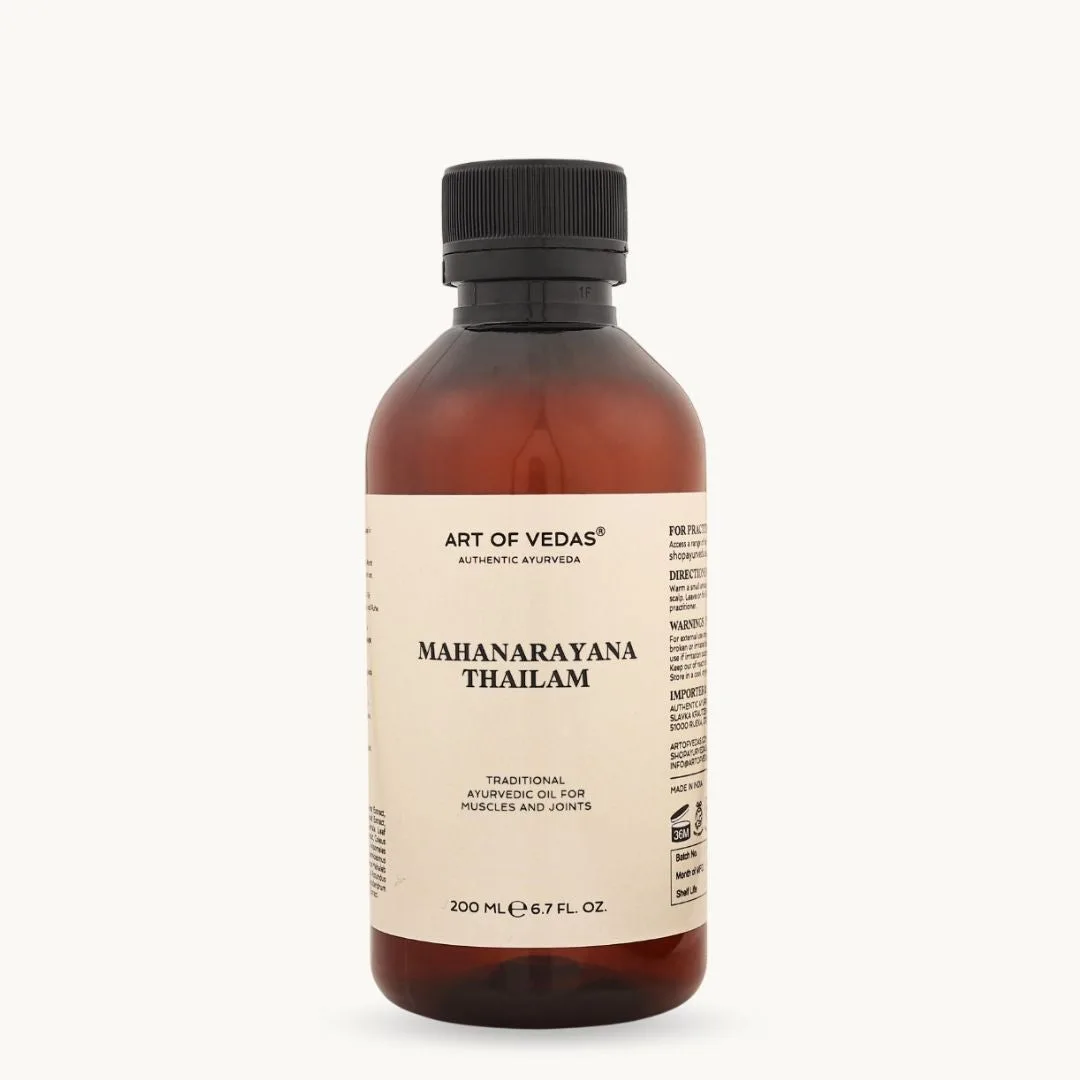
| Mahanarayana Thailam | Joints & bones, sports recovery | Warming, penetrating | Joint pain, arthritis, sports injuries, general pain | Pacifies Vata & Kapha |
| Ksheerabala Thailam | Calming, sleep, gentle nerve support | Cooling, calming | Sleep issues, anxiety, gentle Vata pacification, Pitta-related nerve issues | Pacifies Vata & Pitta |
| Dhanwantharam Thailam | Postnatal care, anti-aging, general rejuvenation | Balancing, strengthening | After childbirth, general weakness, rejuvenation | Balances all three doshas |
When to Choose Mahamasha Thailam
Choose Mahamasha over other oils when you have:
- Numbness or tingling as a primary concern
- Nerve-related discomfort rather than joint pain
- Muscle weakness or debilitation
- Tremors or involuntary movements
- High Vata imbalance with cold, dry qualities
- Need for deep tissue nourishment rather than just lubrication
When to Choose Other Oils
Choose Mahanarayana Thailam if:
- Joint pain is your primary concern
- You have arthritis or bone-related issues
- You need sports injury recovery support
- You want a more general-purpose pain relief oil
Choose Ksheerabala Thailam if:
- Sleep disturbances are your main concern
- You have Pitta imbalance along with Vata
- You need a gentler, cooling nerve support
- You have heat sensitivity or inflammation
Choose Dhanwantharam Thailam if:
- You're in postnatal recovery
- You need general rejuvenation and anti-aging support
- You want an oil that balances all three doshas
- You have general weakness without specific nerve concerns
Can You Use Multiple Oils?
Yes, Ayurvedic oils can be used in combination:
- Alternating days: Mahamasha one day, another oil the next
- Different body parts: Mahamasha on spine/joints, another oil elsewhere
- Sequential use: One oil for a few weeks, then switch to another
Consult an Ayurvedic practitioner for personalized guidance on combining oils.
Side Effects and Precautions
Mahamasha Thailam is generally well-tolerated when used externally as directed. However, certain precautions should be observed.
Possible Side Effects
Rare but possible:
- Skin irritation or rash (especially if allergic to sesame or any ingredient)
- Increased warmth or mild burning sensation (due to heating nature)
- Temporary redness at application site
- Digestive upset if taken internally without proper guidance
Who Should Exercise Caution
Avoid or consult practitioner if you have:
- Active fever or acute infection
- Severe Pitta imbalance (heat intolerance, inflammation, skin redness)
- Active skin conditions (eczema, psoriasis) without practitioner guidance
- Pregnancy (use only under Ayurvedic practitioner supervision)
- Diabetes (generally safe externally but consult practitioner for internal use)
Important Precautions
Before First Use:
- Always perform a patch test on a small area of skin
- Wait 24 hours to check for any allergic reaction
- If any redness, itching, or irritation occurs, discontinue use
During Use:
- Do not apply to broken skin, cuts, or wounds
- Avoid direct contact with eyes, inside ears, or mucous membranes
- If oil gets in eyes, rinse immediately with milk or cool water (not plain water)
- Discontinue if any adverse reaction occurs
Storage:
- Store in a cool, dark place away from direct sunlight
- Keep tightly closed when not in use
- Keep out of reach of children
- Check expiration date on bottle
When NOT to Use Mahamasha Thailam
Avoid during:
- Acute fever or active infection
- Heavy, cloudy, or Kapha-aggravating weather (without practitioner guidance)
- Immediately after eating (wait 1-2 hours)
- Active inflammatory flare-ups (without practitioner consultation)
Pregnancy and Breastfeeding
- External use during pregnancy should only be done under Ayurvedic practitioner supervision
- Internal use is not recommended during pregnancy or breastfeeding
- Postnatal use after delivery can be beneficial but should be guided by a practitioner
Drug Interactions
While external use rarely interacts with medications, inform your healthcare provider if:
- You're taking blood thinners (oils may enhance absorption through skin)
- You're on any medications for neurological conditions
- You're undergoing any medical treatments
Where to Buy Authentic Mahamasha Thailam
What to Look for in Authentic Mahamasha Thailam
When purchasing Mahamasha Thailam, authenticity and quality matter significantly:
Traditional Preparation:
- Prepared following classical Taila Paka method
- Based on formulations from texts like Sahasrayogam or Bhaishajya Ratnavali
- Lists genuine black gram (Masha/Vigna mungo) as primary ingredient
Source and Manufacturer:
- Ideally carefully selected
- Look for GMP (Good Manufacturing Practice) certification
- Manufacturer should be transparent about ingredients and preparation
Ingredients:
- Free from synthetic additives or preservatives
- No artificial fragrances
- Sesame oil (Tila taila) as base
- Contains Dashamoola and other classical herbs
Packaging:
- Dark glass bottle (protects oil from light degradation)
- Clear labeling with batch number and manufacturing date
- Usage instructions provided
- Sealed properly
What to Avoid
Red flags that may indicate lower quality:
- Heavy discounts that seem too good to be true
- No clear ingredient list or vague labeling
- Manufacturer with no Ayurvedic credentials or history
- Plastic packaging (traditional oils should be in glass)
- No information about preparation method
Art of Vedas Mahamasha Thailam
At Art of Vedas, we source authentic Mahamasha Thailam that meets all traditional quality standards:
- Prepared by established classical Ayurvedic manufacturers
- Following classical Taila Paka preparation methods
- Made with genuine, high-quality ingredients
- Properly packaged in protective dark glass bottles
- Complete transparency about ingredients and sourcing
Our Mahamasha Thailam is the same quality used in professional Ayurvedic clinics and Panchakarma centers across Europe.
Shop Authentic Mahamasha Thailam →
European Availability
Mahamasha Thailam can be challenging to find in Europe. Art of Vedas specializes in making authentic Ayurvedic oils accessible to European customers while maintaining the traditional quality and preparation methods.
Frequently Asked Questions
1. What is Mahamasha Thailam used for in Ayurveda?
Mahamasha Thailam is traditionally used in Ayurveda for nerve support, addressing numbness and tingling, muscle weakness, tremors, joint stiffness, and Vata dosha imbalance. It's valued as a nourishing oil for neurological and musculoskeletal wellness.
2. Is Mahamasha Thailam the same as Mahamasha Tailam?
Yes, "Thailam" and "Tailam" both mean "oil" in Sanskrit/Malayalam. The spelling varies by region (South vs North India) but refers to the same classical preparation. You may also see it as "Maha Masha Thailam" (two words).
3. Can Mahamasha Thailam be used for full body massage?
Yes, Mahamasha Thailam can be used for full body Abhyanga (oil massage). It's particularly beneficial for those with Vata constitution or imbalance. Use 30-60ml of warm oil and massage for 15-20 minutes before bathing.
4. How is Mahamasha Thailam different from Mahanarayana Thailam?
While both oils pacify Vata, Mahamasha specializes in nerve and muscle nourishment (particularly for numbness, tremors, muscle weakness), while Mahanarayana focuses more on joint and bone support (arthritis, sports injuries). Mahamasha has a deeper nourishing quality; Mahanarayana has more pain-relieving properties.
5. Are there any side effects of Mahamasha Thailam?
Mahamasha Thailam is generally safe for external use. Rare side effects may include skin irritation in those allergic to sesame or other ingredients. Always do a patch test before first use. Avoid during fever or acute inflammation. Consult a practitioner if you have specific health concerns.
6. Can Mahamasha Thailam help with numbness and tingling?
According to traditional Ayurvedic usage, yes - Mahamasha Thailam is specifically valued for addressing numbness and tingling sensations. It's applied externally to affected areas with gentle massage. However, persistent numbness should always be evaluated by a healthcare provider to rule out serious conditions.
7. Is Mahamasha Thailam vegetarian?
Traditional classical formulations may contain Chaga Mamsa (goat meat). However, many modern manufacturers prepare "Niramish" (vegetarian) versions using plant-based alternatives. Always check the specific product label or contact the manufacturer to confirm whether your chosen brand is vegetarian.
8. How should I store Mahamasha Thailam?
Store in a cool, dark place away from direct sunlight and heat. Keep the bottle tightly closed when not in use. Properly stored, Mahamasha Thailam typically maintains quality for 12-24 months (check manufacturer's expiration date).
9. Can I use Mahamasha Thailam during pregnancy?
External use during pregnancy should only be done under the supervision of a qualified Ayurvedic practitioner. Internal use is not recommended during pregnancy or breastfeeding. Consult both your Ayurvedic practitioner and your healthcare provider.
10. What temperature should I warm Mahamasha Thailam to?
Warm the oil to approximately 36-40°C (97-104°F) - comfortably warm to touch but not hot. Place the bottle in a bowl of hot water for 5-10 minutes. Test on your wrist before applying. Never use a microwave as it can damage the properties.
11. How long does it take to see benefits from Mahamasha Thailam?
In traditional Ayurvedic practice, oils like Mahamasha are typically used for a minimum of 4-6 weeks to experience full benefits. Some people report feeling more grounded and relaxed after even a single use, while deeper tissue nourishment develops over consistent weeks of application.
12. Can Mahamasha Thailam be used on the face?
Yes, but with caution. For facial nerve support or facial massage, use a very small amount and apply gently. Avoid getting oil in eyes. Some prefer to use lighter oils for facial application and reserve Mahamasha for body use. Always do a patch test first on a small area of facial skin.
13. Which is better for nerve pain - Mahamasha or Ksheerabala Thailam?
It depends on your constitution and the nature of the pain. Mahamasha is warming and deeply nourishing - better for cold-type nerve pain with numbness, weakness, and Vata imbalance. Ksheerabala is cooling and calming - better for nerve pain with heat/inflammation (Pitta involvement) or nerve pain causing sleeplessness. An Ayurvedic consultation can determine which is more suitable for you.
14. Can I take Mahamasha Thailam internally?
Some classical texts mention internal use (5-10 drops with warm water), but this should ONLY be done under the direct supervision of a qualified Ayurvedic practitioner who can assess your suitability, any contraindications, and proper dosing for your individual needs.
15. Where can I buy authentic Mahamasha Thailam in Europe?
Authentic Mahamasha Thailam can be difficult to find in Europe. Art of Vedas sources genuine Mahamasha Thailam from traditional manufacturers and makes it available throughout European markets, maintaining traditional quality while ensuring regulatory compliance.
Conclusion
Mahamasha Thailam represents classical Ayurveda's deep understanding of nerve and muscle health. For those dealing with numbness, tingling, muscle weakness, tremors, or general Vata imbalance, this traditional oil offers a time-tested approach rooted in centuries of Ayurvedic wisdom.
Whether you're using Mahamasha Thailam as part of a daily Abhyanga self-care ritual, for targeted support of specific areas, or as part of a comprehensive Panchakarma protocol under practitioner guidance, the key is consistency and proper application.
At Art of Vedas, we're committed to bringing authentic, traditionally-prepared Ayurvedic oils like Mahamasha Thailam to European wellness seekers. Our Mahamasha Thailam maintains the classical preparation methods and ingredient quality that have made this oil a cornerstone of classical Ayurvedic practice for generations.
Ready to experience the nourishing benefits of authentic Mahamasha Thailam?
Shop Authentic Mahamasha Thailam →
Disclaimer: The information in this article is for educational purposes based on traditional Ayurvedic texts and practices. It is not medical advice and should not be used to diagnose, treat, cure, or prevent any disease. Mahamasha Thailam is intended for external wellness use as part of Ayurvedic self-care routines. Always consult qualified healthcare practitioners for medical concerns, and consult a qualified Ayurvedic practitioner for personalized guidance on using Ayurvedic oils.