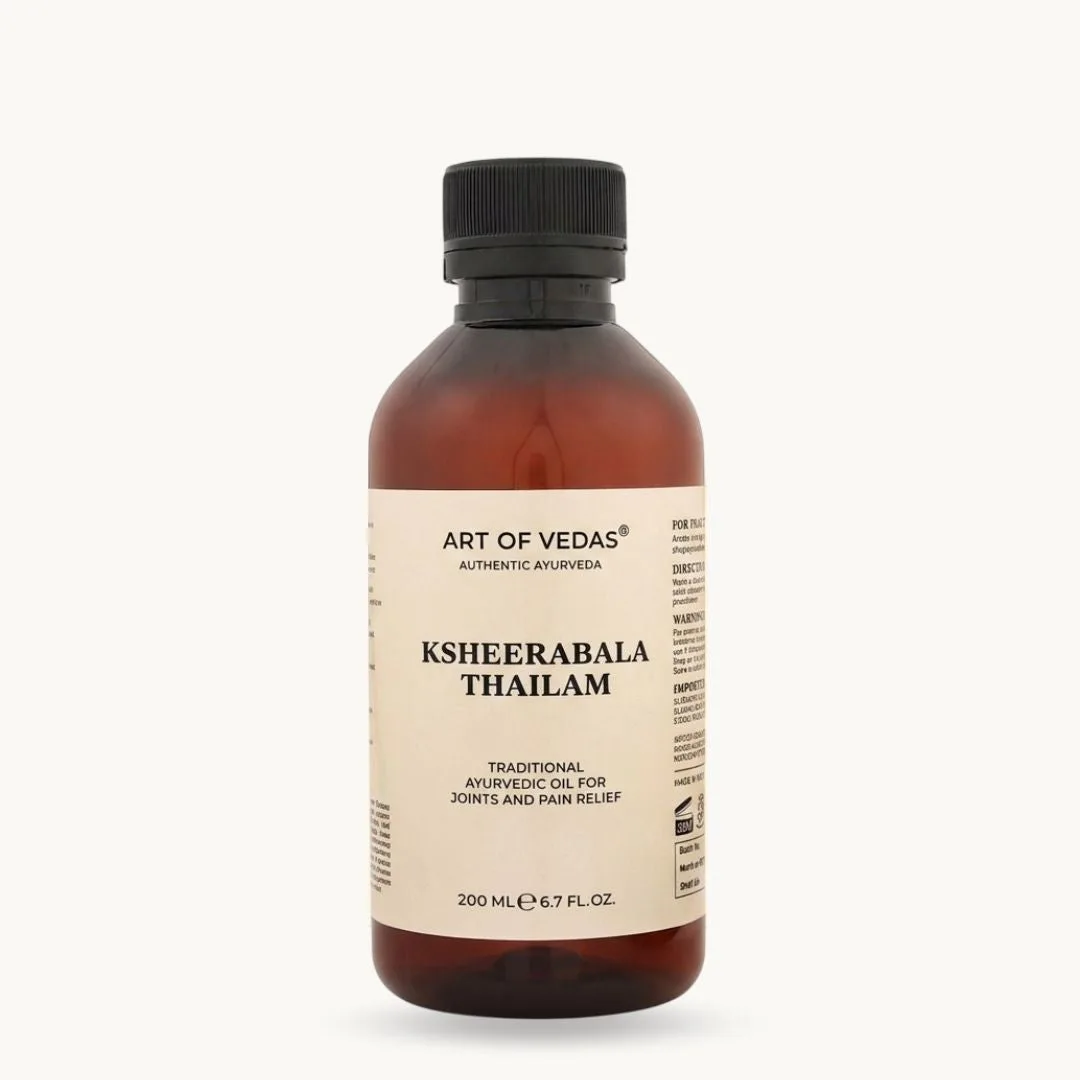
Among the classical Ayurvedic medicated oils, Ksheerabala Thailam occupies an unusual position. Most oils in the Vata range are processed in sesame oil alone. Ksheerabala Thailam uses a triple-base preparation - Bala herb and sesame oil - that the classical texts specifically developed for reaching the deepest tissue layer: Majja Dhatu, the nervous tissue. The name explains it directly. Ksheer means milk, Bala is the primary herb, Taila means oil. Three ingredients in the name; one formulation with a precisely targeted classical action.
This depth of action is why Art of Vedas includes Ksheerabala Thailam as a distinct offering alongside other Vata oils. It is not simply another warming massage oil. It addresses a specific category of Vata condition - the kind involving the neural pathways, nervous tissue quality and the deep nourishment that ordinary oils cannot reach - and it does so through a preparation method that the classical texts describe as uniquely effective for this purpose.
The Classical Text Foundation: Ksheerabala in the Ashtanga Hridayam
Ksheerabala Thailam is described in the Ashtanga Hridayam, Chikitsa Sthana, Chapter 21 - the Vata Vyadhi (Vata disorder) chapter that also contains the references for Dhanwantharam Thailam, Mahamasha Thailam and Narayana Thailam. The fact that multiple foundational Vata oils appear in the same chapter reflects how the Ashtanga Hridayam treats Vata Vyadhi: not as a single condition requiring one formula, but as a spectrum of presentations each requiring a specifically matched preparation.
Within the Vata Vyadhi chapter, Ksheerabala Thailam is placed among the formulations indicated for conditions involving Majja Dhatu - the nervous tissue - and those arising from depletion of the deeper Dhatus through chronic illness, excessive exertion, or the effects of ageing. The Charaka Samhita also references Ksheerabala in the context of Vata-type conditions involving weakness, neural sensitivity and loss of function in the extremities.
The Sahasrayogam, a comprehensive classical Ayurvedic classical text, includes Ksheerabala in several preparation variants and provides detailed guidance on its application for neural conditions. The Ashtavaidya lineages have continued to use Ksheerabala Thailam as a standard formulation in both outpatient Abhyanga protocols and intensive Panchakarma procedures, maintaining an unbroken clinical tradition that supports its classical credentials.
The Ksheerapaka Method: Why Milk Changes Everything
The preparation method of Ksheerabala Thailam is what fundamentally distinguishes it from other Vata oils. The classical method - Ksheerapaka Taila - involves cooking the Bala herb first in milk to produce a milk decoction, then processing this milk decoction together with sesame oil through the classical Taila Paka method. This double-processing creates a finished oil that carries the properties of both the milk and the herb in a sesame oil base.
In classical Ayurvedic pharmacology, milk (Ksheera) has a specific and profound relationship with Majja Dhatu. The Ashtanga Hridayam describes milk as the natural nutritive substance most closely analogous to Majja Dhatu - the substance that most directly nourishes and rebuilds this tissue layer. When milk is used as a processing medium for a medicated oil, the classical texts describe the finished oil as having a deeper affinity for Majja Dhatu than an oil processed without milk.
The practical implication is significant. Most Ayurvedic massage oils work primarily on the superficial tissues - skin (Twak), muscle (Mamsa) and to some extent connective tissue (Meda). Ksheerabala Thailam, through the Ksheerapaka method, is described in the classical texts as penetrating through these layers to reach the Majja Dhatu beneath. This is the specific mechanism that makes it relevant for conditions involving the neural pathways, nerve sensitivity and deep structural nourishment.
Bala: The Principal Herb and Its Classical Properties
Bala (Sida cordifolia) is the single herb that defines Ksheerabala Thailam. Understanding its classical pharmacological profile is essential for understanding why this particular herb-milk-oil combination produces the effects described in the texts.
The Charaka Samhita, Sutrasthana 25, places Bala at the head of the Balya group - the class of herbs that restore physical strength. The name Bala literally means strength in Sanskrit. This is not generic strengthening; classical texts describe Bala's strengthening action as specifically directed at the musculoskeletal system, the neural pathways and the deeper Dhatus that govern movement and sensation.
Rasa (Taste): Madhura (sweet) - the classical taste most associated with nourishing, building and Vata-pacifying action. Sweet taste in classical pharmacology is not a flavour preference; it is a pharmacological category indicating direct nourishing action on the Dhatus.
Virya (Potency): Sheeta (cooling) - a key distinguishing property. Unlike most Vata-pacifying herbs which are warming, Bala is cooling. This means Ksheerabala Thailam is one of the very few classical Vata oils that pacifies Vata through nourishment rather than warming. This makes it appropriate for Vata conditions where heat or inflammation is also present - conditions where warming oils like Dhanwantharam Thailam or Narayana Thailam might aggravate the Pitta dimension.
Guna (Qualities): Guru (heavy), Snigdha (unctuous) - deeply nourishing qualities that directly counteract the lightness and dryness of elevated Vata.
Dosha Effect: Vata and Pitta pacifying. The cooling Virya makes this an oil that simultaneously addresses the Vata depletion and the Pitta inflammation that often co-exist in chronic neural or joint conditions. For this reason, Ksheerabala Thailam is particularly relevant for presentations where pure warming oils have either not been effective or have produced mild aggravation.
Classical Indications: What Ksheerabala Thailam Is Used For
The Ashtanga Hridayam and supporting classical texts describe the following as the primary indications for Ksheerabala Thailam:
Majja Dhatu depletion: The foundational indication. When the nervous tissue is depleted through chronic illness, excessive mental or physical exertion, prolonged stress or the natural ageing process, Ksheerabala Thailam's Ksheerapaka preparation provides the specific nourishment that this tissue layer requires. Classical presentations include generalised weakness in the extremities, poor coordination, reduced stamina and the kind of deep fatigue that is not addressed by rest alone.
Vata conditions with neural involvement: Conditions where Vata aggravation has affected the neural pathways specifically - manifesting as tingling, numbness, altered sensation, tremor or weakness in specific areas. The Ashtanga Hridayam places these conditions at the core of Ksheerabala's indications, emphasising the role of Majja Dhatu nourishment in restoring neural function.
Ksheerabala Thailam 101 for intensive neural support: The 101-Avarthi (101 processing cycle) version of Ksheerabala Thailam is specifically indicated in classical texts for intensive neural conditions including muscular dystrophy patterns, severe Vata depletion and conditions requiring Panchakarma-level oleation. This preparation is used both externally and - under strict physician supervision - internally, as described in the Sneha Pana protocols of the Ashtanga Hridayam.
Convalescence and post-illness recovery: Following extended illness, surgery or prolonged periods of reduced nutrition, the Dhatus become depleted in sequence. Ksheerabala Thailam is specifically indicated for the phase of recovery where Majja Dhatu - the last and deepest of the seven tissue layers to be replenished - requires targeted support. This is a context where Ksheerabala Thailam is often prescribed alongside internal Rasayana preparations.
Pitta-Vata joint conditions: Because of its cooling Virya, Ksheerabala Thailam is the classical choice for joint conditions that have both Vata (dryness, restricted movement) and Pitta (heat, inflammation) components. Where Pinda Thailam is the primary cooling oil for acute Pitta-dominant joint presentations, Ksheerabala Thailam provides the nourishing dimension that Pinda Thailam does not, making it the more appropriate choice when the presentation has both inflammatory and depleting aspects.
Post-partum neural recovery: The classical Sutika Paricharya (post-partum protocols) describe Ksheerabala Thailam as specifically indicated for neural recovery after childbirth - addressing the Majja Dhatu depletion that can manifest as physical weakness, hypersensitivity and fatigue in the post-partum period. This is sometimes used in conjunction with Dhanwantharam Thailam under practitioner guidance.
Ksheerabala Thailam 101 Avarthi: The Clinical Preparation
The 101 Avarthi version of Ksheerabala Thailam represents a completely different clinical category from the standard preparation. One hundred and one processing cycles through the Ksheerapaka Taila method - each cycle involving fresh milk decoction and re-processing - produces an oil of greatly concentrated potency with a correspondingly deeper tissue penetration.
The classical texts describe Ksheerabala 101 as appropriate for conditions that have not responded to standard preparations and for intensive Panchakarma procedures including internal oleation (Sneha Pana). The internal use of Ksheerabala 101 in classical Panchakarma is among its most documented applications - used in specific neurological and deep Vata conditions where ordinary Sneha Pana would be insufficient.
Art of Vedas recommends the standard Ksheerabala Thailam for home Abhyanga and daily Vata-neural support. The 101 Avarthi preparation belongs in clinical Panchakarma settings under qualified Ayurvedic physician supervision. If you have been prescribed Ksheerabala 101 by an Ayurvedic physician, follow their specific guidance on dosing and application method.
How to Use Ksheerabala Thailam for Abhyanga
For home Abhyanga, Ksheerabala Thailam is used with the same classical technique as other medicated oils. Warm the oil gently - placing the bottle in warm water for a few minutes - and apply with sustained strokes to the full body or the areas of specific concern.
Because of its cooling Virya, Ksheerabala Thailam is particularly appropriate for use in warmer seasons or in warmer climates, when warming oils can feel excessive. In colder conditions or for constitutions that run cold, the warming oils (Dhanwantharam Thailam, Mahanarayana Thailam) may be more comfortable for full-body Abhyanga. Ksheerabala can be used locally on specific areas - joints, neck, lower back, soles of the feet - even in cooler seasons.
Allow the oil to remain on the skin for 30 to 45 minutes before bathing. The classical Abhyanga guide from Art of Vedas at the complete Abhyanga guide provides the full technique for classical self-massage with medicated oils.
The full range of classical Vata oils is available in the Art of Vedas Ayurvedic Thailams collection, where Ksheerabala Thailam can be found alongside Dhanwantharam Thailam, Mahamasha Thailam, Pinda Thailam and the other foundational Vata oils.
Frequently Asked Questions
What makes Ksheerabala Thailam different from other Vata oils?
The Ksheerapaka preparation method - processing the primary herb in milk before combining with sesame oil - is unique to a small group of classical formulations of which Ksheerabala Thailam is the most widely prescribed. This method gives the finished oil a classical affinity for Majja Dhatu (nervous tissue) that oils processed without milk do not share. Bala herb's cooling Virya means Ksheerabala Thailam pacifies Vata through nourishment rather than warming - making it the appropriate choice when warming oils are contraindicated due to Pitta aggravation or inflammatory conditions alongside the Vata pattern.
Can Ksheerabala Thailam be used if I have a dairy allergy?
Ksheerabala Thailam is processed using in the classical Ksheerapaka method. The milk is used as a processing medium and the finished oil is predominantly sesame oil. Whether the residual milk proteins in the finished oil are sufficient to produce a reaction in individuals with dairy sensitivity varies considerably. If you have a known dairy allergy or sensitivity, Art of Vedas recommends consulting your healthcare provider before using Ksheerabala Thailam.
When should I choose Ksheerabala Thailam over Dhanwantharam Thailam?
Choose Ksheerabala Thailam when the primary presentation involves neural pathways - tingling, numbness, sensitivity, weakness or fatigue with a deep neural quality - or when there is a Pitta dimension alongside the Vata depletion that makes a warming oil inappropriate. Choose Dhanwantharam Thailam when the primary presentation is musculoskeletal Vata - joint nourishment, muscular weakness, post-partum recovery, or general Vata depletion without a significant inflammatory component. Both oils are excellent daily Abhyanga choices for Vata constitutions; the distinction lies in the specific tissue layer and Dosha dimension being addressed.
Is Ksheerabala Thailam 101 available from Art of Vedas?
Art of Vedas supplies Ksheerabala Thailam in the standard preparation appropriate for home Abhyanga and daily self-care. For the 101 Avarthi clinical preparation, Art of Vedas recommends consulting a qualified Ayurvedic practitioner who can advise whether this preparation is appropriate for your condition and provide guidance on sourcing and use. The 101 preparation's clinical potency means it is best obtained through and used under a practitioner relationship rather than independently.
How does Ksheerabala Thailam compare to Mahamasha Thailam for neural conditions?
Mahamasha Thailam is a warming, heavy oil with a primary affinity for Mamsa Dhatu (muscular tissue) and Majja Dhatu. It is indicated for conditions involving muscular atrophy, severe nerve and muscle weakness and deep Vata conditions with a cold, dry character. Ksheerabala Thailam is cooling and is more appropriate when neural sensitivity or inflammation is present alongside the Vata depletion. For conditions that are purely cold, contracted and depleted, Mahamasha is often the stronger choice. For conditions with any Pitta-inflammatory dimension, Ksheerabala is more appropriate.
What classical text specifically describes Ksheerabala Thailam?
The primary reference is the Ashtanga Hridayam, Chikitsa Sthana, Chapter 21 (Vata Vyadhi Chikitsa). The Charaka Samhita also references Bala herb and Ksheerapaka preparations in the context of deep Vata conditions. The Sahasrayogam includes Ksheerabala in multiple preparation variants and provides guidance on its use classical clinical practice. Together, these texts provide a continuous classical documentation of the formulation across different centuries and regional traditions.
For external use only unless specifically prescribed for internal use by a qualified Ayurvedic physician. Ksheerabala Thailam is a traditional Ayurvedic medicated oil preparation. It is not intended to diagnose, treat, cure or prevent any disease and is not a substitute for professional medical advice.