In brief: Balaguluchyadi Thailam (also written Balaguluchyadi Thailam, Bala Guluchyadi Thailam, Balaguluchyadi Keram or Balaguluchyadi oil) is a classical Ayurvedic oil named after its two lead plants: Bala, the root of Sida cordifolia, and Guluchi, the climber Tinospora cordifolia, better known as Guduchi. It is cited from the Sahasrayogam and belongs to the oils that the tradition uses for Shiroabhyanga, the oil massage of the head, and for Abhyanga of the body. This guide explains what Balaguluchyadi Thailam is, how the classical texts describe it, how it is applied and how often, and which oils in the Art of Vedas range come closest.
What Balaguluchyadi Thailam is and what the name means
The name is a short list. Bala is the root of Sida cordifolia, the country mallow, the root that also gives Ksheerabala and Sudhabala Thailam their names. Guluchi is the older spelling of Guduchi, Tinospora cordifolia, a climbing stem also called Amrita in the texts. The ending "adi" means "and the others": the oil is named after the two plants that lead the recipe.
Balaguluchyadi Thailam, Balaguluchyadi Thailam, Bala Guluchyadi Taila and Balaguluchyadi oil are the same preparation. Balaguluchyadi Keram names the version cooked into coconut oil rather than sesame oil; both are made. The sesame Thailam is fuller and warmer on the skin and suits Abhyanga of the body; the coconut Keram is lighter and cooler and is the form more often chosen for the head.
The classical description
Balaguluchyadi Thailam is cited from the Sahasrayogam. The classical recipe names, among others, Bala root and Guduchi stem, which are simmered into a decoction, together with Devadaru, the deodar cedar. A paste of further plants is added and all are cooked slowly together by the Sneha Paka method until the water has gone. No herb count is given here, because the recipe differs slightly from text to text. Our complete guide to traditional Thailams describes the method and the base oils in detail.
Character in Ayurvedic terms
The classical texts describe Bala as sweet and cooling and Guduchi as bitter, astringent and light, and they describe sesame oil as warming and coconut oil as cooling. The tradition places the finished oil with Vata and Pitta, and describes it as a mild oil that is neither heavy nor hot. That placement is why the tradition names it among the head oils of the classical daily routine, Dinacharya.
How Balaguluchyadi Thailam is used in practice
The main use is Shiroabhyanga, the oil massage of the head. Warm a teaspoon or two by standing the closed bottle in a bowl of warm water for a few minutes; never use a microwave. Part the hair and work the oil into the scalp with the fingertips in slow circles, from the crown outwards, for five to ten minutes. Leave it on for at least half an hour, or overnight with a towel on the pillow, then wash the hair as usual. Once or twice a week is the usual rhythm.
The sesame-based Thailam is also used for Abhyanga of the body like the other mild Bala oils: warmed, applied with long strokes along the limbs, left on for fifteen to twenty minutes and followed by a warm shower. The full sequence of strokes is in our Abhyanga guide.
Who should ask first
Balaguluchyadi Thailam is for external use only. Do a small skin test on the inner forearm before the first full application, keep the oil away from the eyes and broken skin. Anyone who reacts to sesame or to coconut should check the declared list of any oil first. If you are pregnant, or wish to use any oil on a child, ask your doctor or a qualified Ayurvedic practitioner first.
Balaguluchyadi Thailam and the Art of Vedas range
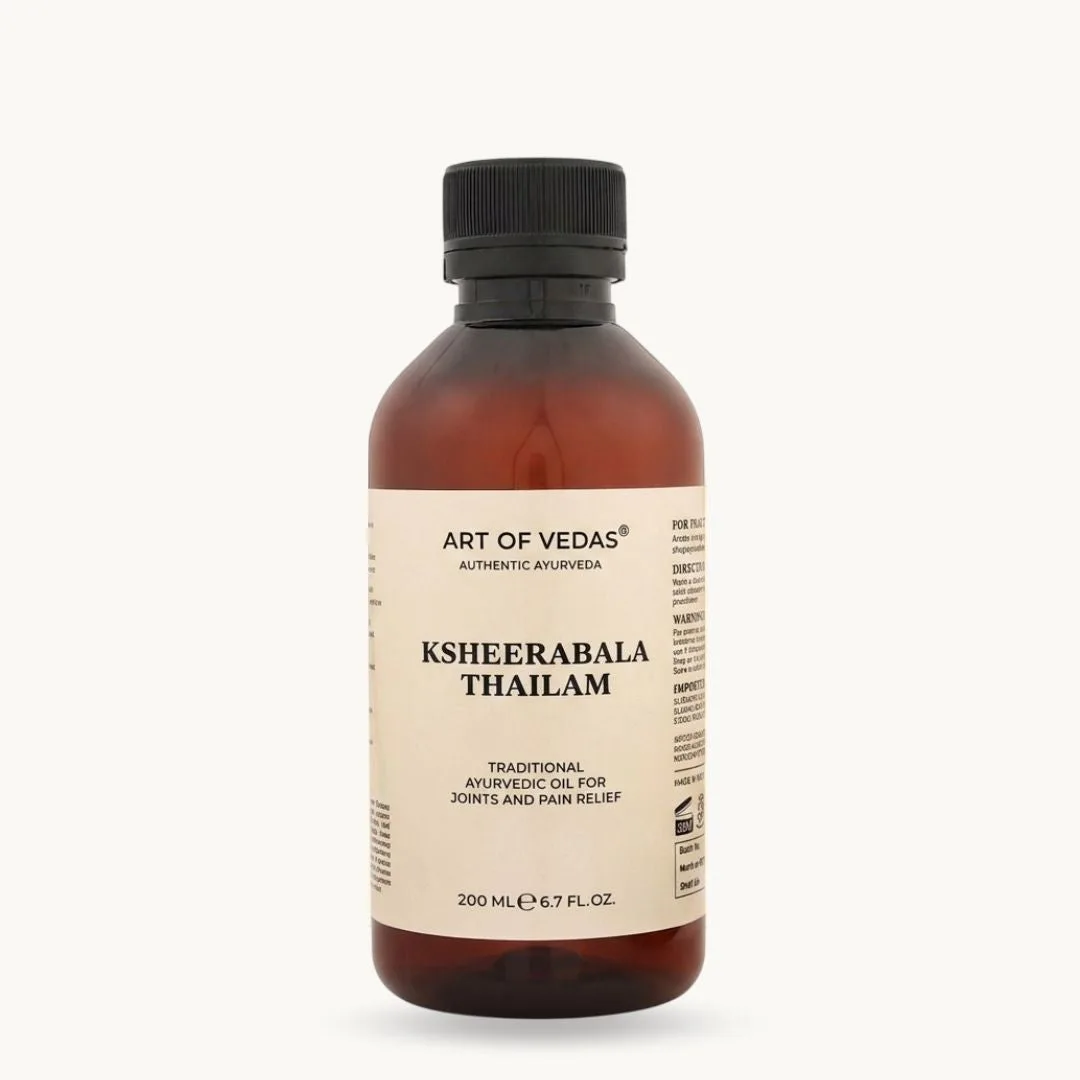
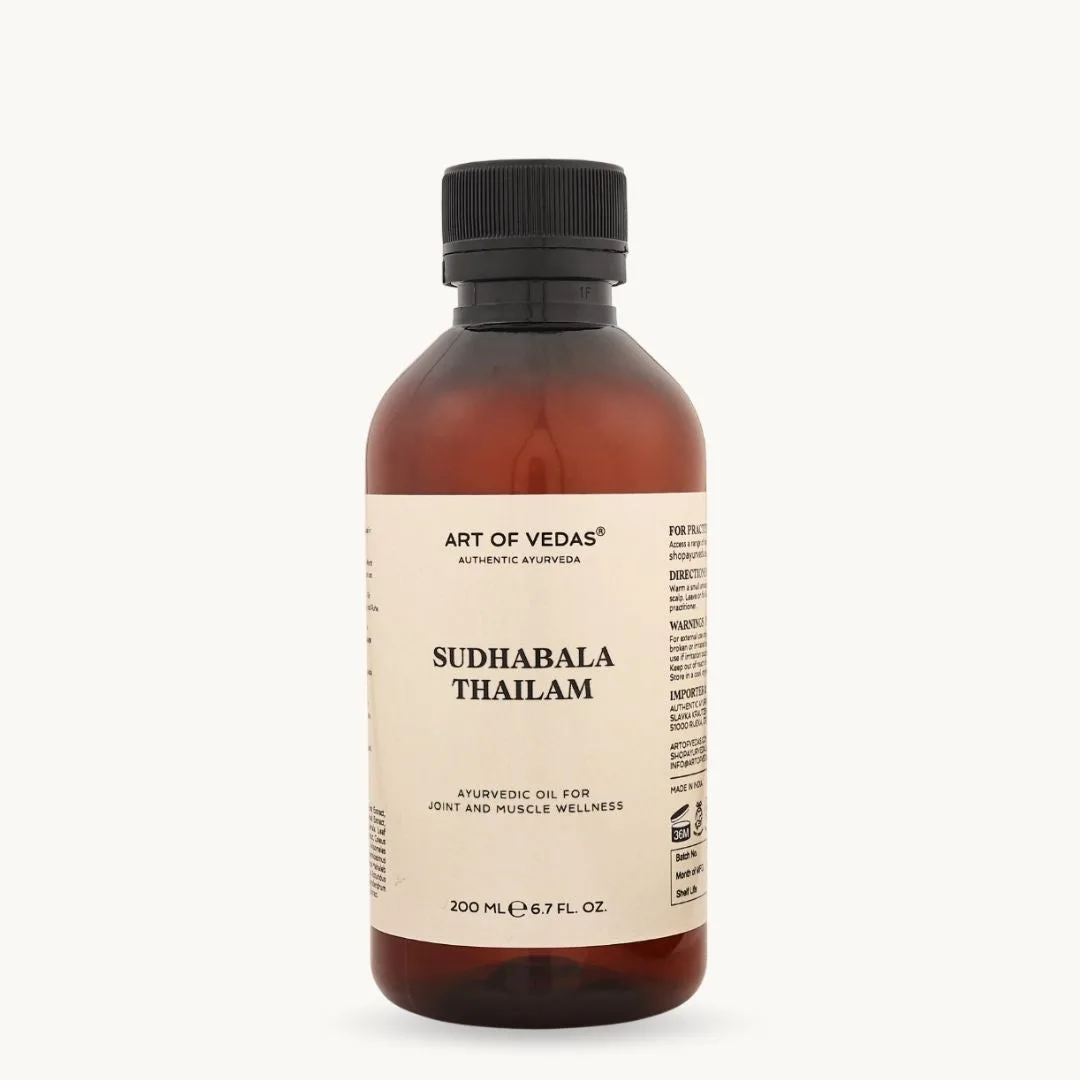
Art of Vedas does not currently offer Balaguluchyadi Thailam or Balaguluchyadi Keram. The closest oils in our range are the two Bala oils: Ksheerabala Thailam, in which Bala root is cooked into sesame oil together with milk, described in the Ashtanga Hridayam and used for both Shiroabhyanga and Abhyanga, and Sudhabala Thailam, the simplest of the family, Bala root alone in sesame oil. For a head oil of mild character Ksheerabala is the nearer match; for a light body oil, Sudhabala. Our oil comparison sets the Bala oils side by side.