In brief: Durvadi Thailam (also written Durvadi Keram, Durvadi Kera Thailam, Durvadi Kera Thailam or Durvadi Taila) is a classical Ayurvedic oil applied to the skin, named after Durva, the grass Cynodon dactylon. It is usually prepared on a coconut oil base, which is what Keram means. The reference usually cited is the Sahasrayogam. The tradition describes Durva as cooling and places the oil with Pitta. Art of Vedas does not currently offer Durvadi Thailam; the closest oils in our range are Nalpamaradi Kera Thailam and Eladi Thailam. This guide covers what it is, how the tradition describes it, how Keram and Thailam differ, and which of our oils to consider instead.
What Durvadi Thailam is and where the name comes from
Durva is the Sanskrit name of Cynodon dactylon, the creeping grass known as Bermuda grass. It is one of the oldest plants of the Indian tradition, named in the Vedic hymns and offered in ritual. The suffix adi means "beginning with", so Durvadi is the recipe that begins with Durva. Thailam, Thailam and Taila are the same word in different transliterations and mean a medicated oil; Keram and Kera Thailam tell you that the base is coconut oil rather than sesame oil.
The classical description
The classical recipe names, among others, fresh Durva grass, used as a juice and a paste, cooked by the Sneha Paka method into a coconut oil base. The Sahasrayogam, the collection of recipes used in the southern tradition, is the reference usually cited, and the supporting plants and proportions vary between the versions in circulation, so the label of a given oil is always the reference. Where the texts describe the oil, they do so as an oil for the skin, and this guide keeps to that description without adding claims of its own.
Character in Ayurvedic terms
The tradition describes Durva as cooling, Sheeta, with a sweet and astringent taste, and places it with Pitta and Kapha. Coconut oil is cooling as well. Cooked together, they give a finished oil that the tradition describes as cooling and places with Pitta. Durvadi Thailam therefore belongs with the cooling skin oils of the southern tradition and not with the warming massage oils of the Vata group.
Keram and Thailam: the two forms of the name
The same recipe is called Durvadi Thailam in one place and Durvadi Keram or Durvadi Kera Thailam in another. In the strict sense a Thailam is a sesame-based oil and a Keram a coconut-based one, and for the skin oils of the southern tradition the coconut form is the usual one. If a label says Durvadi Thailam, read the ingredient list to see which base oil it declares. The two forms are compared in our complete guide to traditional Ayurvedic Thailams.
How a coconut-based skin oil is used in practice
A Keram is applied in a thin layer to clean skin, worked in gently until it is absorbed, left for 20 to 30 minutes and washed off with warm water and a mild cleanser. It does not need to be warmed; coconut oil sets at cool room temperature, and standing the closed bottle in warm water for a few minutes brings it back to liquid. Once a day or a few times a week is the usual rhythm. Keep it away from the eyes.
Who should ask first
Every classical oil is for external use only. Do a small skin test on the inner forearm before the first full application, and do not apply the oil to broken skin. In pregnancy, and for children, ask your doctor or a qualified Ayurvedic practitioner first. Whether Durvadi Thailam or another skin oil suits you is a question for a qualified Ayurvedic practitioner.
Art of Vedas and Durvadi Thailam
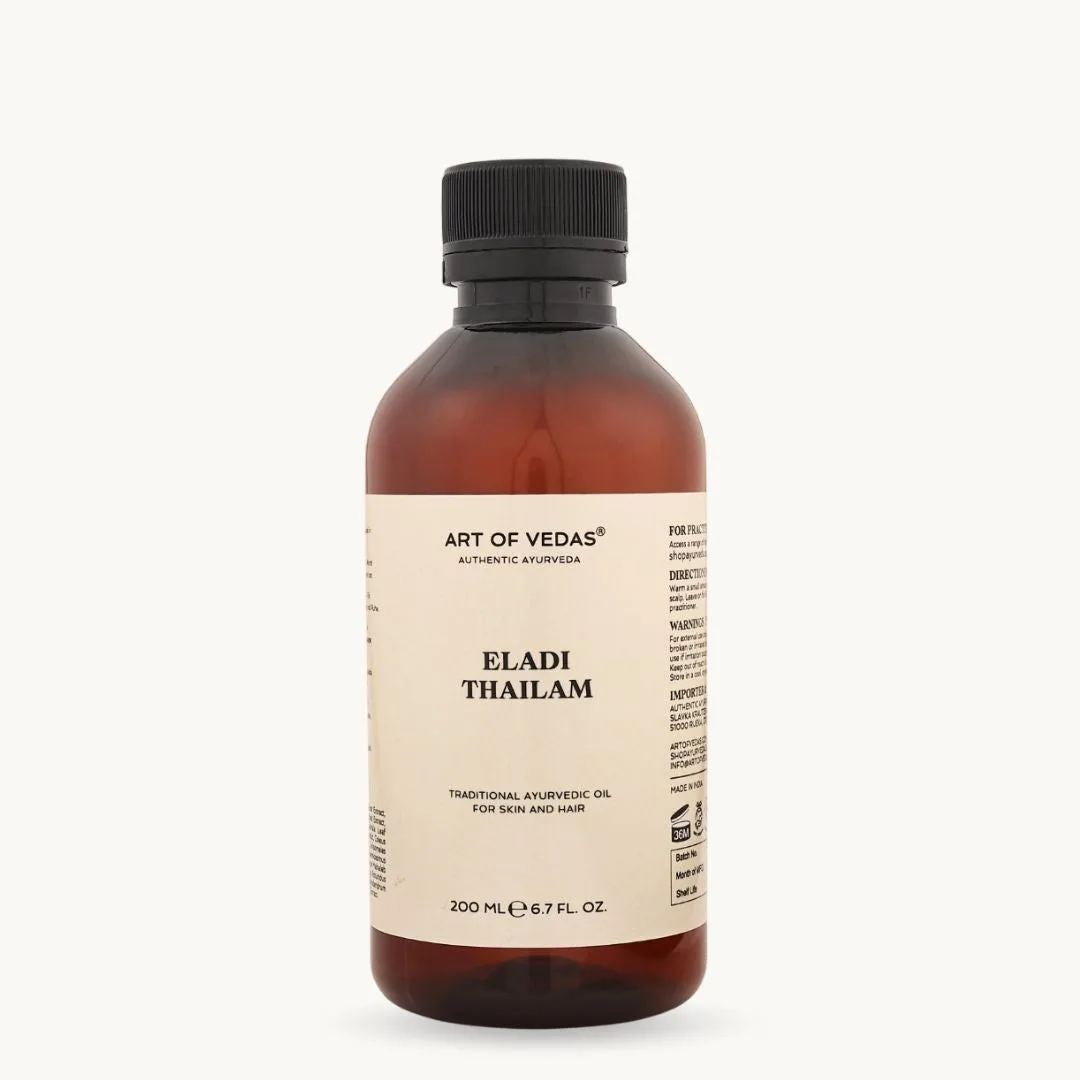
Art of Vedas does not currently offer Durvadi Thailam. The closest oils in our range are Nalpamaradi Kera Thailam, a classical coconut-based skin oil built on Nalpamara, the bark of four fig trees, with turmeric, cooling and placed with Pitta, and Eladi Thailam, a classical oil for the face, skin and scalp with cardamom, cinnamon, nutmeg and resins in a sesame base, traditionally used for Mukhabhyanga, the facial oil massage. Nalpamaradi Kera Thailam is the nearer match, on the same coconut base; Eladi Thailam is the choice when the face is the main concern.