Tongue Scraping: The Classical Ayurvedic Jihwa Nirlekhana Guide
Of all the practices described in the Ayurvedic Dinacharya (daily routine), tongue scraping is perhaps the one that most immediately demonstrates the classical Ayurvedic approach to health maintenance: a simple daily action that takes thirty seconds, requires minimal equipment, and directly addresses one of the most significant accumulation points of Ama (metabolic residue) in the body.
The Ashtanga Hridayam (Sutrasthana Chapter 2) - the foundational text for the classical daily routine - describes Jihwa Nirlekhana (tongue cleaning, literally "tongue scraping") alongside oil pulling, nasal oil application, and tooth cleaning as one of the four essential oral care components of the morning routine. It is not optional or supplementary in the classical framework - it is a foundational Dinacharya practice.
What the Tongue Tells You in Ayurveda
In classical Ayurvedic diagnosis, the tongue (Jihwa) is one of the primary diagnostic surfaces - its colour, texture, coating, and the distribution of any coating across its surface all provide information about the state of the Doshas and the digestive system. The classical Ayurvedic practitioner examines the tongue at the start of every consultation.
In the context of morning tongue scraping, the most important observation is the overnight tongue coat. During sleep, the digestive system processes the day's food and experiences, and the metabolic residue of that processing - Ama - tends to accumulate at the root of the tongue overnight. This morning coat is one of the most consistent classical indicators of the state of Agni (digestive fire) and Ama accumulation:
-
Thin, barely perceptible coat: Good Agni, minimal Ama accumulation - the classical indicator of a healthy digestive system
-
White, thick coat: Kapha excess and Ama accumulation - the most common presentation in temperate climates, particularly in winter and spring
-
Yellow coat: Pitta accumulation in the digestive system
-
Brown or grey coat: Vata aggravation, often associated with irregular digestion or chronic stress
-
Coat concentrated at the back: Accumulation in the large intestine and lower digestive channels
-
Coat at the sides: Liver and Rakta Dhatu involvement in the classical framework
This daily observation of the tongue coat is one of the most practical and accessible forms of self-diagnosis available in the classical Ayurvedic tradition - allowing a sensitive person to track the state of their Agni and Ama accumulation on a daily basis and adjust diet, herbs, or practice accordingly.
Why Tongue Scraping Is Essential, Not Optional
The classical rationale for tongue scraping is straightforward: the Ama that accumulates on the tongue overnight, if not removed, is reabsorbed into the digestive system as the day begins. The act of scraping removes this Ama from the system before it can be reintroduced - interrupting one of the classical feedback loops of Ama accumulation.
Beyond this primary rationale, the Ashtanga Hridayam describes the additional benefits of regular Jihwa Nirlekhana as:
- Clarity of taste perception (Rasa Jnana) - the coating on the tongue dulls taste sensitivity, and its removal directly restores the clarity of taste sensation
- Support for Agni - the stimulation of the taste buds and tongue surface that accompanies scraping is described as activating the digestive fire at the start of the day
- Freshness of breath - Ama on the tongue is the primary source of morning breath in the classical understanding
- Clarity of the sense organ - the tongue is one of the five Jnanendriyas (organs of knowledge) in classical Ayurveda, and its maintenance is part of the broader Indriya prasadam (sense organ clarity) that the Dinacharya practices collectively support
Classical Materials for Tongue Scrapers
The classical texts describe tongue scrapers made from specific metals, each with distinct properties:
-
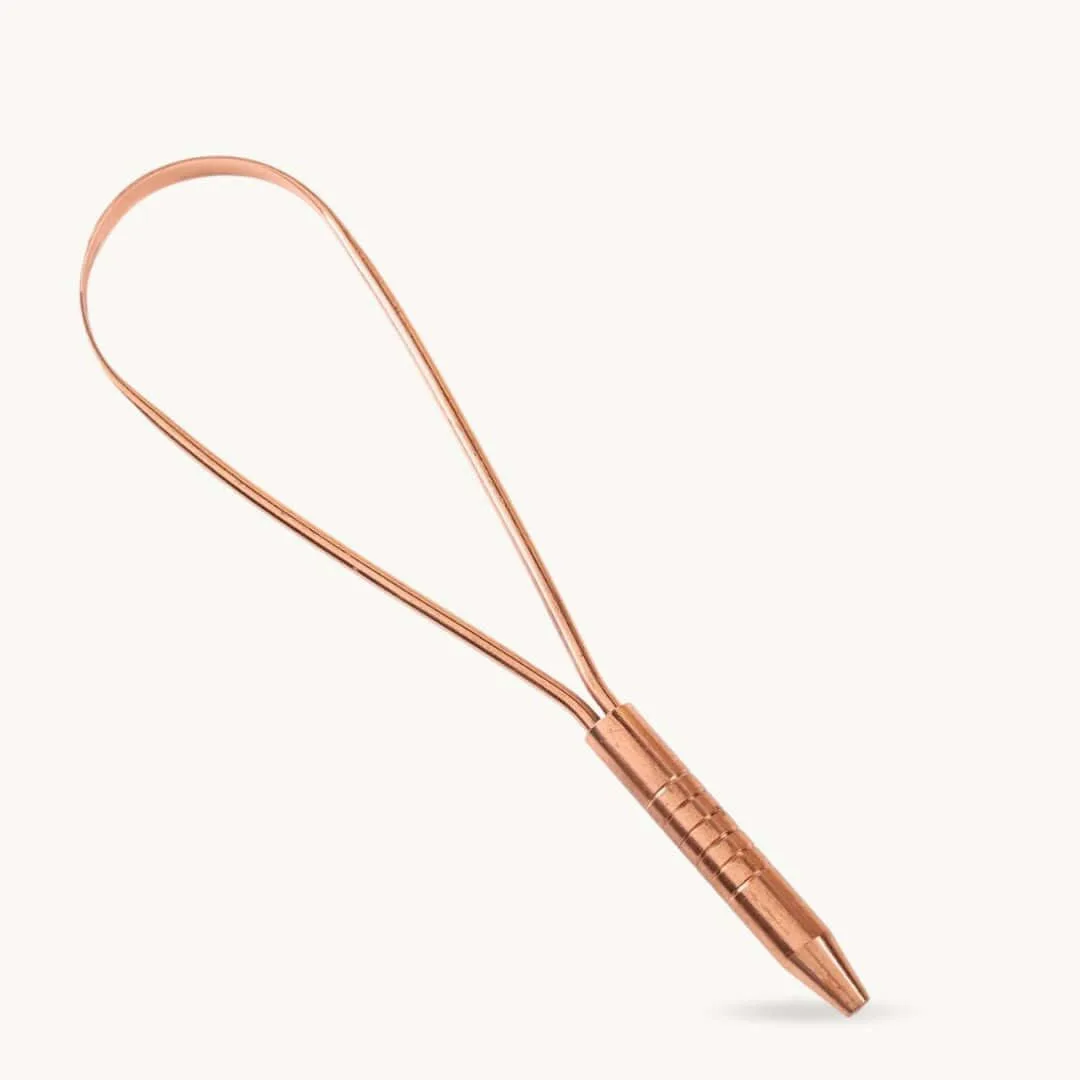
Copper (Tamra): The most widely recommended classical material - described in both the Charaka Samhita and Ashtanga Hridayam as Krimighna, Pitta-addressing through its classical properties, and specifically beneficial for the oral cavity. Copper's natural antimicrobial properties have continuous support across classical Ayurvedic literature. The Art of Vedas copper tongue scraper follows this classical material recommendation directly.
-
Silver (Rajata): Classical silver tongue scrapers are described as more specifically Pitta-cooling - appropriate for Pitta-dominant constitutions
-
Gold (Swarna): Described in classical texts for specific therapeutic contexts - less practical for daily use
-
Stainless steel: A modern equivalent that lacks the classical material properties but serves the mechanical function adequately in the absence of copper
Plastic tongue scrapers are not aligned with the classical material tradition - they lack the classical metal properties and are not described in any Ayurvedic text.
The Classical Tongue Scraping Technique
-
Timing: First thing in the morning, before eating, drinking, or tooth brushing - the Ama coat is most present before any other morning activity and should be removed before any other substance enters the mouth
-
Observation: Before scraping, take a moment to observe the tongue coat - its colour, thickness, and distribution. This is the daily Jihwa Pariksha (tongue examination) that provides the morning's diagnostic information
-
Position: Stand over a sink, extend the tongue comfortably
-
Technique: Hold the scraper by both ends, place it at the back of the tongue (as far back as comfortable without triggering the gag reflex), and draw forward in a single, moderate-pressure stroke to the tip of the tongue
-
Repetitions: The classical standard is seven strokes. For a heavy coat, up to fourteen strokes may be needed. The process is complete when the tongue surface appears clean and the scraper collects minimal further residue
-
Rinsing: Rinse the scraper between each stroke and rinse the mouth thoroughly after completing the scraping
-
Sequence: Classical Dinacharya sequence is tongue scraping first, followed by tooth cleaning (Dantadhavana), then oil pulling (Kavala/Gandusha) - in that order
Tongue Scraping and Oil Pulling
Classical Ayurveda describes oil pulling (Kavala and Gandusha) as the companion practice to tongue scraping in the morning oral care routine. Where tongue scraping removes the overnight Ama coat from the tongue surface, oil pulling addresses the deeper oral cavity - the gums, teeth, and throat. Together they constitute the complete classical oral Dinacharya. See our oil pulling guide for the complete practice.
Frequently Asked Questions
What is Jihwa Nirlekhana?
Jihwa Nirlekhana is the classical Ayurvedic practice of tongue scraping - the removal of the overnight Ama coat from the tongue surface using a curved metal scraper. Described in the Ashtanga Hridayam as a foundational component of the Dinacharya (daily routine), it is one of the five classical oral care practices alongside tooth cleaning, oil pulling, nasal oil application, and Kavala gargling.
Why copper for tongue scraping?
Copper (Tamra) is the most classically recommended material for tongue scrapers in both the Charaka Samhita and Ashtanga Hridayam - described as Krimighna and specifically beneficial for the oral cavity's health. The classical material properties of copper make it the most authentically Ayurvedic choice for daily tongue scraping practice.
How many times should I scrape my tongue?
The classical standard is seven strokes. For a heavier morning coat (indicating more significant Ama accumulation), up to fourteen strokes are appropriate. The process is complete when the tongue surface appears clean and the scraper collects minimal further material on each stroke.
When should I scrape my tongue?
Always first thing in the morning, before eating, drinking, or tooth brushing. The classical reasoning is clear: the Ama coat accumulated overnight should be removed before any other substance is introduced to the mouth, to prevent its reabsorption into the digestive system. Tongue scraping after meals is not a classical Dinacharya practice.
What does a white tongue coat mean in Ayurveda?
A white, thick tongue coat is the classical indicator of Kapha excess and Ama accumulation in the digestive system - the most common presentation in temperate climates, particularly in winter and spring. It suggests that Agni is not at its optimal strength and that some degree of incompletely digested material (Ama) is present in the system. Adjusting diet toward lighter, warmer, easier-to-digest foods and potentially incorporating Deepana-Pachana herbs like Trikatu is the classical response.
Explore Oral Care at Art of Vedas
Browse our Ayurvedic oral care collection at Art of Vedas, including our copper tongue scraper and classical oil pulling preparations. For the complete oral care daily practice, see our oil pulling guide. For the full Dinacharya context, see our Dinacharya guide.
This article is for informational and educational purposes only. The practices described are for general self-care and wellbeing. They are not a substitute for professional dental or medical care. For persistent oral health concerns, consult a qualified dentist or healthcare professional.