Shirodhara: The Classical Ayurvedic Forehead Oil Therapy
Among all the classical Ayurvedic therapies, Shirodhara is perhaps the most immediately distinctive. The image of a continuous stream of warm oil falling onto a person's forehead - their eyes closed, their body at complete rest on a treatment table - has become one of the most recognisable symbols of Ayurvedic Panchakarma worldwide. But beyond the visual impression, Shirodhara is one of the most clinically specific and carefully theorised treatments in the entire classical literature: a therapy with a precise mechanism, defined indications, and a well-articulated understanding of how it works at the level of the mind, the nervous system, and the subtle body.
The Classical Understanding of Shirodhara
Shirodhara belongs to the group of classical head oil therapies called Murdha Taila - described in the Ashtanga Hridayam Sutrasthana Chapter 22 as the highest of all oil therapies for their effect on the nervous system, the sense organs, and the mind. Within the Murdha Taila group, Shirodhara (continuous pouring) is described alongside Shirobasti (oil retained in a cap) as the most deeply acting of the head oil therapies.
The classical understanding of Shirodhara's mechanism operates through several converging pathways:
-
Prana Vata settling: The continuous, warm, rhythmic sensation of the oil stream landing on the forehead directly calms the erratic, upward-moving quality of disturbed Prana Vata - the sub-dosha governing sensory perception, the movement of nerve impulses, and the interface between the physical and the subtle body
-
Sadhaka Pitta clarification: The forehead and the area of the Sthapani marma are described as the seat of Sadhaka Pitta - the sub-dosha governing emotional processing and the conversion of experience into understanding. The cooling effect of the oil stream (particularly with classically cooling oils like Ksheerabala or Brahmi) directly addresses excess heat in Sadhaka Pitta
-
Tarpana (nourishment) of the nervous tissue: The sustained oil contact with the scalp and forehead is understood to provide Tarpana - nourishment and lubrication - to the underlying nervous structures, supporting Majja Dhatu quality through the skin
Classical Indications for Shirodhara
The Ashtanga Hridayam and the classical texts describe Shirodhara as particularly indicated in conditions involving:
- Excess Vata and Pitta in the head region - mental agitation, restlessness, difficulty settling the mind
- Disturbed Nidra (sleep) - particularly when sleep disturbance has a nervous or mental character
- Excess heat or reactivity in the sense organs - particularly the eyes and mind
- Chronic stress and its effects on the nervous system - the accumulated depletion that affects the quality of Prana Vata and Sadhaka Pitta over time
- Scalp conditions with a Vata-Pitta character - dryness, sensitivity, or heat in the scalp
The Experience of Shirodhara
Recipients of authentic Shirodhara consistently report a distinctive experience that is difficult to describe through ordinary categories - a profound quieting of the thinking mind, a sense of deep groundedness and physical ease, and often a quality of expanded perceptual clarity during and after the treatment. Many recipients report the sense of a boundary dissolving between active thought and a deeper, quieter quality of awareness.
In classical terms, this experience is understood as the direct expression of Prana Vata returning to its natural, settled state - the cessation of the excessive upward movement and scattered quality that characterises disturbed Prana Vata, and the return to its foundational quality of clear, steady, downward-and-inward movement that underlies deep rest and integrated sensory experience.
Classical Oils for Shirodhara
The selection of oil for Shirodhara is one of the most important clinical decisions in the therapy - the oil's properties are what determine the specific therapeutic direction of the treatment:
-
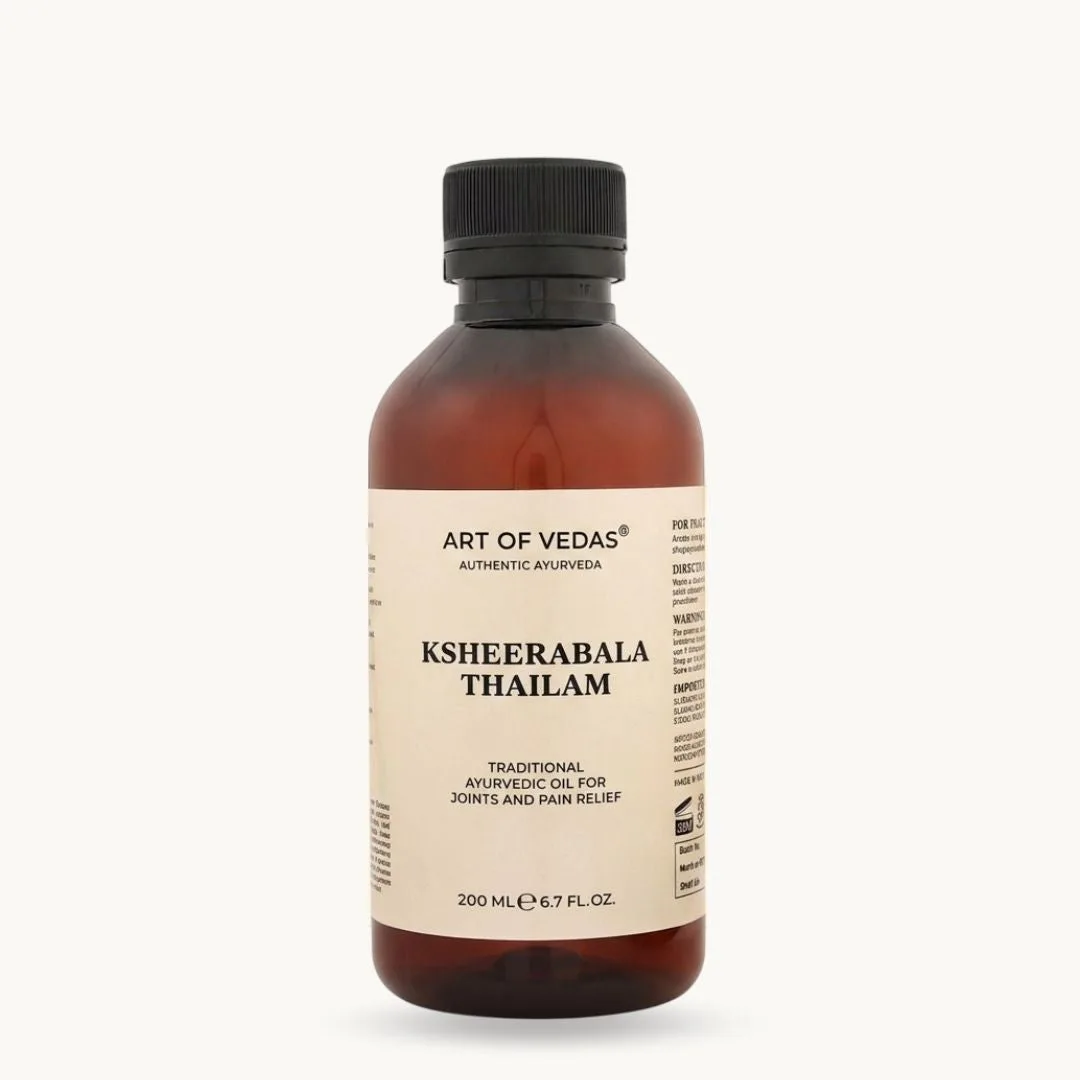
Ksheerabala Thailam: The most widely used Shirodhara oil in the classical tradition - its milk-based processing gives it a cooling, deeply nourishing character ideal for Vata-Pitta conditions of the head and nervous system. See our Ksheerabala guide.
-
Brahmi Thailam: The Medhya Rasayana oil - specifically directed at Majja Dhatu and Sadhaka Pitta, ideal when the therapeutic intention is mental clarity and nervous system nourishment. See our Brahmi Thailam guide.
-
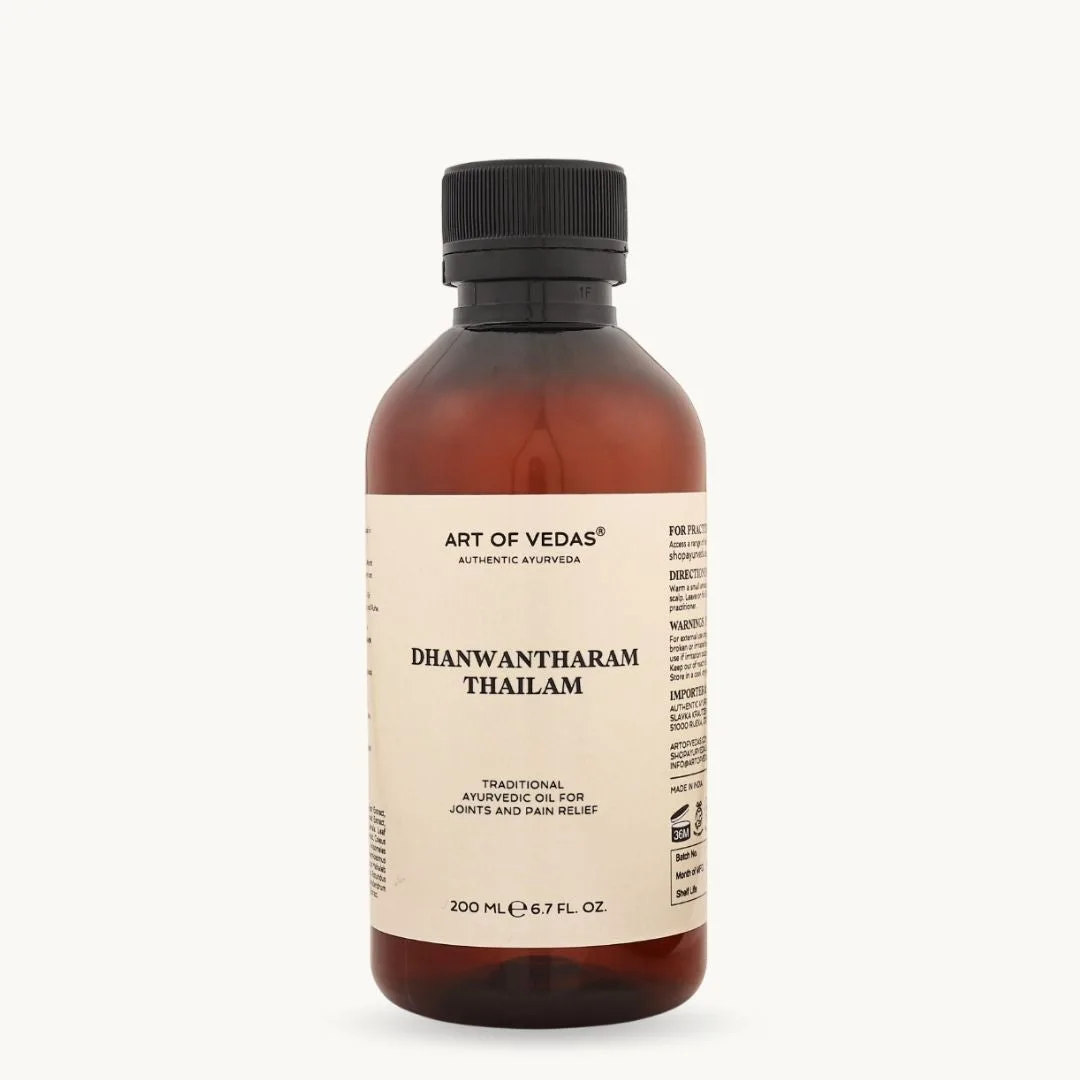
Dhanwantharam Thailam: For Vata conditions with additional musculoskeletal or systemic Vata involvement. See our Dhanwantharam guide.
-
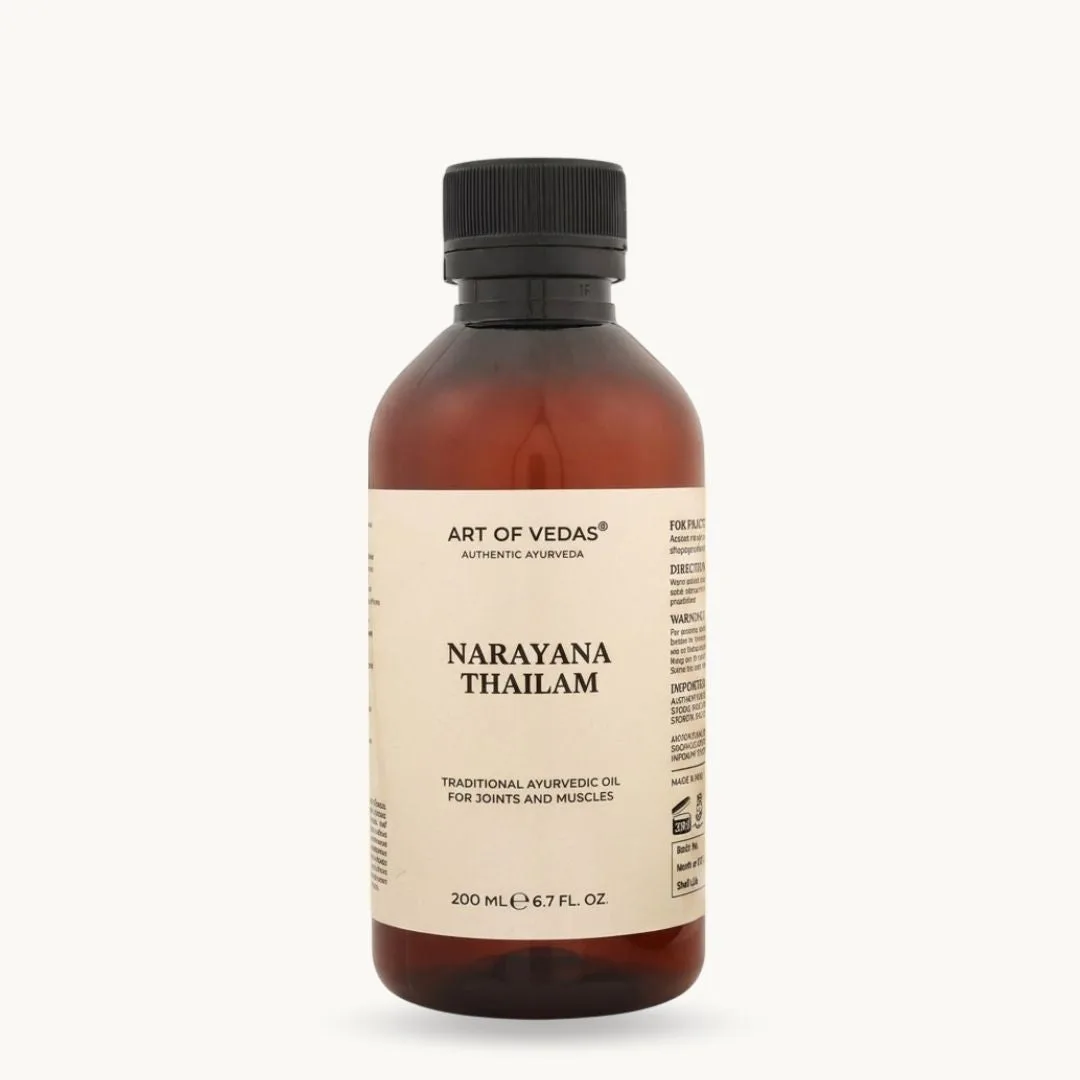
Narayana Thailam: For comprehensive Sarva Vata hara - where Vata is elevated broadly across the system. See our Narayana guide.
-
Takradhara (buttermilk): A classical variant for Pitta-predominant conditions - the cooling, lightness of buttermilk makes it the most Pitta-specific Dhara preparation
Shirodhara as Panchakarma Preparation
In the classical Panchakarma context, Shirodhara typically serves as a component of the Purvakarma (preparatory therapies) - administered daily over a course of seven to fourteen days before the main Panchakarma procedures (Virechana, Vamana, Basti, etc.). In this context, Shirodhara's primary function is Snehana (oleation) of the head and nervous system - softening and mobilising the Doshas from their accumulated positions in the head and nervous tissues so they can be effectively eliminated by the subsequent main therapies.
When used as a standalone therapy outside the full Panchakarma context - as is most common in modern Ayurvedic wellness settings - Shirodhara retains its nervous-system-nourishing and Vata-Pitta-settling function, typically administered as a course of treatments over five to ten consecutive days for the most sustained benefit.
Preparing for a Shirodhara Session
Classical texts recommend the following preparation for receiving Shirodhara:
- A full Abhyanga (warm oil body massage) before Shirodhara - preparing the body and opening the channels before the head treatment
- Light eating before the session - a full stomach is contraindicated in classical practice
- Avoiding cold exposure, screens, and intense sensory stimulation immediately after - the nervous system remains in a sensitive, open state for some time following Shirodhara
- Rest after the session - a period of quiet lying down before resuming activity, allowing the settling effect of the treatment to integrate
For the equipment guide, see our Shirodhara pot setup guide. The Art of Vedas Shirodhara Pot is designed for both professional and home use.
Frequently Asked Questions
What is Shirodhara?
Shirodhara is a classical Ayurvedic therapy involving the continuous pouring of warm medicated oil (or another liquid such as buttermilk) onto the forehead in an unbroken stream, for a sustained duration. It is described in the Ashtanga Hridayam as one of the Murdha Taila (head oil therapies) and is used in classical Panchakarma for its profound settling effect on Prana Vata, Sadhaka Pitta, and the nervous system.
How long does Shirodhara last?
A full classical Shirodhara session lasts thirty to forty-five minutes. In the Panchakarma context, it is typically administered daily over a seven to fourteen day course. Shorter sessions of fifteen to twenty minutes are used in adapted or introductory protocols.
What oil is used in Shirodhara?
The most classically used Shirodhara oils are Ksheerabala Thailam (for Vata-Pitta conditions) and Brahmi Thailam (for mental clarity and Medhya support). The appropriate oil is selected based on the individual's constitution and the therapeutic intention. Non-oil variants include Takradhara (buttermilk) for Pitta conditions.
What is the difference between Shirodhara and Abhyanga?
Abhyanga is classical full-body oil massage - addressing the entire system through vigorous oil application and massage strokes. Shirodhara is specifically directed at the head and nervous system through the continuous oil stream on the forehead. In classical Panchakarma, Abhyanga typically precedes Shirodhara as the body-level preparation before the more subtle nervous-system-directed head therapy.
This article is for informational and educational purposes only. Shirodhara is a classical Ayurvedic therapy that in a therapeutic context should be administered by a qualified Ayurvedic practitioner. The information provided here is for educational purposes and does not constitute medical advice. The preparations and tools described are not intended to diagnose, treat, cure, or prevent any medical condition.