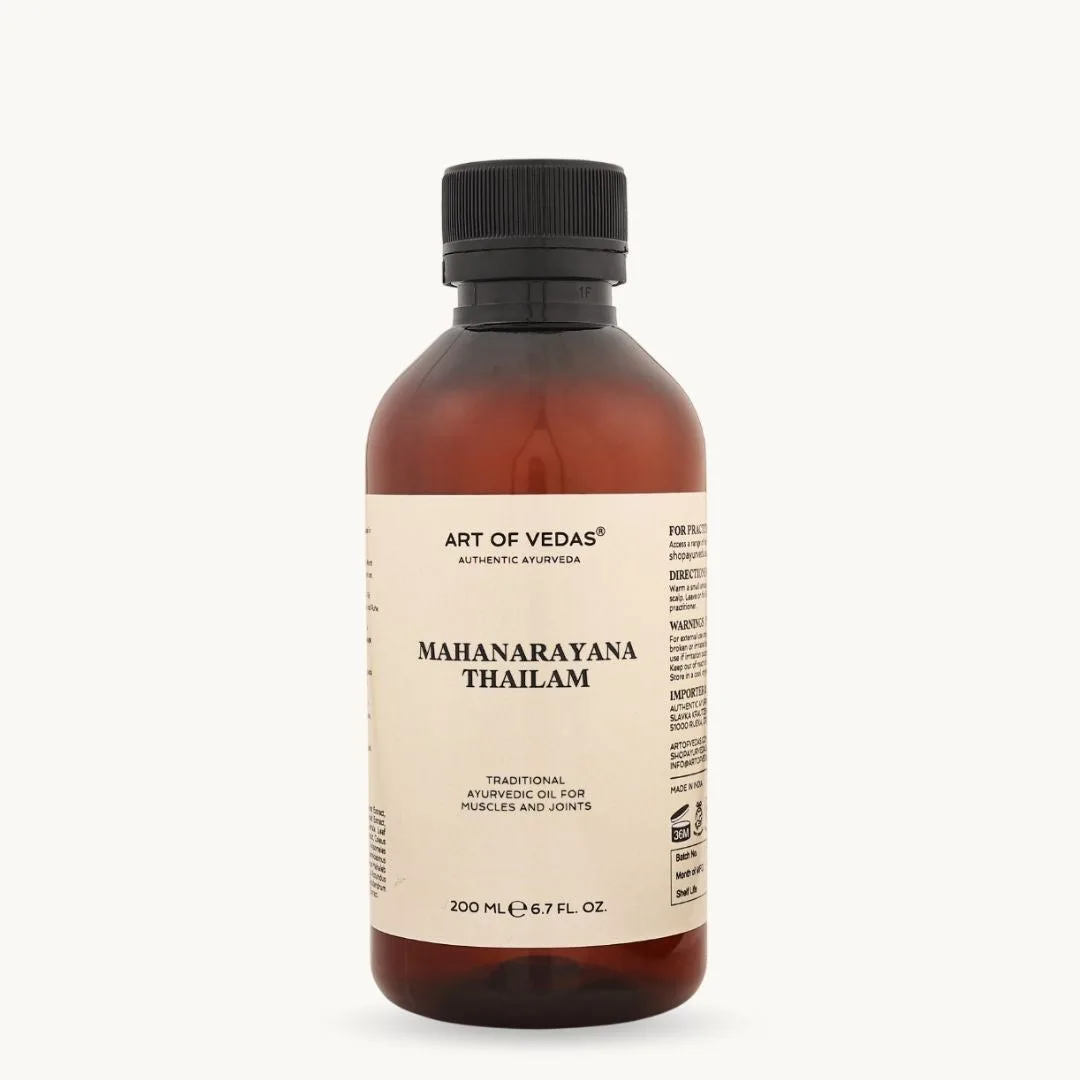
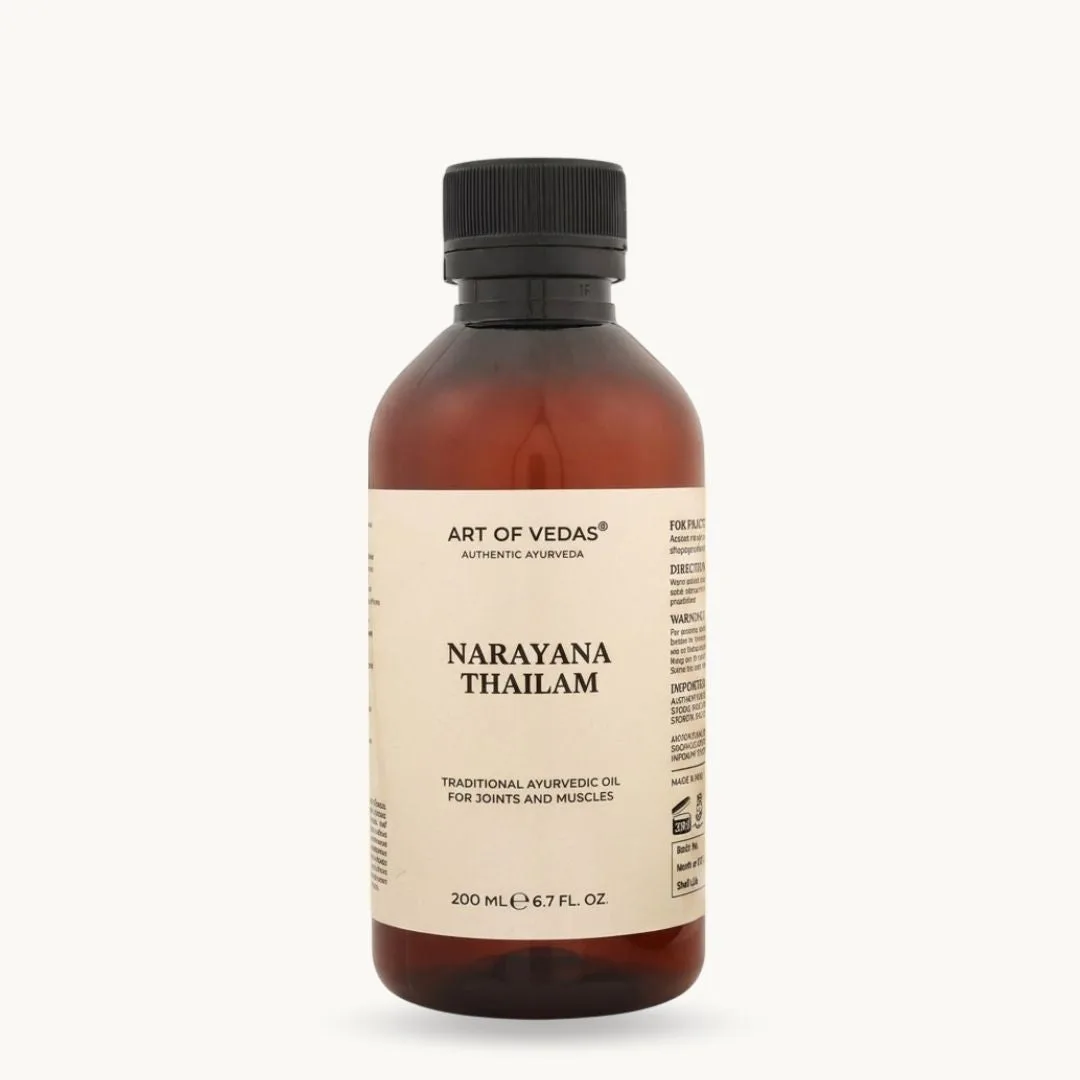
Mahanarayana Thailam and Narayana Thailam are two of the most frequently confused oils in classical Ayurveda, and understandably so: one grew out of the other. Both are warm sesame preparations traditionally used in Ayurveda to support the comfort of joints and muscles when Vata runs high. This guide explains the names, the differences in formula and preparation, and how the tradition decides between them.
One Name, Two Formulas
Narayana Thailam is the older, foundational recipe, recorded across the classical compendia and kept alive with particular devotion. Mahanarayana Thailam, literally the great Narayana, is its expanded descendant: the same idea carried further, with a longer list of herbs and a richer manner of preparation, described in the compendium Bhaishajya Ratnavali. Households that keep both tend to treat Narayana Thailam as the everyday companion and Mahanarayana Thailam as the fuller, more enveloping oil for focused routines. The complete portrait of the larger formula is given in our Mahanarayana Thailam guide.
Valiya, Cheriya, Maha: The Naming Explained
Much of the confusion around these oils comes 's own naming customs. In Malayalam manuals the Narayana formula appears in two sizes: Valiya Narayana Thailam, the large version with the fuller herb list, and Cheriya Narayana Thailam, the small version with a more compact composition. The Sanskrit prefix Maha, meaning great, works the same way: Mahanarayana Thailam stands to Narayana Thailam roughly as the valiya version stands to the cheriya. Different manufacturers follow different regional conventions, which is why the same shelf can carry several oils whose names all contain Narayana. The lineage of these recipes in the classical sources is traced in Mahanarayana Thailam: texts and preparation.
How the Formulas Differ
Both oils share the same backbone. Bala (Sida cordifolia, the classical strengthening root) leads the composition, cooked into sesame oil with Shatavari (Asparagus racemosus, traditionally nourishing) and the ten grounding roots of Dashamoola. The Mahanarayana recipe then widens the circle considerably, adding restorative and aromatic herbs such as Ashwagandha (Withania somnifera, the great Rasayana root), Rasna (traditionally valued in Vata care) and Devadaru (Himalayan cedar, warm and resinous), and in many classical descriptions a milk decoction stage that gives the finished oil a softer, rounder feel. The practical result is a matter of depth rather than kind: Narayana Thailam feels lighter and more matter-of-fact, Mahanarayana fuller, warmer and more enveloping on the skin.
Which Oil for Which Routine
The tradition's own logic is straightforward. For daily Abhyanga, where the whole body is oiled before bathing, the simpler Narayana Thailam serves beautifully and spends more freely. For slow, focused work on knees, shoulders and the lower back, particularly in autumn and winter or in later life, the tradition reaches for Mahanarayana Thailam and its greater herbal depth. Whichever you choose, the shared virtues remain:
- The settling warmth of a classical sesame oil on tired limbs
- Joints and muscles that feel supple, eased and cared for
- A grounding herbal aroma that marks the ritual hour
- Skin left soft and nourished through the cold season
If your comparison shopping extends beyond this pair, our reading of Dhanwantharam versus Mahanarayana Thailam weighs the great alternative, which is traditionally preferred where a gentler, more broadly nourishing oil is wanted.
Frequently Asked Questions
Are Mahanarayana and Narayana Thailam interchangeable?
For general massage, largely yes: they belong to the same family and serve the same Vata-settling purpose. The difference lies in depth. Mahanarayana carries a longer herb list and a richer texture, so those with a focused routine for joints or the lower back usually feel the distinction more clearly than daily Abhyanga users.
Does Maha simply mean better?
Maha means great, and here it describes scale rather than rank. The expanded formula is fuller, not superior in every setting. A lighter oil that is used gladly every day serves the tradition better than a rich one left in the cupboard, which is why many households happily keep both and let the occasion decide.
What do valiya and cheriya mean on labels?
They are Malayalam for large and small. Valiya Narayana Thailam carries the fuller composition, cheriya the more compact one. The pairing mirrors the Sanskrit relationship between Mahanarayana and Narayana, so when reading a label, valiya sits closest in spirit to the Mahanarayana formula and cheriya to the simpler parent recipe.
Which should a newcomer to Abhyanga choose first?
Begin where your routine begins. If you are establishing a habit of full body massage, the simpler Narayana Thailam is a generous, uncomplicated companion. If you already know that your attention will rest on knees, shoulders or the lower back through the colder months, Mahanarayana Thailam rewards that focus from the first evening.
Are both used warm?
Yes. Classical practice warms every Thailam gently before application, until it feels pleasantly warm on the inside of the wrist. Warmth belongs to the character of both oils, softens their texture and deepens the sensory experience of the ritual, whichever member of the Narayana family you have chosen.
For external use only. This article describes traditional Ayurvedic practice for educational purposes and does not constitute medical advice. Always consult a qualified professional before beginning a new routine, especially during pregnancy, while nursing, or if you have specific concerns.