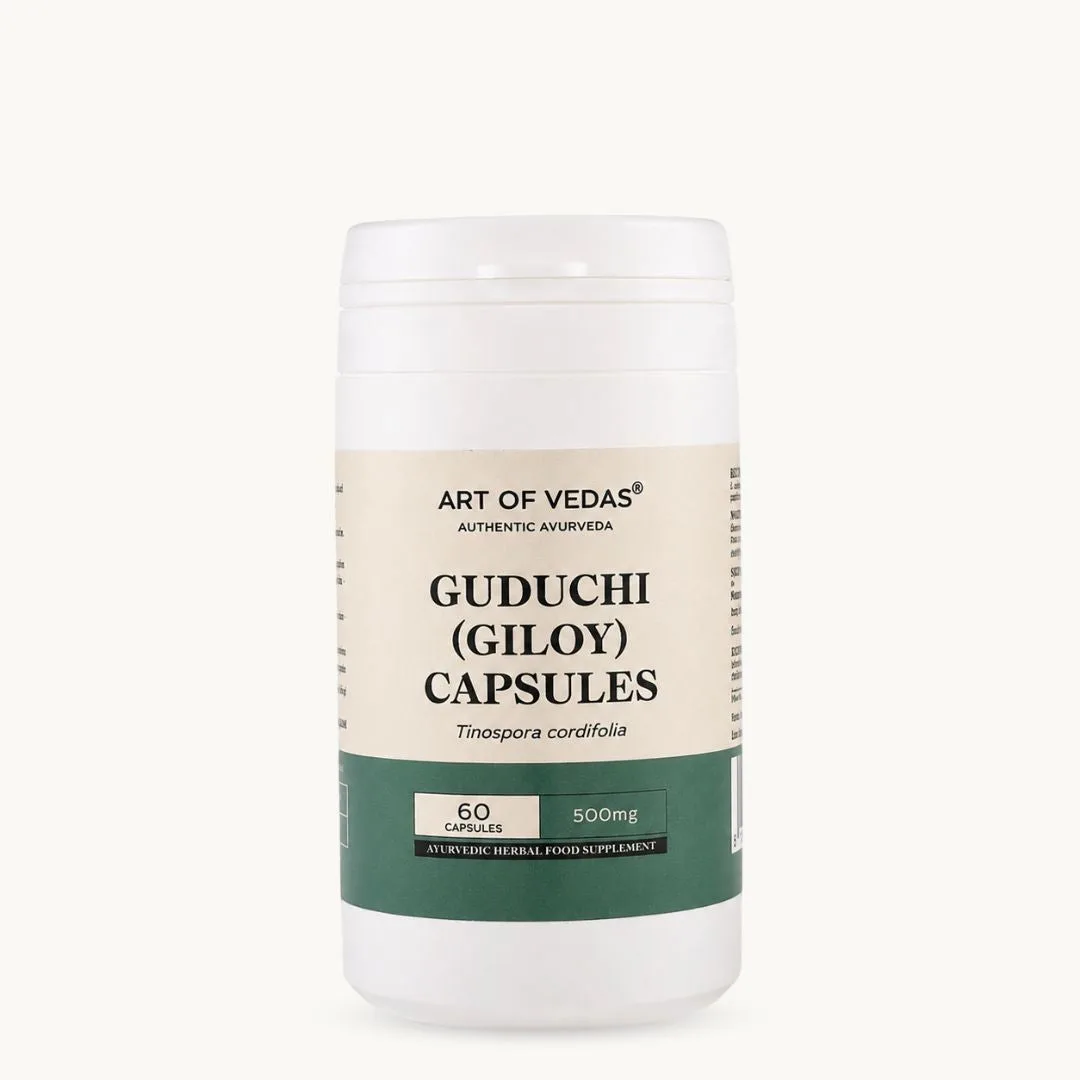
This article is part of our Guduchi in Ayurveda: Classical Properties and Traditional Uses guide series.
This product is a food supplement and not intended to diagnose, treat, cure or prevent any disease. This article is educational in nature and discusses traditional Ayurvedic uses. Consult a qualified practitioner before beginning any new supplement, particularly if you have existing health conditions or take medications.
Guduchi (Tinospora Cordifolia): The Tridoshic Rasayana Herb and How to Use It
In the classical Ayurvedic Materia Medica, Guduchi occupies a position that very few herbs share. It is one of only a handful of herbs described as Tridoshic Rasayana - a rejuvenating herb that is traditionally said to balance all three doshas without aggravating any of them. This is an exceptional classification. Most Rasayana herbs have a primary dosha affinity: Ashwagandha is primarily a Vata Rasayana; Shatavari is Pitta-pacifying; Trikatu stimulates Kapha. Guduchi - described in Charaka Samhita as Amrita, the nectar of immortality - is said to act across all three simultaneously. This property, combined with its classical use as a protective, purifying, and strengthening herb, makes it one of the most versatile and widely applicable plants in the entire Ayurvedic tradition.
This guide covers Guduchi's classical pharmacology, its traditional uses across the major texts, the different preparations available, and practical guidance on incorporating it into daily routine. Art of Vedas offers Guduchi in its supplements collection.
The Classical Name and Botanical Identity
Guduchi (botanical name: Tinospora cordifolia) is a climbing shrub native to the Indian subcontinent, found throughout tropical and subtropical forests. It is commonly known as Giloy in North Indian regional languages - a name that has become widely used in popular discourse, though the classical Ayurvedic name is Guduchi.
The name Amrita - divine nectar, the substance of immortality in Sanskrit mythology - reflects the herb's classical status as one of the most protective and life-sustaining plants in the Ayurvedic tradition. The Charaka Samhita Sutrasthana Chapter 25 lists Guduchi among the highest-ranking herbs in the Jeevaniya (life-sustaining) and Rasayana categories. The Ashtanga Hridayam Sutrasthana's classification chapter similarly places it in multiple traditional categories simultaneously, which is itself an indicator of its versatility.
Classical Pharmacology: Rasa, Virya, Vipaka, Prabhava
Understanding Guduchi's pharmacology Ayurvedic terms explains its traditional actions and applications. Its Rasa (primary taste) is Tikta (bitter) and Kashaya (astringent). Its Virya (potency) is Ushna (warming). Its Vipaka (post-digestive effect) is Madhura (sweet). This combination is unusual and pharmacologically significant: a bitter and astringent herb that is warming in the body and converts to sweet in its post-digestive action. Most bitter herbs are cooling. Guduchi's warming potency combined with its bitter taste makes it both purifying and Agni-supporting in the classical sense - it is traditionally said to clear Ama (undigested residue) without the cooling effect that would suppress digestive fire.
Its Prabhava (special action beyond what the tastes would predict) is its Tridoshic action. The bitter taste generally reduces Pitta and Kapha but can aggravate Vata. Guduchi's Prabhava is described as overcoming this expected pharmacological action and allowing it to balance Vata, Pitta, and Kapha simultaneously. This is the basis of its exceptional classical status.
Traditional Uses in the Classical Texts
Charaka Samhita Chikitsasthana references Guduchi in multiple traditional contexts. The primary classical applications include: Vata-related contexts (where it provides the unusual combination of Vata pacification without the cold quality that most Pitta-reducing herbs carry); Pitta-related contexts associated with heat; Kapha-related contexts where the digestive fire needs support and Ama is to be cleared; traditional contexts of warmth and comfort (the Ashtanga Hridayam Chikitsasthana lists Guduchi prominently in these chapters); and Rasayana use for building Ojas, supporting Vyadhikshamatva (the classical concept of resilience), and supporting long-term vitality.
The resilience-building application has received the most attention in contemporary context. The classical description of Guduchi as building Bala and supporting the body's natural resilience aligns with the modern interest in adaptogens and wellness-supporting herbs. The connection between Guduchi and the resilience framework described in the Ayurvedic immunity guide is direct and.
Guduchi and Agni
One of Guduchi's most notable classical properties is its Deepana and Pachana actions. Most Rasayana herbs are Snehana (nourishing, oily, heavy) in quality, which can suppress Agni if taken without attention to digestive strength. Guduchi is one of the few Rasayana herbs traditionally described as simultaneously nourishing Ojas and supporting Agni - it does not require the digestive system to be functioning optimally before it can be used, because part of its traditional action is to bring the digestive system toward that optimal state.
This makes Guduchi particularly appropriate, in classical terms, as a Rasayana for individuals whose vitality feels depleted alongside sluggish digestion, Ama accumulation, or metabolic dullness - presentations that are very common in European practice. Where other Rasayana herbs might create further heaviness, Guduchi's bitter quality and Agni-supporting action are described as simultaneously clearing the ground and building the structure.
Forms and Preparations
Guduchi Churna (powder)
The dried stem of Guduchi is powdered and taken as Churna - the most direct preparation form. The classical dosage described in Ashtanga Hridayam is taken with warm water, honey, or ghee depending on the dosha condition being addressed. Taken with warm water, it emphasises the Ama-clearing action. Taken with ghee, it emphasises the Rasayana and Ojas-building action.
Guduchi Satva (starch extract)
Guduchi Satva is a refined starch preparation extracted from the fresh stem of Tinospora cordifolia. It is described texts as a cooling, easily digestible form of Guduchi particularly appropriate for Pitta presentations with heat and sensitivity. It is gentler than the churna and is the preferred form in the traditional warmth-and-comfort protocols described in Ashtanga Hridayam.
Guduchi Kashayam (decoction)
Kashayam (water decoction) of Guduchi stem is described in Charaka Samhita as a primary preparation in the traditional joint-comfort and warmth contexts. The fresh or dried stem is boiled in water and reduced to the classical ratio, then taken warm. In classical Ayurvedic practice, this preparation is associated with the Vata-joint presentations and warmth contexts described in the texts.
Guduchi in compound formulations
Guduchi is an ingredient in several classical compound formulations. Guduchyadi Kashayam is a compound decoction featuring Guduchi as the primary herb. Tiktakam Ghritham, a classical medicated ghee associated with Pitta contexts, includes Guduchi. These compound preparations are available from qualified Ayurvedic suppliers and are typically recommended for specific presentations rather than general daily use.
Guduchi and the Pitta Imbalance Connection
While Guduchi is Tridoshic, its cooling Prabhava combined with its bitter Rasa makes it particularly well-suited, in classical terms, to Pitta presentations that involve heat or skin reactivity. The Pitta conditions described in the Pitta imbalance guide are among those for which Guduchi is most classically indicated. The Charaka Samhita Chikitsasthana associates it with Pitta-type skin presentations, heat-related contexts, and conditions involving Rakta (blood tissue) and Pitta.
For individuals supporting Pitta-related presentations - whether skin reactivity, internal heat, or the joint presentations that can accompany elevated Pitta - Guduchi is a natural complement to the cooling oil and dietary routine described in the Pitta and sensitive skin guides.
Guduchi in the Rasayana Context
As a Rasayana herb, Guduchi is most effective within the broader context described in the Rasayana guide. The classical texts describe Rasayana practice as most beneficial when the individual's Agni is functioning well, the Srotas (body channels) are clear, and the lifestyle supports tissue nourishment. Guduchi is one of the most appropriate Rasayana herbs to begin with precisely because its Deepana and Pachana actions help to prepare the ground for deeper nourishment. It is frequently recommended as the first Rasayana herb in a classical rejuvenation routine, clearing Ama before the heavier nourishing herbs are introduced.
Practical Daily Use
For daily Rasayana support, Guduchi is typically taken in one of the following forms: churna (half a teaspoon to one teaspoon) in warm water before breakfast, emphasising the Ama-clearing and Agni-supporting action; or in capsule form for convenience and consistent dosage. The Art of Vedas supplements collection includes Guduchi preparations in available forms. As with all Rasayana herbs, consistent daily use over weeks and months produces the cumulative benefit described in the classical texts. Single occasional doses have minimal effect.
Frequently Asked Questions
Is Guduchi the same as Giloy?
Yes. Giloy is the common name used predominantly in North India and in popular contemporary health writing. Guduchi is the Sanskrit classical name used in the Ayurvedic texts. Both refer to Tinospora cordifolia. The name Giloy has become widely recognised through media coverage in India and has entered international health discourse, but the classical Ayurvedic name for the herb is Guduchi or Amrita.
Can Guduchi be taken long-term?
The classical texts describe Guduchi as a Rasayana herb appropriate for sustained long-term use, which is consistent with its Tridoshic classification. Rasayana herbs by definition are those used over extended periods to build Ojas and resilience, not as short-term interventions. The Charaka Samhita's Rasayana chapter describes many herbs in this context as being taken for months to years as part of a sustained rejuvenation routine. For specific health concerns, the guidance of a qualified practitioner is more appropriate than self-prescription for extended periods.
Who should not take Guduchi?
The classical texts list very few cautions for Guduchi. Its warming Virya makes it mildly stimulating to Agni, which could be temporarily uncomfortable for those with already-elevated Pitta and significant digestive heat. In modern practice, individuals taking immunosuppressant medications should consult their prescribing physician before adding any significant supplement, as the classical resilience-supporting traditions of Guduchi relate to the same systems that these medications manage. Pregnancy and breastfeeding: consult your healthcare provider.
Does Guduchi interact with medications?
This is a question best answered by your physician or pharmacist, who can assess interactions with any specific medications you take. As a general principle, herbs with significant physiological activity should be disclosed to your healthcare provider, particularly if you take medications for immune system conditions, blood sugar management, or blood pressure.