
★★★★★Verified buyer
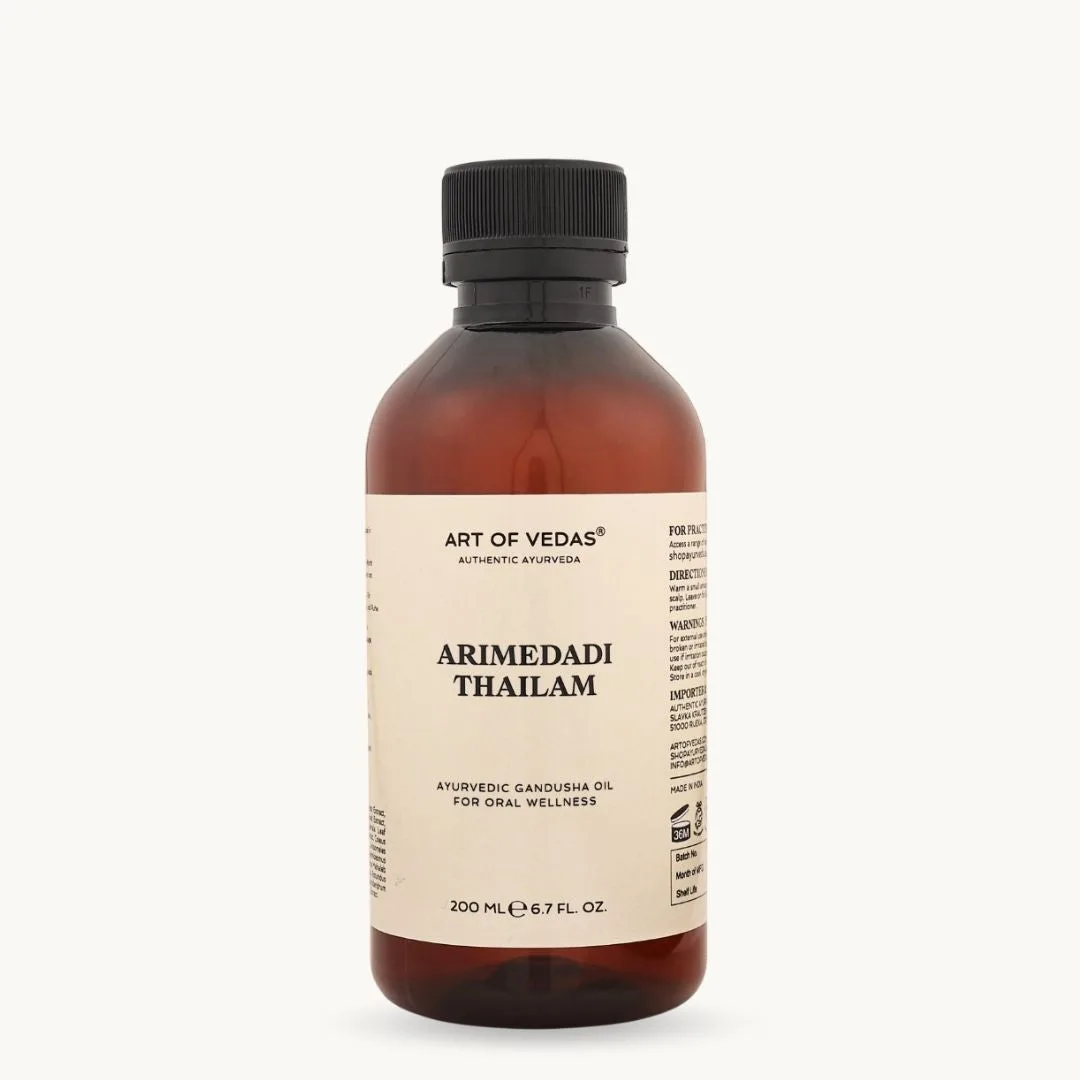
Thailam
Arimedadi Thailam
Classical Ayurvedic Oral Care Oil
Kapha Balancing
£18.00
20% offArimedadi Thailam is a classical Ayurvedic oil long esteemed for the care of the oral cavity, described within the Ashtanga Hridayam.
Net content200ML
Packaging Why this bottle is PET. This oil is bottled in food-grade PET: light, shatterproof in the bathroom and in transit. Quality and shelf life are the same as in glass. Glass changes how a bottle looks, not the oil inside it. Read more: PET or glass for Ayurvedic oils
For professionals Professionals can register on Shop Ayurveda EU for professional pricing across the full Art of Vedas range. Register as a professional
Ingredients
Sesamum Indicum (Sesame) Seed Oil, Acacia Catechu (Catechu) Extract, Acacia Leucophloea (White Babul) Extract, Cinnamomum Camphora (Camphor) Oil, Myristica Fragrans (Nutmeg) Seed Extract, Syzygium Aromaticum (Clove) Flower Oil, Caesalpinia Sappan (Sappanwood) Wood Extract, Cinnamomum Tamala (Indian Bay Leaf) Leaf Oil, Cinnamomum Zeylanicum (Cinnamon) Bark Oil, Shellac, Coleus Vettiveroides (Hribera) Root Extract, Curcuma Longa (Turmeric) Root Extract, Cyperus Rotundus (Nut Grass) Root Extract, Elettaria Cardamomum (Cardamom) Seed Oil, Emblica Officinalis (Amla) Fruit Extract, Ficus Benghalensis (Banyan) Bark Extract, Glycyrrhiza Glabra (Licorice) Root Extract, Mesua Ferrea (Nagkesar) Flower Extract, Mimosa Pudica (Sensitive Plant) Extract, Rubia Cordifolia (Manjistha) Root Extract, Saccharum Officinarum (Sugarcane) Extract, Symplocos Racemosa (Lodhra) Bark Extract, Terminalia Bellerica (Bahera) Fruit Extract, Terminalia Chebula (Haritaki) Fruit Extract, Vetiveria Zizanioides (Vetiver) Root Extract, Woodfordia Fruticosa (Fire Flame Bush) Flower Extract, Myrica Esculenta (Box Myrtle) Bark Extract, Tragia Involucrata (Indian Stinging Nettle) Root Extract, Prunus Cerasoides (Wild Himalayan Cherry) Bark Extract, Prunus Avium (Wild Cherry) Fruit Extract, Piper Cubeba (Cubeb) Fruit Extract, Cinnamal, Eugenol, Isoeugenol, Linalool, Limonene, Coumarin, Benzyl Benzoate

The Classical Oil for Gandusha
Warming in character to balance Kapha, it is traditionally embraced for Gandusha and Kavala, the traditional practices of holding and swishing oil within the mouth.
Traditionally suited for:
- Daily Gandusha and Kavala practice
- Care of the gums and oral cavity
- Kapha-predominant constitution
- A cleansing addition to the Ayurvedic daily routine
How to use
For oral care (oil pulling and gum massage)
- Take about a teaspoon of the oil into the mouth.
- Swish it gently around the mouth, between the teeth and over the gums, for a few minutes.
- You may also massage a little oil onto the gums with a clean fingertip.
- Spit the oil out, then rinse the mouth with warm water.
Recommended frequency
Best used in the morning before eating. Daily use fits naturally into Dinacharya, the classical Ayurvedic daily routine.
Important
- For use in the mouth only. Do not swallow the oil.
- Spit into a bin rather than a sink to avoid blockages.
- Not suitable for young children, who may swallow it.
Classical reference
The practice of Gandusha itself is described extensively in all three major Ayurvedic texts (Brihat Trayi):
- Charaka Samhita - describes Gandusha as part of Dinacharya
- Sushruta Samhita - recommends Gandusha for various oral conditions
- Ashtanga Hridayam - provides detailed Gandusha protocols and specific oils
Sanskrit: अरिमेदादि तैलम् (Arimedādi Tailam)
Breakdown:
- अरिमेद (Arimeda) - Acacia leucophloea, the primary herb
- आदि (Ādi) - "and others," indicating additional ingredients
- तैलम् (Tailam) - oil, specifically medicated oil
The name follows standard Ayurvedic naming convention: the primary ingredient followed by "adi" (and others) and the preparation type.
The Concept of Gandusha in AyurvedaVagbhata states in Ashtanga Hridayam (Sutrasthana, Chapter 22):
"Nityaṃ tailaṃ" - "Daily, oil [should be used for oral care]"
This verse establishes sesame oil as the foundation for daily oral hygiene. The text further describes four types of Gandusha based on therapeutic action:
1. Snigdha Gandusha (Oleating): Using oils with sweet, sour, and salty tastes to address Vata imbalances such as dryness and roughness in the mouth.
3. Shodhana Gandusha (Purifying): Using substances with pungent, sour, and salty tastes to address Kapha conditions such as excessive mucus and buildup.
4. Ropana Gandusha (Healing): Using astringent and bitter substances to support wound healing in the oral cavity.
Ayurvedic Pharmacology (Dravyaguna)
Rasa (Taste): Kashaya (Astringent), Tikta (Bitter), Madhura (Sweet), Katu (Pungent)
Guna (Quality): Laghu (Light), Ruksha (Dry), Snigdha (Oily - from sesame base)
Virya (Potency): Predominantly Sheeta (Cooling), with warming elements from spices
Vipaka (Post-digestive effect): Katu (Pungent)
Dosha Action: Kapha-Pitta Shamaka (Pacifies Kapha and Pitta)
Karma (Actions):
- Dantya - Strengthens teeth
- Danta Shodhana - Cleanses teeth
- Mukha Shodhana - Purifies the mouth
- Mukhavaishadyakara - Creates oral freshness
- Oshtha Shosha Hara - Prevents lip dryness
- Daurgandhya Hara - Removes bad odour
Learn more about Arimedadi Thailam
What is Arimedadi Thailam?
Arimedadi Thailam is a classical Ayurvedic oil for oral care, documented in the Ashtanga Hridayam. Unlike Thailams made for body massage, Arimedadi Thailam is traditionally crafted for the mouth, for the practices of Kavala and Gandusha, known today as oil pulling.
What is Arimedadi Thailam used for?
Arimedadi Thailam is traditionally used for Ayurvedic oil pulling and daily oral care. It is valued for caring for the gums, the teeth and the mouth as part of a morning routine.
How do I use Arimedadi Thailam for oil pulling?
Take a small amount of Arimedadi Thailam into the mouth and gently swish it for a few minutes, then spit it out. Do not swallow. Rinse the mouth afterwards. For oral use; not to be swallowed.
Which Dosha is Arimedadi Thailam best for?
Arimedadi Thailam is traditionally considered cooling and is associated with balancing Pitta, making it well suited to the comfort of the gums and mouth.
Can I use Arimedadi Thailam every day?
Yes. Oil pulling with Arimedadi Thailam in the morning is a classical part of Dinacharya, the Ayurvedic daily routine, ideally before eating.
Is Arimedadi Thailam good for the gums and teeth?
Arimedadi Thailam is traditionally valued in Ayurveda for healthy gums, strong teeth and fresh oral comfort as part of regular oil pulling and oral care. For oral use; do not swallow.
How is Arimedadi Thailam different from a body Thailam?
Arimedadi Thailam is formulated for the oral cavity and the practice of oil pulling, whereas most Thailams are massage oils made for the body. It is used in the mouth, not on the skin.
Can children use Arimedadi Thailam?
Oil pulling suits those who can swish and spit out the oil safely without swallowing, so it is not appropriate for young children. For children, seek the guidance of a qualified practitioner.
What are the ingredients in Arimedadi Thailam, and how should it be stored?
Arimedadi Thailam is prepared with a classical blend of herbs in a sesame oil base, without synthetic fragrance or colour. Store in a cool, dry place away from sunlight, and warm gently before use if it thickens. Do not swallow.
Related guides
- Arimedadi Thailam: quality and testing
- Arimedadi Thailam Ingredients and Texts
- Tongue scraping and oil pulling in Ayurveda: your questions answered
- Copper Tongue Scraper: The Ayurvedic Guide
- Neem in Ayurveda: Classical Properties of Nimba
- Khadira for the Skin: The Classical Ayurvedic Guide
- Khadira: Botanical Name, Family and Profile
- Kapha Type in Ayurveda: The Complete Guide
- Arimedadi Thailam for Oil Pulling: The Classical Method
From our customers
Customer reviews
★★★★★5.0Based on 5 reviews
★★★★★Verified buyer
Arimedadi thailam
I have just tried the product. It has a nice quality, smell and taste. I am using it to do oil pulling, ie mouth gargling and tongue brushing because it is plant based. People say it's good for gum health. Thanks!
★★★★★Verified buyer
Great product
I love it, just what I needed and expectedz
★★★★★Verified buyer
Best oil pulling for a clean smile
Great product for traditional oral care
★★★★★Verified buyer
Snelle reactie en levering
Het product geeft veel baat bij mijn klachten. Helaas wel duur echter zeer effectief.