★★★★★Verified buyer
Good product
Oils that you cannot get everywhere in very good quality

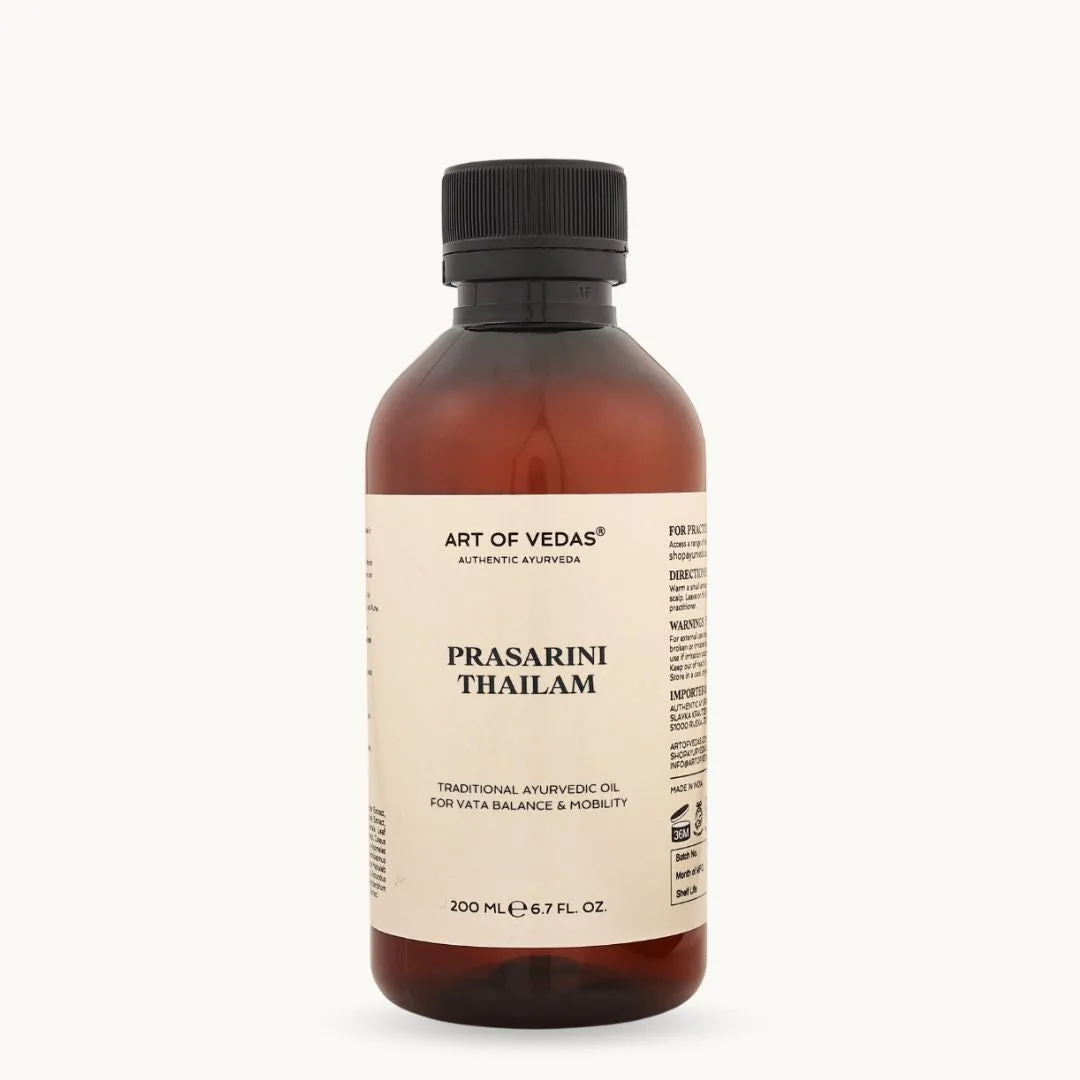
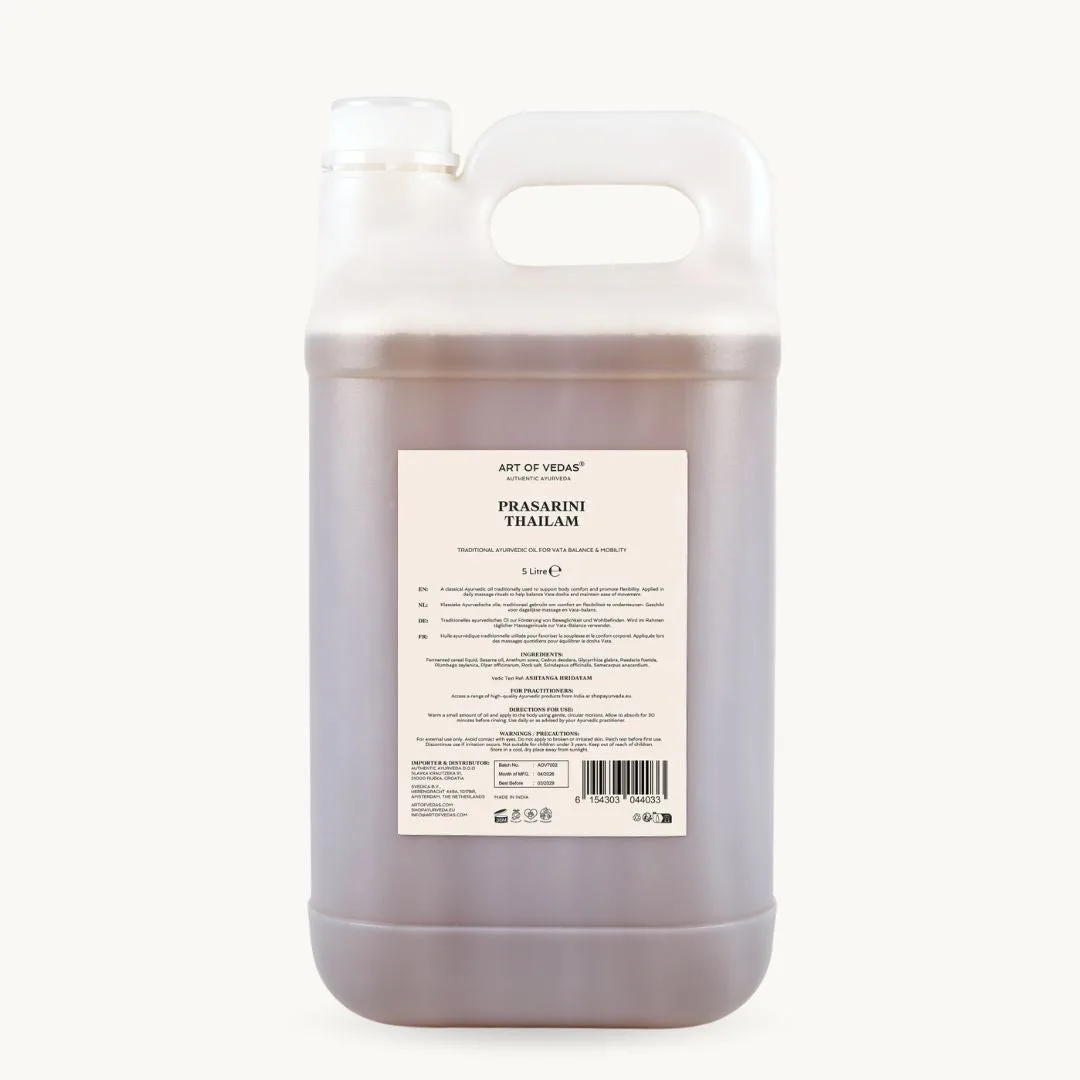
Thailam
Classical Ayurvedic Massage Oil
Prasarini Thailam is a warming classical Ayurvedic medicated oil whose name evokes a spreading, extending quality long prized within the tradition.
Sesamum Indicum (Sesame) Seed Oil, Laccifer Lacca (Laksha) Extract, Paederia Foetida (Prasarini) Extract, Cedrus Deodara (Cedar) Wood Extract, Glycyrrhiza Glabra (Licorice) Root Extract, Plumbago Zeylanica (Chitraka) Root Extract, Anethum Sowa (Dill) Seed Extract, Piper Longum (Long Pepper) Fruit Extract, Scindapsus Officinalis (Gajapippali) Fruit Extract, Sodium Chloride
Composed to pacify Vata and Kapha, it is traditionally chosen to nourish joints and muscles, restore suppleness to stiff tissues, and support easeful, comfortable movement during Abhyanga.
Traditionally suited for:
For Abhyanga (full body massage)
For targeted use
Apply a small amount to the chosen area and massage gently until absorbed.
Recommended frequency
Daily use is the traditional practice. For maintenance, use two to three times a week.
Important
Traditional use: In the classical tradition, Prasarini Thailam is applied in Abhyanga (warm-oil massage) across the joints, lower back, neck and shoulders. In keeping with its spreading (Sara) and Vata-pacifying nature, it is valued to support comfortable, easy movement and suppleness, bringing warmth and ease to areas that feel stiff or contracted, as part of a daily self-care routine.
Prasarini Thailam is documented in several authoritative Ayurvedic texts:
Sharangdhara Samhita (Madhyama Khanda, Chapter 9, Verses 119-123.5), The primary classical reference, appearing in the Taila Prakarana (chapter on medicated oils). This 13th-century text is one of Ayurveda's most important pharmaceutical references.
Sahasrayogam (Taila Prakarana), The classical compendium of formulations includes this oil in its collection of traditional Thailams.
Yoga Ratnakara, Another classical text referencing Prasarini formulations.
Ayurvedic Formulary of India, Volume 1, The modern official reference containing the standardised formula.
Sanskrit Name and EtymologySanskrit: प्रसारिणी तैलम् (Prasāriṇī Tailam)
Breakdown:
The name carries dual significance: it describes both the climbing, spreading growth habit of the Prasarini plant and its therapeutic action of "spreading" into contracted, stiff tissues to restore flexibility and ease.
The plant is also known as Gandha Prasarini ("that which spreads smell") due to its characteristic sulfurous odour when fresh.
The Sharangdhara Samhita lists Prasarini Thailam for:
ClassificationPrasarini Thailam is classified as:
Rasa (Taste): Tikta (Bitter), Katu (Pungent), Madhura (Sweet)
Guna (Quality): Guru (Heavy), Sara (Spreading), Snigdha (Unctuous), Sukshma (Subtle/Penetrating)
Virya (Potency): Ushna (Heating)
Vipaka (Post-digestive effect): Madhura (Sweet), indicating nourishing rather than depleting action
Dosha Action: Vata Shamaka (strongly pacifies Vata), Kapha Shamaka (mildly reduces Kapha)
Karma (Actions):
Dhatu Affinity:
The defining characteristic of Prasarini Thailam is the Sara Guna (spreading quality) derived from its primary herb. In Ayurvedic pharmacology, Sara Guna indicates a substance that:
Prasarini Thailam is a classical Ayurvedic oil built on Prasarini in a sesame oil base, documented formularies such as the Sharangdhara Samhita. Art of Vedas offers Prasarini Thailam as a warming oil for Abhyanga of the joints and muscles.
Prasarini Thailam is traditionally used for massage of stiff, tired joints and muscles. It is valued in Ayurveda for balancing Vata and for supporting comfortable, easy movement as part of a warming ritual.
Warm the Prasarini Thailam and massage it into the joints and muscles, using circular motions around the joints and long strokes along the limbs. Allow it to absorb before a warm bath. For external use.
Prasarini Thailam is a warming, deeply nourishing oil traditionally formulated to support Vata, with a secondary affinity for Kapha. Its sesame base and grounding herbs comfort and steady Vata's dry, mobile qualities, while a cluster of warming, activating botanicals helps lighten and mobilise the heaviness associated with Kapha. Owing to its heating nature, it is generally less suited to those of a predominantly Pitta constitution.
Yes. A daily Abhyanga with Prasarini Thailam fits naturally into Dinacharya, the classical Ayurvedic daily routine, and is especially welcome during cooler weather.
Prasarini Thailam is traditionally valued in Ayurveda for the comfort and flexibility of the joints. A regular warm massage is a classical way to keep the joints feeling supple and at ease. For external use.
Yes. Prasarini Thailam can be used for a full-body Abhyanga, with extra attention to the joints and the lower body, then allowed to absorb before bathing.
Both are classical warming Vata oils for the joints. Prasarini Thailam is particularly associated with mobility and the ease of the joints, while Mahanarayana Thailam is a broader oil for the joints and muscles together.
Prasarini Thailam is prepared in a sesame oil base with Prasarini and a classical blend of supporting herbs, without synthetic fragrance or colour. Store in a cool, dry place away from sunlight, and warm gently before use if it thickens.
From our customers
Oils that you cannot get everywhere in very good quality
Je souffre terriblement d’une inflammation au niveau de la hanche , des la première utilisation j’ai eu moins mal , j’ai laissé agir toute une nuit et je suis plus mobilé
The quality of the oil is very good and satisfying. And Customer Service is very good and helpful.
Namaskār
Subscribe for classical Ayurvedic rituals, new arrivals and 10% off your first order.
By subscribing you agree to receive marketing emails from Art of Vedas. You can unsubscribe at any time.
Thank you for subscribing. A welcome email from Art of Vedas is on its way.
Apply it at checkout on your first order.
Art of Vedas
Before we begin
Share your details so our team can reply by email within 24 hours if your question needs a personal answer.
We use your details only to reply to your enquiry. We never share them with third parties.
Leave your message here and the Art of Vedas team will reply by email. Please do not share sensitive personal or payment details.
Required for the shop to function: cart, checkout and security. Always active.
Anonymous, cookieless statistics that help us improve the site. No personal data, no tracking across other websites.
Cookies that measure our advertising and show more relevant ads, including via Google. None are set without your consent.